
I left my hometown, Kirkland Lake, at eighteen. I know there are innumerable reasons why I was placed there, be they survival instincts, the ability to make do with little, and pivot on a dime.
When I took my children there in 2019 for its 100th anniversary, I cried as we drove away as I didn’t know when I would be back.
I recently returned for a family funeral, and seeing it now, I’m not sure if there is anything that will compel me to return.
Driving into town, I saw so many rural properties where owners intentionally planted beautiful gardens now littered with junk. Cruising along Government and Main streets, I saw many holes in the landscape, where buildings once stood: family homes, apartments, stores. They became hazards as they fell out of code; residents and renters, unable to afford to renovate, bulldozed them, or burned them down for the insurance money.
My father, growing up in its heyday in the 50s and 60s when the town’s population neared 25,000, remembers it from that lens. I grew up as it weathered downturns and recessions in the late 80s, 90s, and early aughts, so I remember it as tough then.
Twenty years later, it is in complete decay.
I don’t say this with any malice. My grief is not the grief of someone looking down on a place, but the grief of someone who learned to love a town even as she fought tooth and nail against it.
My heart aches for the residents, my family and former neighbours, as their dignity gets eroded bit by bit. They will survive – the town preloads all of its sons and daughters with that instinct – but where is the thriving? Some people will bloom where they are planted, absolutely, but while I was sheltered from a lot growing up, I’m not naïve enough to ignore the suffering all around me back then, which I am sure has only intensified since.
And yet, in the midst of it all, my hometown parish is a beacon.
Father Mark Goring once took a drive up there to help a friend move and hopped on YouTube LIve to show us where he was, only remembering its name halfway through the video. I immediately recognized his hotel at the start of the video, the gold mine in Chaput Hughes where he turned around, and the various landmarks through the windows of his pickup. At one point (around the 12:30 mark), he opined on how there were two Catholic churches right beside one another, and how for one of them, you can see an orange cross as you drive into town on Government Road, overlooking the town atop of what we call the French Rocks.
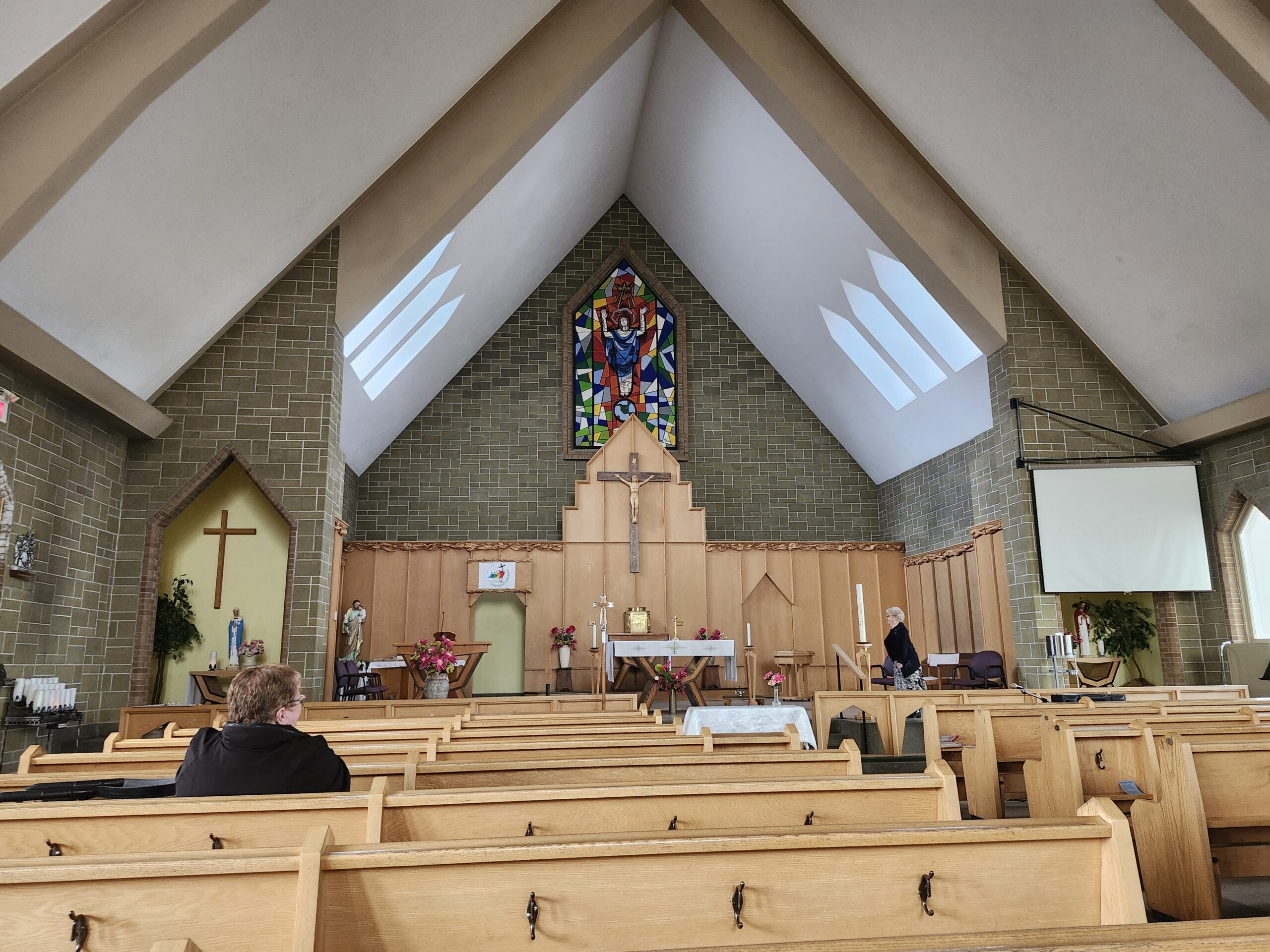
Paroisse Assomption de la Bienheureuse Vierge Marie – that’s the church that built me. The one where my grandparents’ names, Georges & Germaine Larose, are still echoing in the vestibule as founding members of the parish. The one where my mom and dad were married on its feast day – albeit accidentally, originally aiming for August 1 but then switching dates to avoid conflicting with another family wedding. The one where I was baptized on the feast of the Epiphany some 40+ years ago. Where I had my first communion wearing a sunhat and a dress previously worn at my cousin’s wedding. Where I served at the altar, proclaimed the Word of God, was an extraordinary minister of communion, where I flipped the transparencies before singing and playing the organ myself. Where a beautiful mosaic of Mama Mary’s glorious assumption into heaven watched over me in my formative years and flooded me with emotion when I reunited with her in 2019.
It still stands. Solid.
My current parish in Ottawa, though small, pulls in a month what Assomption operates on in a year. We have fundraisers more expensive than what it costs to keep the lights on in my hometown church. And yet, in spite of the decay all around it, Assomption still stands. It still worships. It still welcomes. It remains dignified and beautiful.
In a town where so much has collapsed, the parish remains a sign of God’s fidelity, a reminder that the Church endures even when economies fail, when buildings crumble, when populations shrink, when hope feels thin. The parish is not simply a building; it is a witness. A quiet, steady proclamation that Christ remains present in places the world forgets.
Kirkland Lake may be in decay, but Assomption is a living testimony that grace is not dependent on prosperity. It is a reminder that God plants seeds in unlikely soil, and that sometimes the most radiant signs of His presence are found in the places the world calls lost.
In the midst of grief for my hometown, the parish remains my consolation, a beacon of the dignity, beauty, and hope that refuse to die.