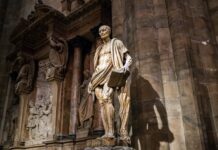

With November being dedicated to the Holy Souls, I’ve found myself thinking about death, the human body, and something that might seem rather unusual to people outside the Catholic Church: our veneration of saints’ bodies and relics.
We Catholics are often accused of idolatry. Two examples that frequently raise eyebrows are the public display of certain deceased saints’ bodies and the veneration of first-class relics. To someone unfamiliar with Catholic tradition, these practices can seem strange, even morbid.
I understand that reaction. My own understanding has evolved quite a bit over the years.
My initial reactions were something along the lines of: “Is that real? Isn’t that a bit sick? Are Catholics Goth?”
Putting my initial squeamishness aside, I eventually realized that perhaps the more important question wasn’t simply why Catholics do this, but what this tradition reveals about our faith.I began asking:
- What did this saint do?
- What is incorruptibility, and how can it be a sign of holiness?
- What can I learn from this tradition?
- What inspiration can I draw from the lives of the saints?
- How are my own body and soul called to reflect God?
Our bodies are not disposable vessels
November begins with Halloween on October 31, followed by All Saints’ Day on November 1 and All Souls’ Day on November 2. The Church dedicates the month of November to the Holy Souls, encouraging us to remember the faithful departed, pray for the souls in purgatory, and look to the saints as witnesses to the hope of resurrection.
But what does this hope of resurrection tell us about the human body?
Catholic theology teaches that we are not souls temporarily trapped inside physical bodies. We are human persons, created as a unity of body and soul. Our bodies are not disposable vessels; they are an essential part of who we are.
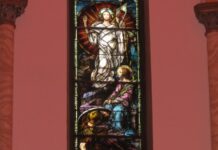
Consider the Incarnation. God did not simply send a message from heaven. He became flesh. Jesus Christ took on a human body, lived among us, suffered, died, and rose bodily from the dead.
St. Paul reminds us: “Do you not know that your body is a temple of the Holy Spirit within you?” (1 Corinthians 6:19).
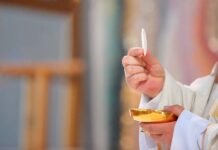
Our bodies participate in our relationship with God. We pray with our voices, kneel in worship, receive the Eucharist, embrace one another, and serve others through physical acts of love. Our faith is not merely an intellectual agreement or an invisible spiritual experience. It is lived through our entire human person.
Even death does not make the body meaningless. Although the soul separates from the body at death, this separation is temporary in God’s plan. We profess our belief in the resurrection of the body. We are not simply hoping for our souls to escape the physical world; we await the fullness of life in Christ.
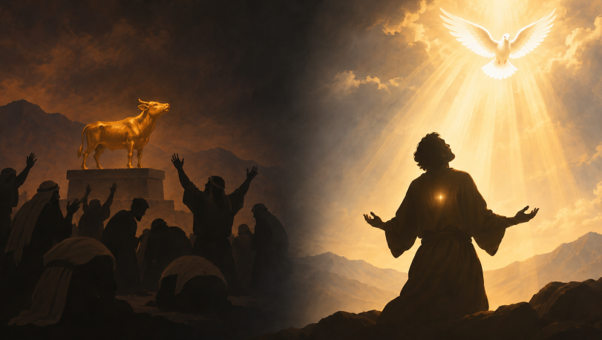
The Golden Calf? Not a dwelling place of God. We are, you are.
This brings me back to the question of relics. Why do Catholics venerate the physical remains of saints? Why would someone travel to see a saint’s body or treasure a fragment of a bone?
Consider the Golden Calf in the Old Testament. The Israelites fashioned an object, gave it divine significance, and worshipped it as a god. The problem was not simply that it was a physical object, but that they directed worship toward something that was not God.
Interestingly, Scripture itself gives us examples of God working through physical things.
- 2 Kings 13:21: A dead man was being buried when his body touched the bones of the prophet Elisha. He immediately came back to life and stood on his feet. Here, God worked a miracle through the bodily remains of a holy person.
- Acts 19:11-12: God worked extraordinary miracles through St. Paul. Handkerchiefs and aprons that had touched his body were carried to the sick, and diseases were healed and evil spirits driven out.
These passages remind us that God can work through physical things. Neither Elisha’s bones nor Paul’s belongings possessed independent divine power. God was the source of the miracles.
Catholic veneration of saints and relics is fundamentally different from idolatry. We do not worship the bodies of saints or believe their bones are gods. Worship belongs to God alone. Rather, we honor the saints because of what God has done through their lives.
First-class relics, which are bodily remains of saints, remind us that holiness is not merely an abstract spiritual idea. These were real people who allowed God’s grace to work through them. Their bodies were instruments through which they loved, served, suffered, and glorified God.
And what about incorruptibility? The extraordinary preservation of certain saints’ bodies is certainly remarkable. While incorruptibility is neither a requirement for sainthood nor proof of holiness in itself, it can invite us to reflect on the mystery of God’s work. The deeper focus should always remain on the saint’s life and the grace of God.
We, too, are called to be dwelling places of God
Catholic veneration of saints and their relics is not an act of idolatry, but a profound expression of our belief in the sanctity of the human body and the promise of resurrection.
Unlike the Golden Calf, which was falsely worshipped as a god, the bodies of saints are honored because they were dwelling places of the Holy Spirit and instruments of God’s grace. Through the Incarnation, Christ revealed that our physical bodies are not merely temporary vessels, but essential parts of who we are, destined for resurrection. The saints remind us that holiness is not reserved for a select few, but is a calling extended to each of us.
Ultimately, venerating their remains is not about worshipping the dead, but recognizing what God can accomplish through human lives and remembering that we, too, are called to become dwelling places of God, in both body and soul.
Holy friends in Heaven, pray for us!