
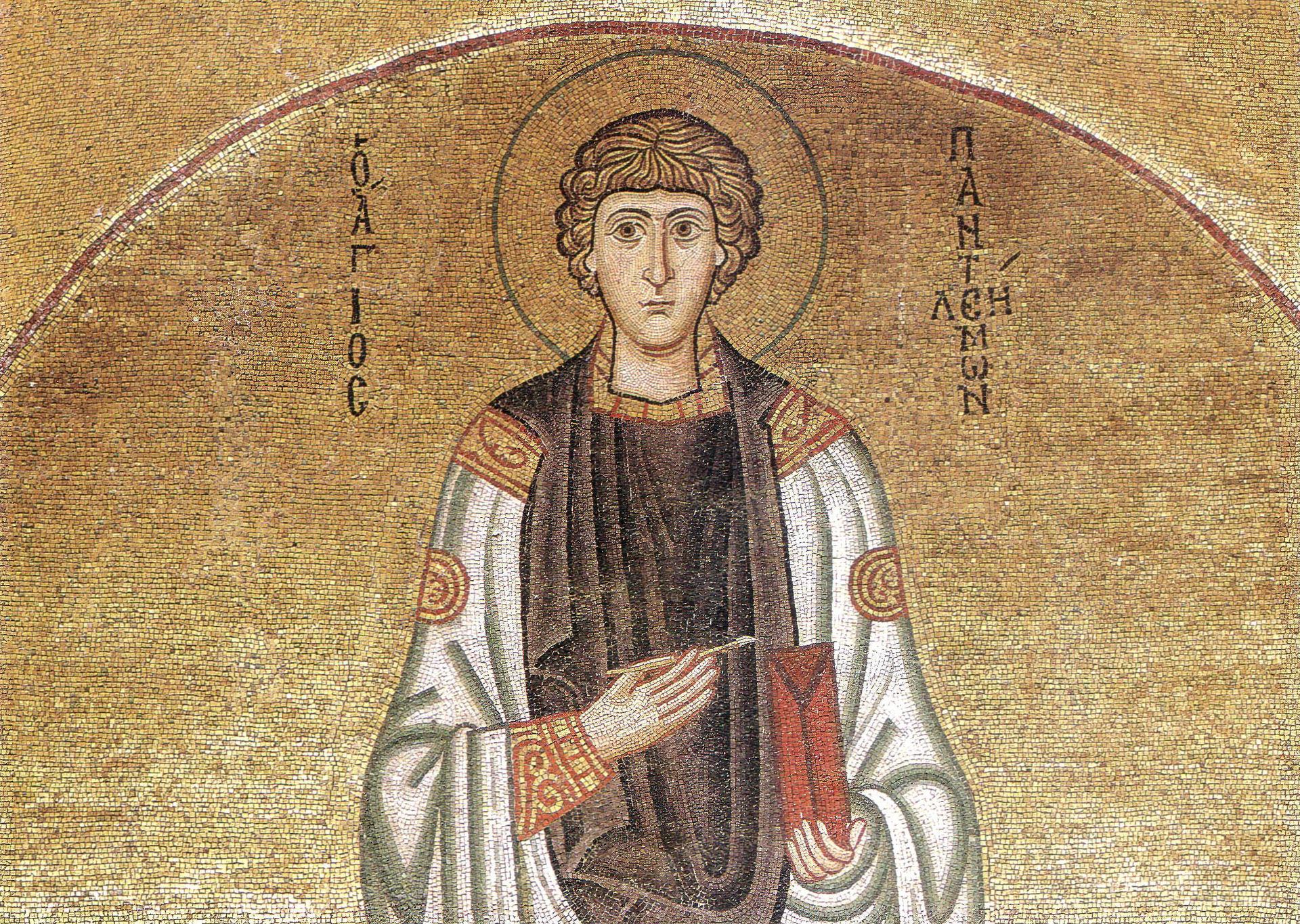
Saint Pantaleon (275 – 305) was a martyr under the persecution of Diocletian, who, like the later Saint Augustine, had a pagan father and Christian mother, who instructed him in the faith. At first, the lad followed his dad, away from the Church, studying medicine, and became the personal physician of the emperor, either Maximian or Galerius. Inspired by Saint Hermolaus – who may have been bishop of Nicomedia – Pantaleon returned to the faith of his boyhood, that Christ is the most perfect of ‘physicians’, and healing souls far better than healing bodies.
Pantaleon was eventually denounced in the subsequent persecution, the emperor himself pleading with him to do so. When he stood fast, he was condemned, but, according to the legends, he could not be killed – he floated to the surface when drowned, swords broke or bent, wild animals became tame, and boiling oil became cool by Christ’s presence. As is usual in such legends, he was eventually beheaded, but not before he pleaded for ‘mercy upon all’, whence his traditional name derives – pan – t – eleimon. (Just as we sing Kyrie, eleison – Lord have mercy – at Mass).
He was once very famous, and there are innumerable churches and places named after Pantaleon. His name was given to a lampoon character in commedia dell’arte, who shows up even in Shakespeare’s As You Like It, in the seven ages of man (he’s the sixth and penultimate age)\, a ‘lean and slippered pantaloon’, whose clothes now hang loose, and is more than a bit of a fool. Pantaloon is portrayed as wearing long trousers instead of the customary knee-breeches, and hence, we derived the term ‘pants’. Such are the vagaries of history and terminology.
But we pray for the intercession of the original saint, who was no fool, nor old, but died young and wise, and so attained the ‘pearl of great price’. Saint Pantaleon is the patron of many things – medicine, midwives, apothecaries, headaches, loneliness, along with crying children and lottery tickets and winners (!).
Pope Saint Celestine I (359 – 432) held the papal office from 422 to his death, and had to combat a number of heresies, including Pelagianism – that getting to heaven was all our effort; Novatianism – that some sins, especially apostasy, could never be forgiven; and Nestorianism – that Our Lady gave birth to the ‘human person’ of Christ, and not to God, hence was not ‘Theotokos’, but rather ‘Christotokos’. With the help of the great minds and souls of Saint Cyril and Saint Augustine, Pope Celestine decreed in no uncertain terms that we need grace to live a fully good life, and, more to the point,] attain beatitude, that any sin could be forgiven, with proper repentance and contrition, and that Mary was indeed the Mother of God, since Christ, although fully human, was not a human person, but rather ‘one divine person and hypostasis’.
Celestine clarified the universal authority of the papacy, which is to say, the ‘seat of Peter’, the final arbiter in all questions, moral, doctrinal and canonical:
We charge you to uphold the authority of the Apostolic See. Since the instructions that have been given to you tell you that you ought to take part in the assembly, if it comes to a debate, you are to pass judgment on their statements but not to descend to controversy. (Letter 17, Memorandum to his Legates).
Or, as Celestine’s contemporary Saint Augustine put it, Roma locuta est, causa finita est. Something to ponder in these fractious days.
Pope Celestine died on this 27th of July in 432, when his feast has traditionally been commemorated in the Catholic Church. Even if he’s not in the universal calendar, we invoke his intercession for our current Holy Father, Leo XIV, that he too uphold the tradition and truths of our Faith.