
As a child, I was struck with a certain astonishment at the perverse and sometimes startling coincidence that opposites exist. I think most children within their early life recognize the division of the world in this way. Ordinary things are known by their opposite, or by the contrast with other things around them. You might be reading this short essay on a computer screen or a phone. The forms of the letters are known to you precisely because the letter is different from the page it rests on. Just the same, you might recognize a figure as being distinct because it is different from the background it inhabits, or the two sides of a coin as being distinctive from one another by their respective contrast. These distinctions appear obvious, and we take their separation for granted. However, a secondary consideration to this process might reveal a particular and perhaps unsettling truth: that the letter and the page, the head and the tail of the coin, the figure and the background, all require their opposites to exist. That is to say, opposites are fundamentally bound together as a pair in such a way that they require their own existential contrast.
What can be said about the strange existence of such significant opposites in our world? Death and life, good and evil, time and eternity – all are paired together. These are not arbitrary divisions. They are the very grammar of creation, the lines by which the world is written and our cognitive processes come into focus. They draw the lines of human experience and perception, often in conflict, yet always bound together. We treat them as absolute metaphysical divisions, but like the two sides of the coin, their very opposition points toward something beyond themselves. Their tension hints at a deeper unity that our meager sublunary intellects and rationalizations alone cannot fully resolve. As a scientific precept, we must understand that the world is not a collection of random isolated parts, nor is it governed by the infinite regression of dualisms, locked in a perpetual conflict. Creation is patterned upon the order through which it was made. The opposites we encounter are signs of a hidden reality that lies deeper than the divisions themselves.
This is perhaps not a new revelation. Plato spoke of this in the fifth century before Christ, stating that “everything arises in this way, opposites from their opposites”. Much has been said of this phenomenon in scientific and philosophical circles as well. The psychiatrist C.G. Jung borrowed the phraseology of the Greek Presocratic Heraclitus to call it Enantiodromia, the resolving of conflicting unconscious processes into an underlying unity. Sir Isaac Newtown, for his part, in the parlance of mechanical physics, also noted this phenomenon in his Third Law of Motion: “for every action, there is an equal and opposite reaction”.
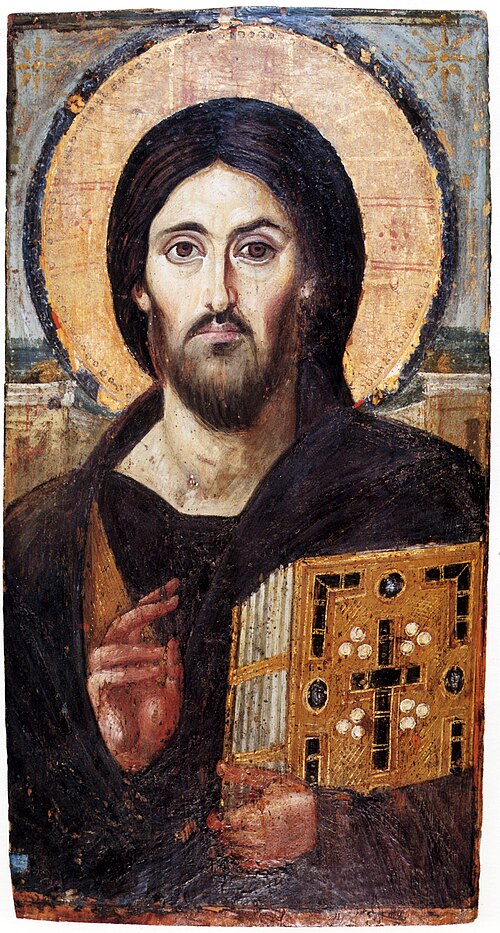
However, nowhere is this more evident than in the person of the majestic Christ. The biblical image of Christ as the cornerstone is not only an architectural metaphor. The cornerstone anchors the entire structure. Fundamentally, it unites geometric opposites, joining the vertical and the horizontal, height with breadth. It is the point where angles meet, where centrifugal forces balance, where the whole structure finds its proper alignment. In the person of Christ, the deepest existential chasm we can imagine is fully bridged, not by human effort, but by the strange and mysterious act of divine condescension. He enters the realm of time without ceasing to be eternal. He takes on the weakness of humanity without surrendering his omnipotence. He lives within creation while remaining the Creator of all. This is the transcendent image of Christ Pantokrator, Christ the Cosmic Ruler of all things, whose very being harmonizes the contraries of existence. Or, to draw upon another common Byzantine metaphor, Christ the physician of souls, who engenders a moral homeostasis of the conflicting parts of the created world, bringing them into himself that “they may all be as one” (John 17:21).
Without the underlying presence of this unity we have a certain philosophical problem. If opposites cannot be resolved by their opposites, without the unity of polarities, we have a schizophrenic universe which is entirely and permanently unintelligible to us. If nothing exists to reconcile what is divided, then opposites remain forever in a state of war, never resolving, never revealing their shared origin or designed purpose. Good and evil are reduced to preferences, life and death to biological incidents, time and eternity to incommensurable realms. Without this resolution, the cosmos is a cacophony of irrational and indiscernible forces, “a heap of broken images”, a chord that never returns to the tonic.
At the core of this is the latent mystery of the Christian doctrine of the Incarnation, of God- becoming-man, of opposites united and resolved in their own opposite. The infinite and the finite, the holy and the fallen, the eternal and the transient are all bound together in the one Person of Christ. They are shown to be parts of a single divine reality, drawn together by the One who Himself is both Alpha and Omega, beginning and end (Rev. 22:13). This is why the Incarnation rests at the center of Christian life and our ancient liturgical calendar. It is the central moment in human history, the Axis Mundi through which our civilization anchors itself, the lens through which the nature of our humanity comes truly into focus.