
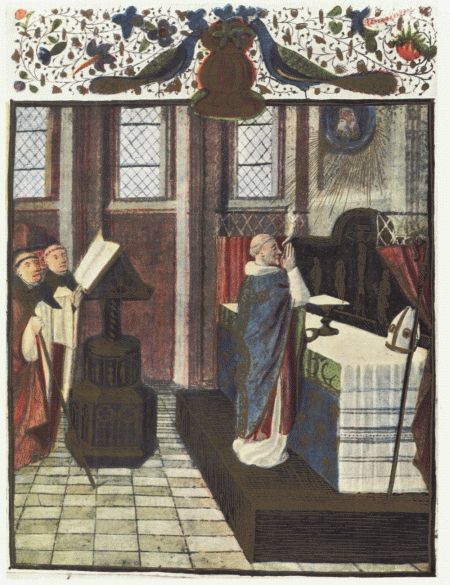
The limits recently placed on the Latin Mass at the Oratory of Saint Philip Neri in Toronto bring to the fore the quasi-Hegelian tension between Benedict’s Summorum Pontificum and Francis’ Traditiones Custodes. By the former, the TLM – as it is somewhat inaccurately called, but we take is as given – was universally approved. By the latter, it has been nearly-universally proscribed. At least, it seemed to be Francis’ intention to ‘wean’ Catholics off their attachment to the usus antiquior or, if you will, the vetus ordo. Extraordinary! Or is that, ordinary.
Which brings us to the point of these few words: Do we have a ‘right’ to the TLM?
Some may respond with a hearty ‘aye!’, and end there. But the answer is more complex, for rights don’t just exist in theory, but in praxis, in the hic et nunc of reality. In sum, rights are relational and reciprocal.
Every single man has a right to get married, but he needs a particular woman to say yes. And, I would add, vice versa.
Someone may also have a right to house ownership, but if mortgage rates are too high, and his income too low, or the market saturated, then his right remains theoretical. He cannot just usurp someone else’s home.
To make this more liturgical, if a priest were to deny me Holy Communion – for unjust reasons – what am I do to but suffer the privation, until things are set right? I cannot go and ‘grab’ a Host out of the ciborium. Perish the very thought!
God will provide the grace in some other way, not least by my suffering. Deus supplet.
Many saints suffered such indignities, and I’m no saint, so who am I to complain?
The reader may see where we’re going with this: Let’s presume we do have a right to the TLM, as per the words of Pope Benedict from Summorum:
In the history of the liturgy there is growth and progress, but no rupture. What earlier generations held as sacred, remains sacred and great for us too, and it cannot be all of a sudden entirely forbidden or even considered harmful. It behooves all of us to preserve the riches which have developed in the Church’s faith and prayer, and to give them their proper place.
Yet if a subsequent Pope and his Magisterium decree – however unjustly in one’s eyes – that this right is not to be fulfilled, what are we to do? Can we ‘seize’ the Mass, outside the very hierarchical structure of the Church? Would that not be like me usurping a Host?
The Oratorians have practised what they preach, responding with grace and aplomb, obeying like the good sons of Saint Philip they are, who used to quip that sanctification resides in the space of three fingers, as he placed them over his forehead: Mortificatione rationalis! The mortification of the reason, by proper obedience, even if such does not make sense to us in the hic et nunc.
One hears the refrain, ‘but souls are at stake!’. Sure, they always are, but God can take care of souls by what means He wills. Scripture is replete with evidence that often what seems ‘less perfect’ from our perspective is the way God often chooses. Bethlehem? Nazareth, whence no good comes? That said, the Novus Ordo can be celebrated beautifully, with transcendence. A music director mentioned to me recently there are untold treasures of chant and polyphony fitting for this Mass, which will be a conduit of grace to numerous souls. When we add the sweet spice of obedience to this sacrifice, well, what better gift to present to our God and Lord?
We must always remember that God’s ways are not our ways, nor His thoughts our thoughts. Who are we to decree with absolute finality and certainty what is best for our salvation, especially if this means disobeying the Church He founded?
Obedience is better than sacrifice, said the Lord to Saul, who thought he knew better how to worship Him. Perhaps Saul’s way, in some way, was objectively ‘better’, but that’s not the point, is it?
The tides are shifting, as a majority of younger priests say the TLM. Anyone persevering through the seminary these days is almost sure to be traditional and conservative, liturgically and morally.
So have hope, and patience, dear reader. God will vindicate His own in His own time and restore the Church’s full inherent transcendent glory.