
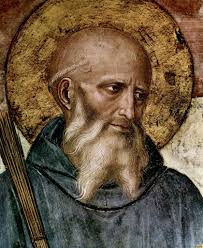
On this feast of Saint Benedict (+543), we commemorate the monk credited with saving what we know as ‘civilization’. As a student in Rome in its sixth century fin de siècle, Benedict found he could no longer live amongst the enervating and debilitating milieu of his fellow scholars. Their carousing and worldliness – all of which sounds sort of au courant – was an obstacle, a scandal, to his own call to a more perfect path of life, more detached, more intentionally focused on his ultimate end and purpose. After joining a community for a time, Benedict’s quest led him to his solitary cave overlooking Lake Subiaco, which is still the heart of a monastery which has existed since the Middle Ages. He did not stay alone for long, for others came to join him. After some years, he went public, so to speak, founding the famed monastery at Monte Cassino, high on a plateau overlooking the rolling plains of Italia. His life was written a half-century after his death, by a fellow saint and Benedictine, who became Pope Gregory the Great.
The ‘Rule for Monks‘ which Benedict wrote seems almost divinely inspired, having stood the test of time for a millennium-and-a-half as the basis and inspiration for any number of religious orders, with its balanced blend of the human and divine, of prayer and work – ora et labora – a whole life lived in praise of God our Creator and Redeemer. This small treatise has quite literally changed the world, and Benedict’s industrious monks quite literally preserved the world from falling into the darkness of paganism, desuetude and despair.
Hilaire Belloc’s claim that ‘Europe is the Faith, and the Faith is Europe‘, rings true. We are all to some extent formed and shaped by the Christian culture of that cradle of civilization. As the Faith recedes from each nation, we will regress a neo-paganism and barbarism that, as Pope John Paul declared in his 1995 encyclical defending the culture of life, we thought we had left behind forever. On October 1, 1964, in the midst of the Second Vatican Council, Pope Saint Paul VI, in the letter Pacis Nuntius, declared Benedict one of the patrons of Europe, and truly a saint for our times – troubled as they are, with many similarities to what Benedict faced as a young man in decadent Rome.
As we are all sort of Europeans, are we also all Benedictines, in some sense?
The reality, if not the term, of retreating from ‘the world’ that we call the Benedict Option goes back well before crunchy-con Rod Dreher’s popular book, even before Saint Benedict himself, at least back to Moses, Elijah and Elisha, who ‘opted’ to listen for God’s voice in the stillness and quietness of the desert.
But to Benedict the name has stuck. Few are called to overtly follow Benedict, but the option named after him applies to all of us in some way; the question is, how?
The beginnings of an answer may be found in the thought of Saint Thomas Aquinas. As a young boy of noble lineage, he began his own spiritual journey in 1230 or so as a puer oblatus – a ‘boy who is offered’ – in the same monastery of Monte Cassino seven centuries after Benedict, with his family’s expectation that he would one day become the abbot (but to his family’s consternation, the teenaged Thomas chose the new radical Dominicans instead).
If the mature Thomas were somehow to get his hands on Dreher’s book, suitably translated into mediaeval Latin, his mind would likely see the essence of the ‘Benedict Option’ in light of the sin of scandal (and its opposing virtue, edification), which in the Summa he distinguishes into two sorts (cf., II-II. q. 43, a. 1, ad 4): Active scandal, when someone leads someone else to sin; and passive, wherein we allow ourselves to be led into sin.
Active scandal may be provided not just by persons, but by the culture or milieu in which we live (even if these may ultimately be traced back to a person). At some point, this social structure may become so dispositive to sin that one would have difficulty avoiding evil, either by commission (being forced to act in some way contrary to God’s laws) or by omission (hindered in doing the good that we are called to do, for we must do more than avoid grave sin to attain heaven). Hence, the attractive option to retreat to a more favourable environment that will incline us more to virtue than to vice, that is, edify rather than scandalize.
Although Saint James exhorts us to keep our souls unstained from the world, not all of us need run off to a monastery to remain pure and reach heaven (although it does help for many, if so called). Yet, as the Second Vatican Council exhorted, it is incumbent upon all Catholics to follow that universal call to holiness, whether lay, clerical or consecrated life, in accord with Christ’s command to be ye perfect….
Hence, we should all adopt some sort of interior ‘Benedict Option’, to ensure our souls are not conformed to this age, to keep our thoughts and motives as pure as we can. Fair enough. Yet, as incarnate beings, we cannot remain interiorly detached from the world (along with the flesh and the devil) unless there is at least some corresponding exterior detachment. That is, we must carve out, set apart and make sacred some physical place, as well as some time of each day. This could be daily Mass, a visit to the church, a prayer corner in our homes, or just going for a meditative walk. How much time we give to God we must also decide: Some moments in the morning, offering the day to Him, seeking counsel and guidance; the reading of Scripture; an examination of conscience in the evening; devotions to the saints.
We also keep ourselves ‘unstained’ by avoiding complicity in evil, whether in terms of companions, speech, media, complaisance and adulation, along with any formal cooperation in the nefarious deeds of the world. This is an increasingly difficult problem in health care, with enforced complicity in abortion and euthanasia being the two most glaring examples. It is already the case that the training and education of health-care personnel is morally fraught, and it is getting more difficult to avoid some sort of compromise, even formal cooperation, with abortion, euthanasia and other nefarious practices. The same may be said of education, politics, government, policing, businesses of all kinds, and the list goes on.
How, the ‘Benedict Option’ may be instantiated is the work of prudence, good counsel and courage.
Benedict, of course, decided to get away from it all, adopting a life of total, isolated dedication to God through prayer and manual work, ora et labora. The Church has consistently taught the objective superiority of what would come to be known as the consecrated religious life, the ultimate and most perfect ‘Benedict option’, especially in its enclosed, contemplative dimension, a sure and certain path to heaven, if lived well. Saint Philip Neri called such a vocation the greatest gift Our Lady could offer a soul.
For the rest of us not called to be monks or nuns, the consecrated life still offers an ideal and guide. One of the misinterpretations of Vatican II was that the clergy and religious should ‘lighten up’, secularize and become more like the laity, when it was quite the other way around: Sure enough, the laity, who make up about 99% of the Church’s billion-plus official members, have the specific vocation to sanctify temporal affairs – all that is meant by the ‘world’ – but that does not mean that they should themselves be secularized. Rather, the laity were urged to share in the graces, and some of the practices, of those more fully consecrated to God. The Decree on the Laity urges them to adopt a ratio, a rule or plan of life, one that is conducive to holiness: a daily schedule of prayer, an examination of conscience, meditation, good works, or even enrolling in a third order or pious association of some sort. All in all, giving to God a little more, and more consistently, of our time and space.
Most laypeople are called to marriage, and the Church asks them to form their family life as an ecclesia domestica, a domestic church, which is more than a glib and pious phrase: The family should govern itself like a true sacred community, with regular prayer and some level of retreat from the insidious effects of the ‘culture of death’, with every home becoming a centre and source of holiness and spiritual growth.
In certain social milieux, such as Benedict’s Rome in its final stages of decline, or, closer to our own day, Soviet Communism, Nazi Germany, and, now the totalitarian dogma of hedonistic and agnostic relativism, a more intentional and external Benedictine retreat from the world seems to be required, to avoid the encroaching scandal and the assaults of the evil one. How much retreat, and of what sort, will vary for each particular case.
Single people without children dependent upon them, not called to the convent or monastery, may choose a type of self-imposed Benedict Option to seek greater spiritual perfection, but if formed well, they need not run off like Thoreau to find some quixotic splendid isolation in a cabin in the woods. By adopting and sticking to living by a self-imposed rule (ratio) of life, aided by the grace of God, they can in the main resist the allure of the world while living in its midst, and prove to be valiant quasi-apostles and missionaries, sanctifying the path on which they are called.
The main impetus for those with families to follow a more intentional Benedict Option, it seems, is to protect their children, whose developing souls, as Christ Himself implied, are more open to being scandalized, and more affected by what is around them. Children are not apostles to be sent out into the fray, but rather still-developing and easily-swayed beings, who need stable, holy, even, one might put it, quasi-monastic, environments wherein they may take in and assimilate all that is good and true and holy.
We will close with a few factors that one may want to consider in building your own Benedictine option:
First, there is the liturgy, especially Holy Mass for Catholics, the source and summit of the Christian life. Strive to find a place with a good, solid, orthodox Eucharistic and sacramental life, which may sustain you. Dreher – a Catholic who has unfortunately jumped ship to schismatic ‘Orthodoxy’ – does mention families who have set up house near the Clear Creek Benedictine community in Oklahoma, with similar communities existing here and there across North America. Not practical for all, but certainly a consideration. Lex orandi, lex credendi, the law of praying is the law of believing; and lex credendi leads to lex agendi, the law of acting. We really are as we pray, and, like Moses and the Israelites in their own exile, we need to pray and rely much upon God.
Second, retreat to a place where you can educate your children according to your own conscience, in the faith and all that is entailed in Christian culture and tradition, whether this be home-schooling, a private school, or a decent public school with some serious home catechesis and prayer. The ‘Catholic’ school system has more or less collapsed; and even in the purported ‘good’ schools, all it takes is one wayward child with a mobile device – a window into any kind of evil image – to corrupt the mind and soul of your child during recess.
Third, on that note, control media of all sorts in your home, whose insidiousness is increasing. There is the obvious pornographic, gratuitous and voyeuristic trend of films of all sorts, and the addictive, dissipating nature of video gaming, and, of course, the ubiquitous ‘smart’ phone which, on average, people check 130 times per day.
Yet there is always worse: I had a young family over for dinner, and they mentioned that on the YouTube ‘children’s’ channel, a video kept popping up in the algorithmic shuffle with a creepy character called ‘MoMo’ instructing children on how to slit their wrists, warning the young moppets ‘not to tell their parents, since they too might get harmed’.
Fourth, for now, we should try to live near extended family, rediscovering in some way the old clan system and the strength of local communities. Along with this, we should also do our best to build up a spiritual familial community of like-minded believers, with whom we can forge friendships and offer each other mutual support, which we will need more and more as the culture of death waxes strong, and Mordor creeps ever closer to the borders of the Shire.
Whatever the Benedict Option means for you, at least ponder the example that our forefathers in the faith have left us; build up that spiritual castle and refuge within your own heart and conscience, where the world and its wiles of the tempter may not enter.
And remember, ultimately, God is our refuge and our shield.
Saint Benedict, ora pro nobis! +