
There’s an old joke that asks what’s the difference between God and a doctor?
God doesn’t think He’s a doctor.
Sure, it’s hyperbolic and cynical, and many physicians do sacrificial hidden work for their innumerable patients, for which we should be grateful. There is a sort of secular sanctity in medicine, if practised well. But that’s just the point. As I’m wont to say, just as in vino veritas – in wine there is truth – so also in joco veritas – in every joke there’s some truth. Otherwise it wouldn’t be funny.
For physicians do hold a lot of power, and many of their decisions are weighted with life-or-death consequences. When this goes awry, it really go awry. Corruptio optimi pessima. In a morally sound society, such auctoritas is held in check, by laws and mores, as well as by the physician’s conscience, rightly formed by family, tradition and the teachings of the Church.
Now, with legally-sanctioned abortion and euthanasia, not only are there fewer guardrails, but increasing pressure to do no longer what is right, good and true, but what is convenient, quick, easy, in accord with the zeigeist. For laws not only sanction and coerce, but also teach, in ways that are subtle.
Recent case in point: It has recently come to light that in 2024, Dr. James MacLean ‘diagnosed’ a man outside a Tim Horton’s as qualifying for MAiD – that, is, murder-suicide. The patient’s condition?
In a report involving 2024 MAID deaths, the coroner’s panel highlighted the case of “Mr. A,” a male in his 40s with inflammatory bowel disease who, because of his illness, didn’t have an active social network, had difficulty maintaining a job, found personal relationships difficult and was dependent on family for housing and financial support.
He had a history of mental illness, previous bouts of suicidal thinking and on-going alcohol and opioid misuse that cost him his driver’s licence.
So he had trouble going to the bathroom, along with psychological difficulties and suicidal ideation, addictions, lived with his mother and couldn’t drive. Mr. A needed help and support, a loving hand and heart to see him through.
Dr. MacLean’s solution was to suggest he kill himself, and drove ‘Mr. A’ to the euthanasia site – a human abattoir, if you will – to have it done. The College of Physicians and Surgeons were ‘concerned’, and gave Dr. MacLean a slap on the wrist – ‘six months supervision’. He’s still a practising physician. Mr. A, on the other hand, received a sentence of death – and who knows what afterwards. Miserere ei.
And this was not MacLean’s first offense – he has killed people with dubious consent, and once botched a job, with the patient victim starting to breathe again after MacLean had left the house (most MAiD is done at home, which in some ironic way makes it more ghastly). How many has this man murdered? And how long before the choice is no longer ours, and we’re dragged away from Tim Hortenses if we display signs of a ‘terminal’ illness? Or, at least, we check into a hospital for treatment, and are never seen again?
Farfetched and hyperbolic? Keep in mind it wasn’t that long ago that doctors killing patients was deemed unthinkable, the stuff of future dystopias, say, Robin Cook’s Coma and Michael Anderson’s Logan’s Run. As recently as 1998, Dr. Jack Kevorkian was convicted of first-degree murder for euthanizing Thomas Youk live on 60 minutes. Mr. Youk was a 52 year-old sufferer from Lou Gehrigh’s disease, the same that afflicted Stephen Hawking. Kevorkian received a 10 – 25 year sentence. People knew back then that a physician’s first principle is ‘primum non nocere‘ – first, do no harm, and that murder is murder, regardless of the intention or motivation. Now, we’re paying doctors to put us out of our (apparent) misery.
We may not yet be in the realm of forced euthanasia, but the coercion will ramp up, to save costs, time, trouble, precious resources, trauma to family, eating up one’s savings and leaving a meagre will, and so on. It will descend from there.
An (alleged) recent ‘academic paper’ published in ‘Sage’ – which you may find here – suggests (just ‘suggests’, of course) that the government could save up to $1.27 trillion by 2047 if euthanasia were made more expansive – and less voluntary. Keep in mind that benefits to the elderly is the largest portion of the federal budget.
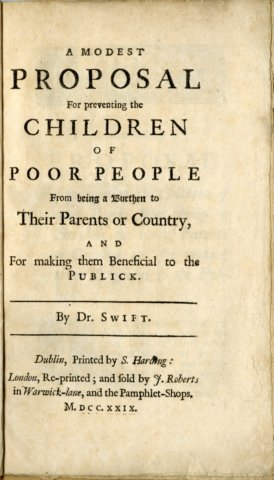
This paper reads like morbid satire, in the mode of Swift’s ‘Modest Proposal’. Take this section from the ‘academic paper’ deserves to be quoted in full:
…MAiD could be expanded to other vulnerable population groups, such as attempted suicide patients, which represent a demographic where it could be predicted with a high degree of certainty that all of them would make the choice to end their lives. Similarly, citizens with severe mental health problems would likely opt in. The homeless and drug users also face unique challenges in terms of stability and substance dependency and may select ending their lives (Gomez et al., 2010). Similarly for the retired elderly, some may select MAiD, but non-voluntary euthanasia in some European cases exist (Bilsen et al., 2009; Heide et al., 2007) and in 2006, the Royal Dutch Medical Association had proposed that simply being over 70 and weary of life could be seen as a legitimate basis for requesting euthanasia (Sheldon, 2005). Finally, indigenous communities in Canda (sic) may also be viewed as good candidates as they are particularly marginalized (Allan & Smylie, 2015; Kirmayer et al., 2014; Smye et al., 2023), with high rates of substance abuse (Firestone et al., 2015), suicide (Kumar & Tjepkema, 2019), and poverty (Anderson & Collins, 2014). Historical practices, such as elders sacrificing themselves for the community (Spearim, 2020; Stegman, 2022), indicate a complex relationship with end-of-life decisions, yet current leaders voice strong opposition to expanded euthanasia (Agnieszka, 2021).
Attempted suicides? Being over 70? Weary of life? Indigenous communities? Homeless? What hellish drivel is this? Kill ‘em all, and let God sort them out? At least Swift was being satirical – perhaps not to everyone’s taste – in his (parodic) suggestion that Irish poverty be solved by selling their infants as food for the Brits.
Everyone knew that was not a real proposal, and Swift ends his treatise with some real and practical suggestions.
Now, however, it’s getting more difficult to discern what’s real on the internet, insofar as the internet itself is ‘real’. If this paper is to be taken at face value, and not as morbid satire, we’re already ahead of where the Nazis were in the 1930’s. Their death cult began with doctors – psychiatrists, in particular – all with ‘good reasons’, offing those who had no reason to live, in their estimation. Life unworthy of life was the mantra propagated in 1920 by jurist Karl Binding and psychiatrist Alfred Hoche in their chilling and fateful book Die Freigabe der Vernichtung Lebensunwerten Lebens (Allowing the Destruction of Life Unworthy of Life). This was adopted by the Nazis, first for the ‘incurables’, then for the ‘undesirables’, then for pretty much everyone who got in their way – memento mori, indeed.
We’re now entering the terminal stage of the culture of death, as its cancer metastasizes, and like the pagan god Saturn, society begins to devour its own children. The architects of the culture of death – those who legalized and propagated these evil laws permitting abortion and euthanasia – will now face the piper. Take, as a case in point, of our former Prime Minister Justin Trudeau, who oversaw the legalization of euthanasia here in Canada (just as his father legalized the murder of the unborn). Justin’s now in his mid-fifties, his marriage fallen apart, he’s dating a faded pop chanteuse – is that trifecta enough to qualify for being euthanized? How long before a bout of sciatica makes it impossible for him to surf off Tofino? Or some more serious affliction leads him to choose the fate he has opened up for others, or have it chosen for him?
Saint Paul warns that the ‘wages of sin is death’ (Rom 6:23). Those who remain in grave sin, unrepentant and unshriven, are courting death, not only in this life, but the eternal death of the next. We’re standing on the edge of an abyss looms – we don’t need MAiD – we need metanoia, along with a good dose of apostolic parrhesia.
Like Saint Joan of Arc, we must listen to the still, silent voice of God and stand in the breach to defend those who cannot defend themselves. A white, bright line in the sand – thus far, and no farther.
Even if, like Charles Llwanga and his companions, it cost us our lives.