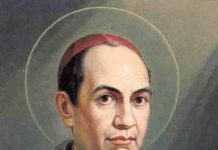

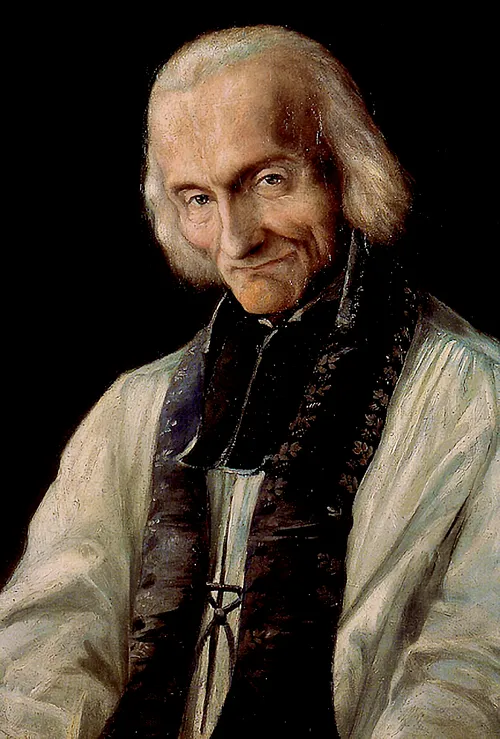
August the 4th is the Memorial of St. John Vianney, the Curé of Parish Priest of Ars. Canonized in 1925 by Pope Pius XI, he was named patron saint of priests in 1929 by the same pontiff. The American author Kevin Wells has written a must-read book on the life of and relevance of this parish priest. Its title is Coached by the Curé, Lessons in Shepherding with St. John Vianney. It is no exaggeration to say that this book is a providential a one for parents, grandparents, priests and anyone concerned with the salvation of those entrusted to their care; most especially the young people victimized by contemporary culture.
As a bibliophile, a lover of books, with St. Teresa Benedicta of the Cross – Edith Stein – I assert that there is a providence of books. Her reading of the autobiography of the Spanish mystic St. Teresa of Avila was the catalyst for her conversion to the Catholic faith and the fulfillment of her Jewish heritage. Often enough, for the Christian disciple who wishes to deepen his knowledge of God, a book comes along at the right time and it proves to be an experience of grace, providing a new or deeper perspective on the joy and privilege that is Christian life. I read such a book many years ago; its title is God’s Gentle Rebels, Great Saints of Christianity. Among other saints, both men and women, the author discusses the life of St. John Vianney, the Curé of Ars, whose feast we celebrate today. In this book, Christian Feldmann presents the life of ordinary people who, in the process of being true to themselves as men and of women of integrity seeking to follow God’s commands, became saints – despite the detractions, misunderstandings, envy and jealousies of others. The godless say, ‘let us wait for the righteous one, who makes life inconvenient to us and opposes our actions; who reproaches us for sins against the law, and accuses us of sins against our training’ (Wis. 2:12). The author and more importantly, the lives of these saints challenge our need to conform and be obedient to be Christian. Sometimes, our fidelity to God demands that we not conform; and indeed in the course of history this has often been the case. This is of particular relevance to us as we struggle with government overreach, the pressure to conform to a plethora of mandates and diktats, and compelled speech, even at the cost of doing violence to our conscience.
This is not a battle cry for anarchy. It is impossible to be a Christian without obedience, but the obedience that is exemplified in the lives of the saints presented in this particular book is what St. Benedict describes as a listening with the ear of our heart. Their refusal simply to conform – a pressure we are all facing today – in a real sense turned the world they knew upside down; but in so doing provided that prophetic witness which is at the core of Christian faith and life. Do not be conformed to this world but be transformed by the renewal of your mind, that you may prove what is the will of God, what is good and acceptable and perfect (Rom. 12:2).
In His high priestly prayer Our Lord prayed for us because the pressure to compromise and to conform is one of the most common manifestations of the spirit of the world: I have given them thy word; and the world has hated them because they are not of the world, even as I am not of the world. I do not pray that thou shouldst take them out of the world, but that thou shouldst keep them from the evil one. They are not of the world, even as I am not of the world. Sanctify them in the truth; thy word is truth. As thou didst send me into the world, so I have sent them into the world. And for their sake I consecrate myself, that they also may be consecrated in truth (Jn. 17:14-19).
In February 1818, Fr. John Vianney was sent to the tiny village of Ars whose population was about two hundred people. He would stay there until his death on August 4th, 1859, by which time he had become Curé of all of France and beyond. His journey to the priesthood had not been an easy one, nor the exercise of his priestly ministry. He was born in in 1786, three years before the beginning of the French Revolution, whose tragic events marked his childhood. Because of the Revolution and its fierce persecution of Catholics, Jean Marie received his First Holy Communion in a barn where a priest who had not sworn allegiance to the revolution, remaining faithful to the Church, and who had secretly celebrated Mass. While the Jacobins, supported by the Freemasons, were organizing the hunt for such priests and sending them and their faithful to the guillotine, young Jean-Marie was studying the catechism in secret and understood that the Crucified One must indeed deserve all since so many thousands of priests and lay people were giving their lives for Him, tolerating even the most atrocious torture. Such is the power of constancy and faithful witness; it produces saints.
The Revolutionaries were engaged in a grand project of remaking the world without God; and our secular culture in many ways is a product of this ongoing project. In this new world order there is no room for the ‘superstitions of religion’ and most certainly not for a sacrificing priesthood. If you are thinking that history is repeating itself as our times unfold, you are not wrong, and you have a keen mind. Everything is always best understood when it is considered critically (using our God-given reason), comparatively and contextually (not in isolation).
When St. John Vianney arrived in Ars he found a parish that had suffered the full effects of the Revolution, but he undertook his duties with zeal and so he began to serve his flock, some of whom resented him and even tried to have him removed. Nonetheless, he fasted and prayed for them and reminded them of the truth of Christ that endures for ever; and gradually Ars was changed and once again God was worshipped in spirit and in truth. Christian charity was soon in evidence. Gone was the cruelty of paganism. This is why pilgrims visited him by the thousands and why penitents waited for days to make their confession to him. Surely, they came because he was a saint; but also because the Revolution was to have destroyed such priests, and in many places, it had succeeded. Here too there is a parallel with our own times.
There have been other revolutions inspired by this same grand project to remake a world without God; in Spain, Mexico, Russia, Germany, China; and now it would seem that this project is a global effort – and in all these revolutions, priests have also been hunted down and martyred because, as Saint Jean Vianney said, the priesthood is the love of the Sacred Heart of Jesus; and a godless world cannot understand such a love. A godless world is a world marked by cruelty, the brutal cruelty of pagans. Nevertheless, this love, the love of the Sacred Heart of Jesus is what will save the world; and no less the beauty that radiates from the lives of those who love and serve God; the prophetic witness of the saints, God’s gentle rebels who understand that there is no greater honour and duty on this earth than to serve God, and no greater power than to know that we are children of God. Those who arrive at this conviction understand that Love Crucified can only be loved with a crucified love; that is, sacrificial love.
Let us then in so far as we can, first and foremost in the ‘parish’ of our own soul, then in our homes, create islands of sanity and sanctity where the primacy of God’s holy order is absolute. To the extent that we can, let us remain faithful to prayer and to our work, whatever it may be. No one can stop us from saying our prayers and from doing our work. Blessed is that servant whose master finds him doing so when he returns (Mt. 24:46). God calls us to holiness and if we endeavour to remain faithful to our training, we shall be the aroma of Christ to God among those who are being saved and among those who are perishing (2 Cor. 2:14-15). Our prayer always is that none be lost and all be saved. May the Patron Saint of priests intercede for all priests everywhere; that they may grow in the spirit of sacrifice exemplified by the saintly Curé; and may his witness help all who follow Christ the High Priest along the path of devout discipleship to remain faithful to the Truth and steadfast in withstanding all pressure to conform to the spirit of the world, the spiritus mundi that increasingly manifests and asserts itself with intolerant ferocity.
St. Jean Marie Vianney, priez pour nous!