
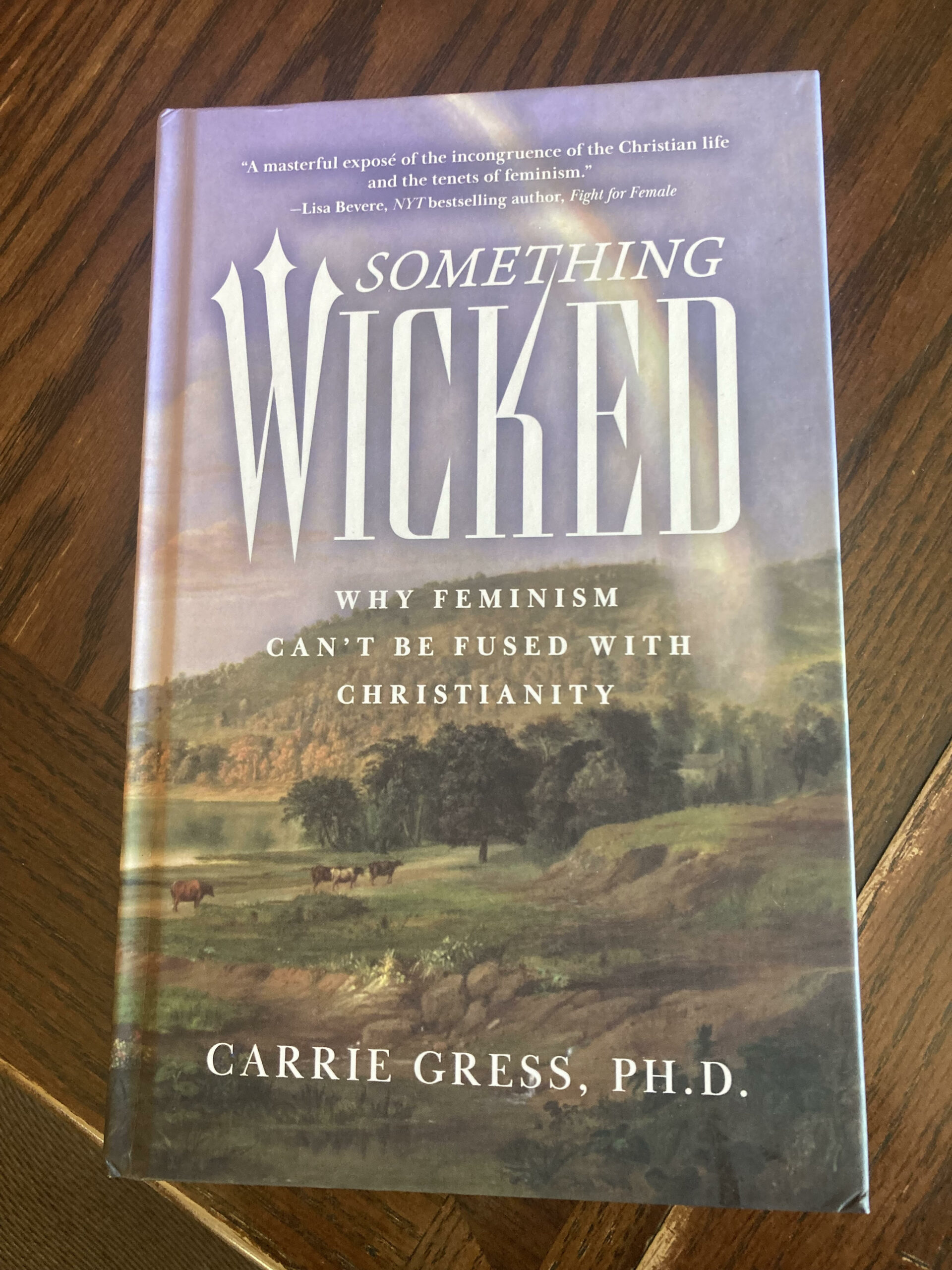
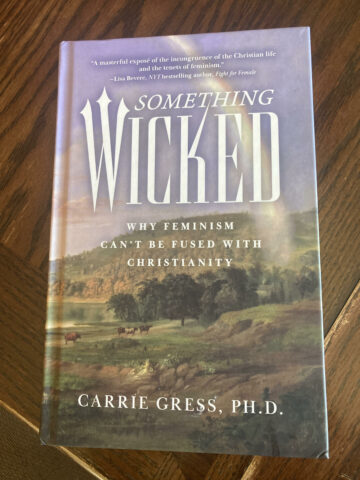
Something Wicked: Why Feminism Can’t Be Fused with Christianity
Sophia Institute Press
Manchester, New Hampshire
Copyright 2021, 2025
241 pp.
I’ve been meaning to write a few words on a new, and controversial, book making the rounds, namely, Dr. Carrie Gress’ Something Wicked: Why Feminism Can’t Be Fused with Christianity. Her main premise is whether the term’ feminism’ can be redeemed, for even the late, great Pope Saint John Paul II uses the term ‘Christian feminism’ (as Dr. Gress alludes and tries to explain towards the end). One can see from the subtitle Dr. Gress’ opinion on this – but, as we will see, with some distinctions.
I was prompted to get to this task by Alexa Bulman’s reflection on spiritual motherhood. I say in class, some some tongue-in-cheek, that in English we emphasize the corruption of some good thing by adding an ‘ism’ to the end. Thus we have ‘rationalism’ and ‘fideism’, ‘biologism’ and ‘naturalism’, ‘teleologism’ and ‘proportionalism’, ‘communism’ and ‘socialism’, each of which signifying an over-emphasis to one thing, to the diminution, if not outright exclusion, of some other, often necessary, complement.
There are exceptions to the ‘ism’ rule: We may take as given that Catholicism, monasticism, even perhaps ‘romanticism’ are all good as they are.
Is ‘feminism’ an inherent corruption of the proper and true sense of femininity? Or is it irredeemable, like the term ‘gay’ to mean happy to joyful, or ‘euthanasia’ to imply a ‘good death’, or even ‘liberal’ to evoke a love of freedom, and not a fellow traveler of Trudeau and Carney.
Ah, the vagaries of language.
Dr. Gress’ argues feminism is its origins is linked with the occult, with the hatred of men, with libertinism – a disordered sense of freedom – especially from domesticity and the ‘home’ and any submission to patriarchy.
We may sum up Gress’ argument with her open salvo:
Feminism emerged from a confluence of events and ideas in eighteenth-century England. New ideas of rationalism over religion were grinding down the Christian faith; the authority of the Church was displaced with state authority. The sacred was supplanted by the secular while the revolutionary spirits were shipping around what had been the stabilizing foundation for most of human history. (p. 23).
These ‘stabilizing foundations’ are, as she goes on to say, ‘faith, marriage and the family’, and feminism was the primary motivation, if not defined by, a the ‘significant shifts’ in how these were viewed – and, we may add, lived (or not lived, as the case may be).
Gress admits that there were legitimate grievances:
At this time in history, women in England were often seen as ornaments, property, or the means through which to expand wealth and prestige by having children.
By why pick on England? The subjugation of woman has been a theme throughout human history, and across the globe. Gress’ claim is that it is in England that the counter-reaction, or here we might say over-reaction, to the objectification of women took formal shape in England, especially through the writings and example Mary Wollstonecraft (1759 – 1797). But we may trace its origins further back, to Rousseau and the French Revolution, the notion of ‘liberty, fraternity and equality and the triumph of reason over tradition’ (p. 25).
Thus begins a trek through the history of feminism, which I will not rehearse here, from Wollstonecraft and her feminist tract, A Vindication of the Rights of Woman, to her daughter Mary Shelley (and Shelley’s own amorous endeavours with Perce Bysse), through Hannah More (1745 – 1833). This leads us to the ‘Building of the New Woman’ (1900 – 1960) and laying the groundwork for the sexually liberated feminist, with the likes of Virgina Woolf, Alfred Kinsey and Margaret Sanger and Simone de Beauvoir’s The Second Sex (1949), all of whom, in their own way, undermined traditional sexual and familial mores. Now we’re in the realm of transgenderism and Judith Butler, losing any sense of what it means to be a woman.
Dr. Gress summarizes three ‘commandments’ of feminism: promiscuity, hatred of men (and the ‘patriarchy’), and engaging in the occult (pp. 86, ff.). A heavy brew, if one excuses the metaphor. We may add one more: Women must get out into the workforce, as Betty Friedan advocated in her 1963 manifesto, The Feminine Mystique.
This all culminates, as Gress concludes in her sixth chapter, with the ‘sacrament of abortion’, and the ‘scapegoating’ of the unborn child, who must be sacrificed for the sake of a woman’s freedom, the end point of what John Paul II would later call the ‘culture of death’. The disastrous consequences of all of this are all around us, and have led to a collapse in marriage and birth rates. One can now glimpse the demographic demise of humanity itself.
Yet some would like to rescue the notion of feminism, as a term signifying the rightful struggle for the proper view of woman. Helen Roy, for one, takes Dr. Gress to task for being too extreme and condemnatory, and there is some truth that she does paints with a wide brush. Whatever its historical origins, it is true that many now and in the past have called themselves ‘feminists’ who are not linked with the occult, nor with the undermining of moral principles. Pope Saint John Paul II uses the term – not often, but in a few places.
Allow us to conclude with a distinction, and hopefully a reconciliation: What Gress calls the ‘old feminism’- in its concrete, historical origins and all that entails – cannot be redeemed. As a term and a movement, it seems inextricably linked with its origins, and with a disordered view of woman, family, home, hearth, and freedom itself. She argues – rightly – that John Paul II did not intend to build a ‘new feminism’ upon this old one, but upon an entirely new foundation, on revelation and the teaching of the Catholic Faith, beginning with the Garden of Eden. Dr. Gress lists the principles of this new Christian feminism – or, better, the Christian view of the genius and dignity of woman: God as the source of freedom, embracing an interdependency of man and woman, of woman in relationship with family, and not as perpetual victims, emphasizing love and service, prioritizing the needs of children and upholding monogamy and marriage (pp. 167-168). These are in contradistinction to disordered principles of the ‘old feminism’, as described above.
Dr. Gress ends on a note of hope, that the tide is turning, with culture and even science and recent brain studies signifying that men and women need each other’s respective gifts and genius to build a flourishing culture of life and love. We will leave the reader for now with the question Dr. Gress poses in her final pages:
Are Christian communities forming women who are steady, unwavering, nourishing and sustaining? Women who can help lead and build civilization in a uniquely feminine way?
The Church has the answer, in her Magisterium, not least John Paul II’s rich teaching, and her panoply of saints, of the Virgin Mary and the strong and valiant women through history, from Monica to Catherine of Siena, Teresa of Avila, Gianna Molla, Zelie Martin, Edith Stein, and countless others who are not known, or, rather, known only to God and their loved ones, which is really all that matters. In whatever path a woman is called – to marriage, religious, consecrated or single life – and whatever we call their rightful dignity, we certainly the maternal and feminine genius of the fairer sex.