
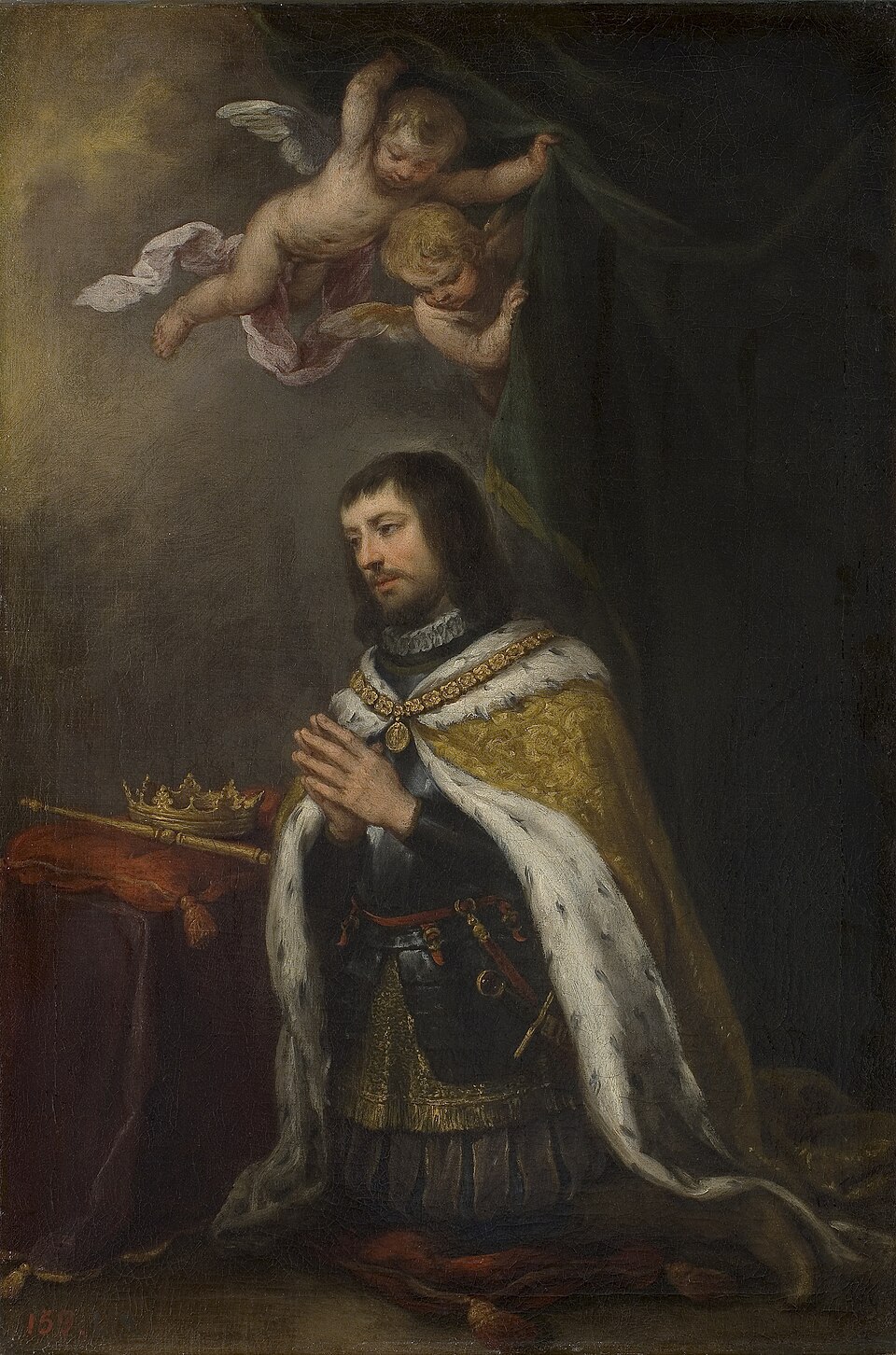
I didn’t know that ‘San Fernando’ in California (and other places) was named after the saint we commemorate today, Saint Ferdinand III (1201 – 1252), the great, 13th century King of Leon, Castile and Galicia, who by his military prowess, courage and genius, helped unify what would later be known as ‘Spain’, taking back vast territories which had been conquered and subjugated by the Muslims in the 8th century.
Ferdinand is similar to his contemporary, Louis IX of France, who is also canonized. Both were amongst the greatest of soldiers in history, back in the time when even swords had names (Ferdinand’s was Lobera – oh, to live in such days of yore! Of valiant and noble kings! When in contrast to these days of drone warfare governed by AI, one to actually see the enemy one had to kill, mano a mano, or perhaps espada a espada, in defense of one’s patria, of home and hearth, of one’s wife and children).
But both kings were also saints, living a prayerful, sacramental, chaste and holy life. Ferdinand spent his last days as a Franciscan tertiary, dying a pious death with the full rites of the Church. His incorrupt body still lies in Seville’s cathedral, reclining and wearing the golden crown he wore in life. Ferdinand had always supported the new – and controversial – mendicant Orders, founded by Saint Francis and Saint Dominic the century before, seeing in them a new and radical path to holiness. In the midst of his many duties, Ferdinand was a devoted father and husband: His first wife, Elisabeth of Swabia, bore him ten children. After her death, he married Joan, Countess of Pothieu, and had another five. Many of these descendants also changed history, one of them, Eleanor (from the second marriage) marrying Edward I of England, also known as Longshanks. (And, no, he’s not like he’s falsely portrayed in the bowl of historical pottage known as ‘Braveheart’).
We could use a few more such saintly leaders, who govern not for themselves, but for others, and primarily for God. There are a couple of articles this morning in Crisis and The Catholic Thing on Saint Joan of Arc, both emphasizing that she was canonized not for leading France to freedom, but for listening to and obeying the voice of God. Such did Ferdinand, and Louis, and Charles of Austria and many others. We pray that our current leaders may do so also, whose authority, whether they know it or not, is by the permission and grace of God. As Pope Leo XIV alluded in his recent encyclical, should they listen His voice – to paraphrase a more modern Louis – oh, what a world this would be!