

Many gospel episodes leave us guessing about their backstories. For example, I’ve often wondered about the “rich young man,” who “turned away sad,” when Jesus invited him to “be perfect” in poverty. Was he the disciple, Barnabas, “Son of Encouragement,” seen later in Acts? Among all those who donated their property to the new-born Church, Barnabas is the only one singled out by name. Was Luke clearing his name, given his earlier stumble? Might Jesus himself have been sad with that earlier failure, knowing his future potential? Maybe yes, maybe no, but nothing hinges on it.
Some episodes, however, really demand that we flesh out the whole situation. One such is the jarring tale of Ananias and Sapphira in Acts (5:1-11). We’ve already been told that the new Church’s wealthier members were selling off all their property, turning the proceeds over to the common purse, and everybody simply took what they needed. So Ananias and Sapphira sold their property, but when Ananias came to Peter, “with his wife’s full knowledge, he kept back part of the money for himself,” and “put the rest at the apostle’s feet.”
Peter abruptly accuses him: “Ananias, how is it that Satan has so filled your heart that you have lied to the Holy Spirit and kept back some of the money you got for the land? …You have lied not just to human beings, but to God.” And with that, Ananias falls down and dies.
Three hours later, his accomplice Sapphira shows up, unaware of what’s gone on, and Peter asks her, “Tell me, is this the price you and Ananias got for the land?” When she says yes, Peter accuses her of conspiring to “test the Spirit of the Lord.” He then warns, “Listen! The feet of the men who buried your husband are at the door, and they will carry you out also.” And with that, Sapphira also falls down dead.
Whoa! I used to think, that’s a bit harsh! A death sentence for fudging on their Sunday envelope? Might Ananias and Sapphira been allowed to keep back that part of their money, if only they’d been honest about it? But then, what is the real situation here?
First, simply on a practical level, a community cashbox like that, “sharing everything they had,” would be an open invitation to every grifter and con artist in Palestine. So common sense suggests, when Peter charges, “How is it that Satan has so filled your heart?” he knows that their intent was to buy their way into the community, so they could bleed it from the inside.
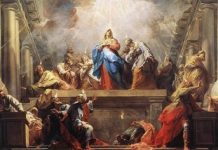
Providentially, however, the Pentecost Church didn’t need to resort to vouchers and log books, so corrosive to trust, once the Holy Spirit stepped in. “Great fear seized the whole church.” No kidding. It would likely take centuries before some young punk would dare to rifle the poor box.
But did the offense merit a death sentence? This is where things get interesting. The Catholic Church understands that mankind’s sentence of inevitable death—Adam and Eve’s exile from the Tree of Life, given their disobedience—was truly an act of Divine love. Their destiny to die someday saved them (and us) from living eternally in a world awash in sin. Oscar Wilde’s novel, The Picture of Dorian Gray, is an example of how that would look: endless, hopeless despair with meaningless, mounting personal corruption. (So incidentally, the “transhumanists” might think twice about their biotechnical ambitions: they would construct their own personal hells.)
We can’t know how Ananias and Sapphira would have turned out, if they’d been allowed to pilfer the newborn Church. But the Holy Spirit did. In fairness, they may have been expecting no more than a simple life on Easy Street, lifting just enough cash not to be noticed, with no real malice. But it couldn’t stay that way.
Remember Judas, likewise a thief. Jesus knew, way back in Galilee, that Judas had cut himself off from His own and everyone else’s friendship, making himself literally an “enemy agent.” That’s not a happy place. Secretly plundering your innocent friends smolders as a hidden, personal rebuke. And the holier the friends, the more bitter the rebuke. If not doused with repentance, it ignites first into contempt, then burns as real malice.
So, instead of thinking of Ananias and Sapphira’s death sentence as a punishment, think of it as the love of the Holy Spirit, like the expulsion from Eden, saving them from a far worse eternal fate. The Holy Spirit doesn’t care how long we live, but only how we end up. And who knows? Assuming they weren’t really malicious, following their necessary Purgation, the Communion of Saints may celebrate them as the folks who freed the new Church from the need for accountants.