
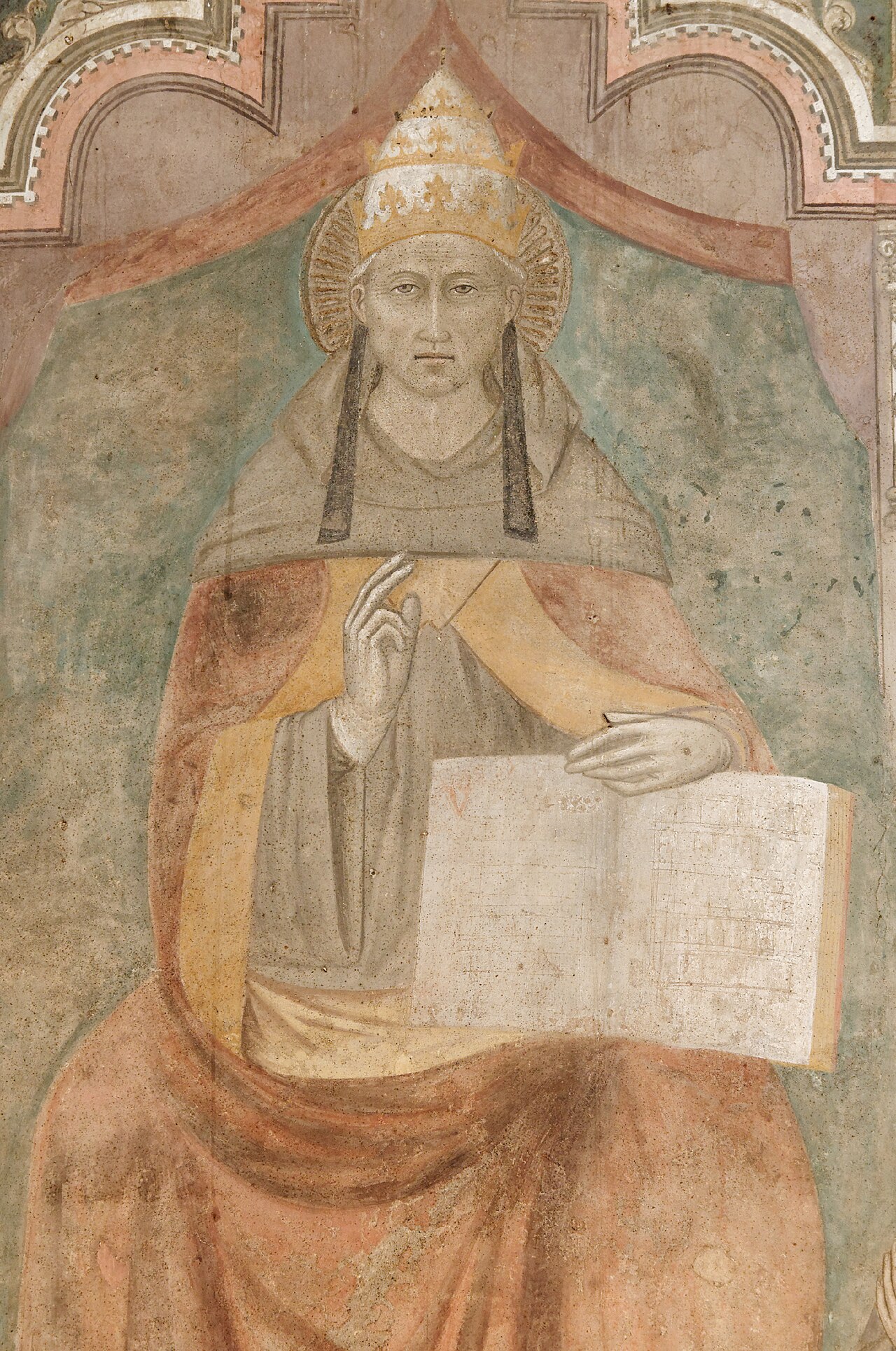
The controversial Pope Saint Celestine V the third-last pontiff to resign the papacy, and the one who codified this possibility into canon law, died on this day on 1296, and so stands as his commemoration.
He began life as Peter Morrone (1215 – 1296), a poor peasant, whose father died while he was young. His mother saw potential in the lad, and spared no expense scrabbling together enough funds to send him to school. Always prayerful and introspective, Peter flourished, joining the Benedictines, and adopted the name ‘Celestine’. He went beyond their rule, eventually taking on an eremitical and ascetical life. Others, inspired by his example, joined him. So began the small order of the Celestines, whose monks followed the Benedictine rule, but with added austerities and strictures. Celestine continued to live by himself in a cave overseeing the monastery, paradoxically becoming widely known as a saint and a miracle worker.
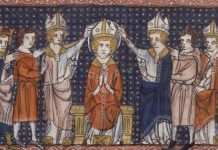
The Church was in rough shape in the late 13th century, divided by factions, worldliness, politics. Pope Nicholas IV died in April of 1292, and the cardinals remained deadlocked for two year on choosing a successor. Celestine sent a warning to them, that divine vengeance would fall upon them if they did not quickly choose a pope. They were so moved, and Latino Malabranca, the dean of the College of Cardinals, cried out, “In the name of the Father, the Son and the Holy Spirit, I elect brother Pietro di Morrone!”, to which the others heartily assented.. Finally, a saint to run the Church!
A caveat to those who caveat cardinals. Celestine refused, even tried to run away, but finally submitted as (apparently) God’s will.
He was not a good pope, at least as those things are judged by historical and political standards. An innocent ingénu, he was taken advantage of, not least by Charles of Anjou (less holy than his brother, Louis IX), appointed people to positions who didn’t deserve them, not seeing the malevolent intentions of others. A sort of Pollyanna pope, if you will.
The worldly cardinal Benedetto Caetani convinced Celestine to resign, saying it was for the best, and Celestine agreed, as mentioned, codifying this into law, perhaps as a salve for his conscience.
As this is phrase in the current (1983) Code:
Si contingat ut Romanus Pontifex muneri suo renuntiet, ad validitatem requiritur ut renuntiatio libere fiat et rite manifestetur, non vero ut a quopiam acceptetur.
If it happens that the Roman Pontiff resigns his office, it is required for validity that the resignation be made freely and properly manifested but not that it is accepted by anyone
Celestine manifested his intention in a brief letter, stating in part:
the desire for humility, for a purer life, for a stainless conscience, the deficiencies of his own physical strength, his ignorance, the perverseness of the people, his longing for the tranquility of his former life
Which sounds not dissimilar to Pope Benedict’s own letter of resignation in that fateful February of 2013.
So ended one of the shortest papacies in history: The Celestine papacy began on July 5, 1294, and ended on the 13th of December that same year, five months and eight days. Pietro reverted back to his pre-papal name of Peter Morone, and Cardinal Gaetano was elected as Boniface VIII – which is another whole story. The sometime hermit Peter tried to run off into the woods, even boarding a boat to Dalmatia. But his ship was blown off course, and Pope Boniface imprisoned him in a castle, for fear he would be made an anti-pope. One may presume Peter didn’t mind, being used to the eremitical life, and he died on this May 19th, 1296, at the ripe old age of 80, or perhaps 87, depending on how you count his birth year. He was canonized by the French Avignon pope Clement V on May 5th, 1313.
Two other popes have resigned since: Gregory XII, to end the Great Western Schism at the Council of Constance in 1415, and Benedict XVI in 2013.
There was a massive earthquake in 2009 in L’Aquila, where Celestine’s remains remain. Although there was widespread destruction, his tomb was unscathed, a sign taken as a posthumous miracle. When Pope Benedict visited the tome the following year, he prayed at Celestine’s resting place, and left his pallium – the sign of his papal authority – on top of the glass sarcophagus as a gift. A sign of things to come, and what was already going through his heart and mind.
Dante Alighieri placed Boniface VIII in his Inferno, as a worldly enemy of the Church. There is some evidence that he also put Celestine there, for his resignation allowed Boniface to become pope. But not by name, but an indirect allusion:
vidi e conobbi l’ombra di colui che fece per viltade il gran rifiuto. (“I saw and recognized the shade of him who due to cowardice made the great refusal”) (Inferno, III, 59-60)
But this could be someone else. That’s the thing about poetry – it’s ambiguous, until it’s not, like Boniface in the eighth circle of hell. And keep in mind the Pope was still alive when Dante wrote that. Again, this could be metaphorical, on what might happen to Boniface, who, although many misdeeds were attributed to him – including ordering the razing of the town of Palestrina with the death of 6000 innocent lives – did defend the rights of the Church against the aggression of King Philip IV, to the cost of his life.
What we do know is that Peter Celestine is a saint, sanctified through his own holy life, his prayer and asceticism, his life of charity, even amidst the vagaries of his life and choices, or the choices foisted upon him. God writes straight with crooked lines, as the saying goes, and can bring about His will through wqys that are mysterious, even odd and disconcerting, to us. We must trust not only in Him, but in His Church, that through her weakness and the foibles of her members, even her imperfect Popes and bishops, God will not abandon His Church, and always work to save souls, unto the end of time.