
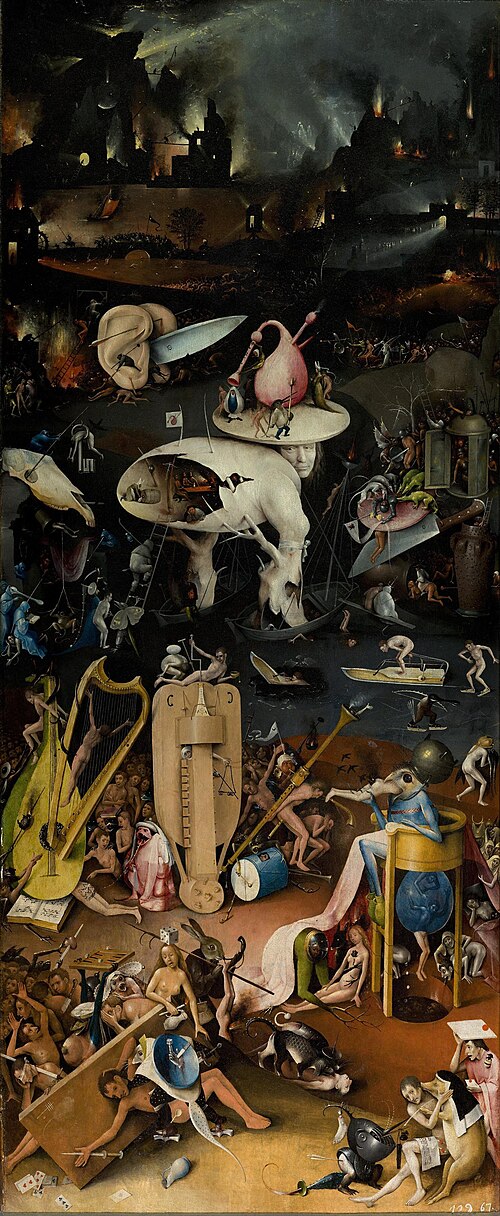
(As we meditate on this day on Christ’s burial, and His descent into hell, it is fitting to ponder here with contributor Peter Marcus how the world seems to be heading there as well. The difference is that, although God cannot ‘redeem’ hell, nor those therein, He can and did redeem the world. There is never any necessity to reject God and His kingdom, and He will do everything to help lead us there, except violate our free will. It’s all about love, and truth, and may Europe choose both before it’s too late) Editor
A Christian parliamentarian in Finland has just been convicted for making available a church pamphlet on marriage and sexual ethics, under a criminal code chapter dealing with “war crimes and crimes against humanity,” even though the same court acquitted her over a Bible tweet quoting Romans 1. At nearly the same time in Belgium, publicly funded radio presenters smashed statues of Jesus and Our Lady for amusement, then admitted they would treat Islamic symbols with greater caution because that would be “dangerous.” Those two events tell the whole story of the modern West in miniature. Christianity is mocked where it is weak, prosecuted where it still speaks, and treated as a disposable inheritance by people who still live on its moral capital.
That condition did not arrive in a single leap. The West went from deeply Catholic to Protestant, from Protestant to vaguely secular Christian, from secular Christian to secular, from secular to post Christian, and from post Christian to openly anti-Christian. Each phase kept some borrowed goods while cutting deeper into the root that had nourished them. Hilaire Belloc gave the old formula with brutal accuracy: “The Faith is Europe and Europe is the Faith.” He also wrote, “The Church is Europe: and Europe is The Church.” Those words sound excessive only to people formed by an age that has forgotten how Europe became Europe in the first place.
The deeply Catholic West possessed a unified vision of reality. God ruled history. Christ ruled kings. Nature had purpose. Law answered to moral truth. Art, architecture, music, philosophy, political order, family life, feast days, universities, hospitals, guilds, the calendar itself, all of these grew within a sacramental imagination shaped by the Church. Europe had sin, corruption, brutality, and every familiar human vice. It also had a coherent account of the good. A civilization can survive many crimes more easily than it can survive metaphysical amnesia. Belloc’s line is salient because it declares a civilizational fact.
Then came the Protestant rupture. Here one must speak carefully and plainly. The Reformers claimed to have sought renewal, and their grievances against late medieval corruption had some substance. Yet their actions and their long-term effect was fragmentation of authority, sacramental thinning, liturgical reduction, and a transfer of interpretive sovereignty toward the private reader, the prince, and the sect. Benedict XVI, in Regensburg, identified the Reformation as a major stage in the “dehellenization” of Christianity, a process that treated the synthesis of biblical faith and reason as alien accretion rather than providential achievement. Once theology was severed from metaphysics and ecclesial authority, faith steadily lost its public grammar.
Brad Gregory in The Unintended Reformation put the consequence in one devastating sentence: “Because 16th- and 17th-century Christians could not agree about what was true, right and good, modern individuals were eventually permitted to determine these things for themselves.” That line should be read slowly, because it explains far more than a shelf of fashionable social commentary. When Christians cease agreeing on truth, public order shifts toward procedure. When truth becomes contested territory, power gradually hands moral sovereignty to the individual will. Then every man becomes his own little magisterium, armed with appetite, sentiment, grievance, and a smartphone.
The secular Christian phase came next. That was the age in which Christian language remained socially useful even as Christian dogma weakened. People still spoke of dignity, rights, charity, conscience, equality, and neighbor love. They still baptized their children, married in churches, and quoted Scripture at funerals. Yet increasingly these practices served as cultural mainstays rather than living convictions. Christianity became a moral perfume sprayed over an anthropology already drifting away from Christ. This was a civilization surviving on inheritance, spending principal while imagining it was living on interest.
Then secularism hardened the drift. Jay Anthony wrote in Junk Food Christianity, “The past fifty years have seen a steady decline of biblical mores in the United States and much of Western culture.” He was correct, and the phrase “steady decline” matters. This was never merely a sequence of random scandals. It was a long institutional catechesis. Schools trained children to treat religion as private sentiment. Courts redefined liberty as radical self-definition. Markets monetized vice. Entertainment normalized sacrilege. Psychology replaced sin with dysfunction. Medicine, in some corners, shifted from healing nature to manipulating identity. The state increasingly claimed jurisdiction over the body, the family, speech, and conscience.
By that stage, “post Christian” became the accurate term. Post Christian society still remembers Christian symbols, which means it can parody them, prosecute them, and profit from them. It retains enough memory to resent Christianity for shaping the civilization it now wishes to edit. Paul Kingsnorth in Against Christian Civilization described our age as a “culture of inversion,” and that phrase is exact. What once formed the soul is now framed as oppression. What once marked shame is now celebrated as identity. What once protected the weak is now dismissed as exclusion. Kingsnorth also speaks of a “psychic wound” bound up with losing an entire metaphysics. That phrase explains the eerie agitation of modern Western life. A civilization that has forgotten what man is will eventually lose its nerve, its joy, and its future.
Hence the present anti-Christian phase. Anti-Christianity goes further than unbelief. Secular society once sought neutrality. Post Christian society once sought replacement. Anti-Christian society seeks humiliation, legal subordination, and ritual public shame for Christian conviction. In Finland, Scripture-inflected moral witness now risks criminal sanction. In Belgium, Christ and His Mother can be smashed for sport, while another religion receives protective caution out of fear. That asymmetry exposes the fraud. This has nothing to do with equal respect. It has everything to do with civilizational contempt directed toward the faith that built Europe.
Benedict XVI saw this coming. At Regensburg he warned against the “self-limitation of reason” and the “pathologies of religion and reason.” Once reason is reduced to the empirically verifiable, questions of God, ethics, and man’s final end are pushed outside serious public discourse. Then theology is downgraded, metaphysics is mocked, and moral truth becomes either private preference or administrative decree. Benedict’s remedy was simple and profound: reason and faith must come together again, and the West must recover “the whole breadth of reason.” Without that recovery, technological power grows while wisdom shrivels. Our machines become brilliant. Our civilization becomes childish.
This is why the decline of the West is inseparable from its rejection of Christianity. The West did not accidentally misplace church attendance while preserving its soul elsewhere. Its soul was formed by the Gospel, by the Church, by the Logos, by a sacramental account of man and history. Once those foundations were kicked aside, every secondary crisis accelerated: demographic collapse, family breakdown, sexual chaos, speech control, legal confusion, aesthetic ugliness, loneliness, nihilism, and the bureaucratic management of despair. A people without transcendence eventually settles for therapy, consumption, and surveillance, which is a pitiful trade for cathedrals, saints, and civilization.
So here we are. The old Christian world has been dismantled in layers, with each layer pretending it could survive without the one beneath it. It could not. A severed branch can look green for a little while. Afterward comes decay. Belloc was right. Gregory was right. Kingsnorth is right. Anthony is right. The anti-Christian West is living proof that a civilization at war with its spiritual source soon turns on its own people, its own children, and finally its own memory.
The answer is neither nostalgia nor panic. The answer is conversion, worship, courage, and a public return to Christendom’s first principles. Christians must recover the full Catholic account of truth, nature, law, beauty, marriage, freedom, and human dignity. Churches must preach like eternity is real. Families must live like holiness actually matters. Intellectuals must stop flattering the age. Politicians must relearn that rights severed from truth destroys societies. Europe and the wider West will either return to Christ or continue their elegant suicide. History is already giving its verdict.