
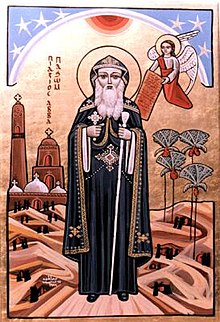
The great desert Father, and founder of cenobitic monasticism, Saint Pachomius, died on this 9th day of May in 348 A.D., eight years before his fellow monk, Saint Anthony of Egypt, generally considered the founder of eremitic monasticism (even if his feast in many calendars is on May 15th). That is, Anthony was a hermit (from eremos – literally ‘desert’ where one went to dwell alone), while Pachomius’ rule was for monks sharing a life in common (from koino-bios – literally ‘common life’).
Raised a pagan and drafted into the Roman army in North Africa, Pachomius in his peregrinations came across some fervent Christians, and thought he should investigate the religion that inspired such zeal and charity. Convinced of the truth of the Faith, he managed to secure his release from the military, was baptized, and spent seven years with Saint Anthony learning the ways of the monk in eremitic life. A voice from God, however, urged him to found a community, a lavra, where those who wished to ‘flee the world’ could live a life of prayer and work together, supporting one another, dedicated solely to God.
He wrote a way of life, adaptable to the proclivities of each monk, and Pachomius’ rule was the foundation for the later and more lasting rules of Saints Basil and Benedict. Pachomius took all the administrative work upon himself, leaving his monks free of such burdens. They called him ‘Abba’ – a colloquial term for ‘Father’ in Hebrew and Arabic – whence we derive the canonical term ‘abbot’.
Pachomius’ persevered in his vocation joyfully unto the end, his monks spreading throughout the Empire, in Egypt and beyond, and went to his eternal reward after death from what may have been a plague.
Stories of Pachomius and his followers are collected in the ‘Sayings of the Desert Fathers’, well worth a perusal – delightful, edifying, even humorous and quite human. Grace builds on nature, and we need perpetual witness of monasticism to teach us the way to heaven and keep our eyes on what this transitory life all about.
Saint Pachomius, ora pro nobis! +
(source, in parte: wikipedia.org)