
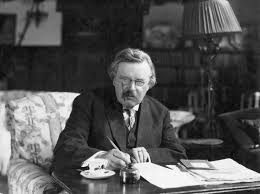
(In my pilgrimaging through England a couple of summers ago, which now seems like a different era, I made my way to the grave of the great G.K. Chesterton, not far from the house where he lived, still standing, but one wonders for how long, as they – the iconoclastic developers – want to turn into a set of flats, or something. Chesterton’s birthday was May 29th, and this is sort of the novena of that day, so here is a gem from the pen of Father Callam, on reading Chesterton, instead of just quoting him aphoristically. Enjoy!) Editor.
G.K. Chesterton is known as the most frequently cited of any writer . . . and the least read. It’s easy to see why he is often quoted; consider this sample of his wit:
- “A dead thing can go with the stream, but only a living thing can go against it.”[1]
- “It is terrible to contemplate how few politicians are hanged.”[2]
- “The whole pleasure of marriage is that it is a perpetual crisis.”[3]
- “‘My country, right or wrong,’ is a thing that no patriot would think of saying. It is like saying, ‘My mother, drunk or sober.’”[4]
- “These are the days when the Christian is expected to praise every creed except his own.”[5]
The last of these, I may note, was published in 1928. There are hundreds of such statements, all equally amusing and arresting. He is quotable, delightfully so. Why, then, is he not read? The answer is that he was too Catholic, and he defended the faith, directly or indirectly, in everything he wrote . . . and he wrote volumes, and on every topic—politics and economics, literature, philosophy, morality, religion, history, biography, apologetics—and in every form—columns in newspapers and magazines, novels, literary criticism, essays, biographies, poetry. We can demonstrate this Catholic ethos by having a look at one of his Father Brown stories: “The Invisible Man.”[6]
The starting point is the love of two men—the dwarfish Isidore Smythe and the lanky James Welkin—for the same woman, Laura Hope. She eventually rids herself of them by insisting that she would never marry anyone who had not made his fortune by his own efforts. Nothing happens for several years, until Laura, now being courted by John Angus, is accosted by Smythe who reappears to claim her hand. He has become wealthy from the invention and marketing of robots that can perform simple household tasks: “Smythe’s Silent Service.” Welkin, somehow present but never seen, is consumed by jealousy and, with a note that no one has delivered, threatens Smythe: “If you have been to see her today, I shall kill you.”[7] The murder occurs, but in a mysterious, even “supernatural”[8] manner. Smythe has disappeared from his flat, leaving behind only a blood-stained carpet with the robots, silent and sinister, positioned about the room. There is only one entrance to the block of flats, and everyone—a chestnut seller, a policeman, the doorman, the janitor—swears that no one entered or left the building, even though footprints in the snow demonstrate that someone must have come and gone. “‘God,’ cried Angus involuntarily, ‘the Invisible Man.’”[9] Father Brown, however, knows that men and women can be invisible by being overlooked, what he terms “mentally invisible”:[10]
Suppose one lady says to another in a country house, ‘Is anybody staying with you?’ the lady doesn’t answer, “Yes; the butler, the three footmen, the parlourmaid, and so on,’ though the parlourmaid may be in the room, or the butler behind her chair. She says,
‘There’s nobody staying with us.’[11]
Who, then, is similarly unremarked in this case? The answer is, the postman—Welkin—who entered, killed Smythe and then left with his bulky mailbag stuffed with Smythe’s conveniently dwarfish body, seen and yet “mentally invisible” to four witnesses. The story ends with a confession, but not to the police. “Father Brown walked those snow-covered hills under the stars for many hours with a murderer, and what they said to one another will never be known.”[12]
Chesterton’s Method
How did Father Brown solve the crime? The answer to that question reveals not only the method of Father Brown, but also that of Chesterton as a Catholic apologist. It’s simply this: he realized that you need more than logic because of the simple fact that there are always several logically consistent explanations of any event, from a simple remark to the origins and purpose of the universe, as we can see in another Father Brown story, “The Honour of Israel Gow” (cf. infra). In “The Wrong Shape,” for instance, what seems to be a suicide note turns out to be a quotation from a piece of fiction. Father Brown has three qualities that allow him to penetrate the mind of the criminal and thus to identify him. First, he is a priest, and “a man who does next to nothing but hear men’s real sins is not likely to be wholly unaware of human evil.”[13] It follows, then, that Father Brown has an interest in the case beyond solving the crime and bringing the culprit to justice. He wants to reconcile the sinner to God, as at the end of “The Invisible Man,” when he hears the Welkin’s confession. And thirdly, most significantly, Father Brown has sympathy for the criminal because he recognizes that he himself is a sinner and as such would be capable of every enormity, including the crime under investigation:
I try to be inside the murderer. . . . Indeed, it’s much more than that, don’t you see? I am inside a man, moving his arms and legs; […] thinking his thoughts, wrestling with his passions, […] [t]ill I really am a murderer.[14]
The limitations of logic are brilliantly described in what may be his greatest book: Orthodoxy. There’s a chapter the title of which contains in a nutshell its entire contents: “The Maniac.” And what is a maniac? In replying to this question, Chesterton is at his most paradoxical and most profound: “The madman is not the man who has lost his reason. The madman is the man who has lost everything except his reason.”[15] To demonstrate his point, he uses the example of someone who is paranoid: “Everyone is out to get me,” he says. And when you point out, “Be sensible; no one is even looking at you,” he has a perfectly logical response: “Aren’t they clever!” And, indeed, if people were really out to get him, they would act as if they were oblivious to his presence. There’s no logical way you can prove that he’s wrong. You see, he spends all his time thinking about his monomania, and he has an answer ready and waiting for any casual, rational observation you may make. As Chesterton observed, “If you argue with a madman it is extremely probable that you will get the worst of it.”[16]
Well, what then is the flaw in the logically irrefutable position of a maniacs? Chesterton can tell you: “He’s in the clean and well-lit prison of one idea.”[17] It’s not a lack of logic; it’s a lack of imagination. For instance, to cure, or at least to challenge the paranoid, ask him why the entire population of Toronto would have the least interest in an ordinary person such as he. His position is not illogical, it’s implausible. Chesterton uses the same approach to, say, an atheist. He may be able logically to account for the universe, but it’s a very small universe. I refuse to accept it not because it’s illogical but because it’s boring. In such a cosmos all the interesting things are eliminated, such as free will, virtue and vice, love and self-sacrifice, even, when you think about it, beauty and purpose. It really is surprising that anyone would want to view man as a puppet controlled by the mindless forces of matter when the glorious vision of freedom, responsibility and virtue is open to him as a real—and logically defensible—alternative. Let’s look at another story from this point of view: “The Honour of Israel Gow”[18]
Chesterton begins with a description of Glengyle Castle, a grim-looking pile set in a gloomy, isolated, even sinister Scottish glen. The reader, thus rendered queasy from the start, is primed to expect something unsettling, anything from human malevolence to diabolical possession. We also learn the crucial fact that the Earl of Glengyle was a miser whose treasure consisted of gold in all its forms from coins to candlesticks. In the interests of economy, the domestic staff had been reduced to one, the eponymous Israel Gow. Flambeau, a private detective, arrives with Father Brown to examine the circumstances of the Earl’s recent death. As they search the house, they find a bizarre collection of objects that seem without rhyme or reason: loose diamonds; piles of snuff; a heap of minute wheels and springs; wax candles. Flambeau is flummoxed, but Father Brown, without half trying, suggests a couple of manias that could have brought the Earl to assemble them, such as an obsession with the era of the French Revolution or a propensity for house breaking, diamonds and small steel wheels being useful for cutting glass.
Then further, more disturbing items are found, which completely mystify Flambeau: lead (of the sort used in mechanical pencils); a bamboo stick with a splintered top; old missals and Catholic pictures in which the sacred images have been “curiously cut and defaced”; and finally, a headless body in the coffin. At first Father Brown shares his malaise, to the point of suspecting that the castle might have housed a cult of Satan. The solution is appropriately surprising and satisfying. Israel Gow, whom Father Brown knew to be obsessively honest as only a Scot can be, had been left all the Earls’ gold, and so he collected it, every piece: from jewellery settings (the loose diamonds), snuff boxes (leaving behind piles of snuff), watch casings (and hence the heap of minute wheels and springs) and candlesticks (but not the candles). The second group of objects can be similarly accounted for: Gow took the gold pencils (while scrupulously leaving behind the lead), the gold knob (from a bamboo walking stick), the gold foil (from illuminated manuscripts), and—Father Brown is brilliant here—the Earl’s gold tooth. As Flambeau and Father Brown leave, they see, silhouetted against the sky, Gow opening the grave to restore the Earl’s head to his body.
[1] G.K. Chesterton, “The Five Deaths of the Faith,” The Everlasting Man (New York: Doubleday Image Books, 1955), pp. 261-262.
[2] G.K. Chesterton, The Cleveland Press, March 1, 1921.
[3] G.K. Chesterton, “David Copperfield,” Chesterton on Dickens. The Collected Works of G. K. Chesterton, vol. XV (San Francisco|: Ignatius Press, 1990), p. 333.
[4] G.K. Chesterton, “A Defence of Patriotism,” The Defendant (London: Dodd, Mead & Company,1901), p. 125.
[5] G.K. Chesterton, Illustrated London News, August 11, 1928.
[6] G. K. Chesterton, “The Invisible Man,” The Father Brown Omnibus (New York: Dodd, Mead & Company, 1951), pp.82-100; cf. H.G. Wells, The Invisible Man (London: C. Arthur Pearson, 1897).
[7] “Invisible Man,” p. 92.
[8] “Father” said Flambeau, . . . “no friend or foe has entered the house, but Smythe is gone, as if stolen by the fairies. If that is not supernatural, I—.” “Invisible Man,” p. 97.
[9] “Invisible Man,” p. 95.
[10] “Invisible Man,” p. 98.
[11] “Invisible Man,” p. 98.
[12] “Invisible Man,” p. 100.
[13] G.K. Chesterton, “The Blue Cross,” The Father Brown Omnibus (New York: Dodd, Mead & Company, 1951), p. 23.
[14] G.K. Chesterton, “The Secret of Father Brown, The Father Brown Omnibus (New York: Dodd, Mead & Company, 1951), p. 639.
[15] G.K. Chesterton, Orthodoxy: A Centenary Edition (South Orange [NJ]: Chesterton Institute Press, 2008), p. 90.
[16] Orthodoxy, pp. 89-90.
[17] Orthodoxy, p. 95.
[18] G.K. Chesterton, “The Honour of Israel Gow,” The Father Brown Omnibus (New York: Dodd, Mead & Company, 1951), pp 101-16.