
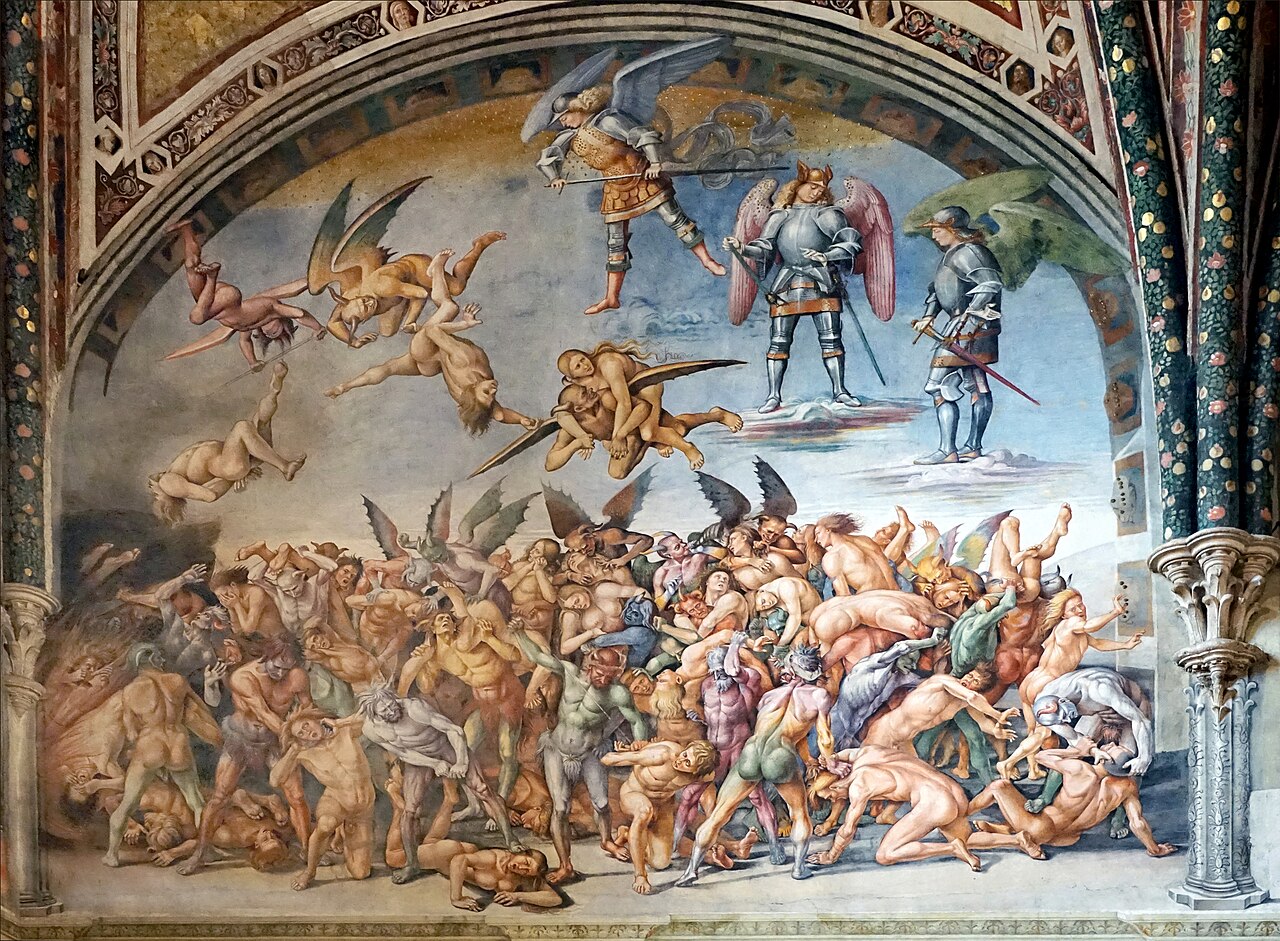
There was a time when the thought of hell motivated Catholics to seek God and his mercy. Mortal sin was seen as something to be avoided. Once committed, though, Catholics knew enough to seek God’s forgiveness in the confessional. There was an understanding that holiness was something to strive for.
But in recent times, some have sought to downplay the existence of hell. Considering the consequences of serious sin is no longer as common as it once was. This of course changes nothing. “Jesus Christ is the same yesterday, today, and forever” (Hebrews 13:8). If something was true two thousand years ago, it is true today. Throughout the Gospels Jesus warns us of the judgment to come and the possibility of eternal damnation. Some examples are:
- The Parable of the Weeds (Matthew 13:24-30, 36-43)
- The Parable of the Dragnet (Matthew 13:47).
- The Parable of the Unforgiving Servant (Matthew 18:23-35)
- The Parable of the Workers in the Vineyard (Matthew 20:1-16).
- The Parable of the Two Sons (Matthew 21:28-32).
- The Parable of the Wedding Feast (Matthew 22:1-14).
- The Parable of the Ten Virgins (Matthew 25:1-13).
- The Parable of the Talents (Matthew 25:14-30).
- The Parable of the Sheep and the Goats (Matthew 25:31-46).
- The Parable of the Barren Fig Tree (Luke 13:6-9).
- The Parable of the Rich Man and Lazarus (Luke 16:19-31).
- The Parable of the Ten Gold Coins (Luke 19:11-27).
Altering or ignoring any part of the Gospel robs it of its meaning, purpose, and power. The apostle Paul tells us we will be judged by what is in our hearts (1 Corinthians 4:5). What is in our hearts when we neglect any part of the Gospel? Jesus thought it was important to preach about hell, and so should we.
The Bible tells us that most people will not make it to heaven (Matthew 7:13-14). Jesus further emphasizes the point in Matthew 22:14 when He says: ”For many are called, but few are chosen.” Passages such as these should motivate us to spread the word. If a dam were about to break, wouldn’t you do everything in your power to warn the people who lived downstream? Who would be thinking: “No, let’s not do that. It might upset them?”
On June 6, 1944, allied forces landed on the beaches of Normandy. As the landing craft approached the shore, the invading troops could hear the roar of battle all around them. Landing craft exploded into flames. Some prayed, some threw up. All were scared. Officers gave last minute instructions. It was common knowledge that many of them would not live to see another day. Their concern was logical and to be expected.
Our own situation is similar. We are all headed for eternity. We are told that most of us will not make it to heaven. And yet, all too many of us don’t seem to be concerned at all. Keep in mind that dying physically is not nearly as catastrophic as dying eternally. That is why Paul tells us to: “Work out your own salvation with fear and trembling (Philippians 2:12).
I don’t mean to say that we should live in constant fear. Those who follow Christ need not fear (Romans 8:1). However, those who live by the world’s standards, need to fear, and fear greatly. As the Scripture says: “For the Lord searches all hearts, and understands every plan and thought. If you seek Him, He will be found by you; but if you forsake Him, He will cast you off forever” (1 Chronicles 28:9).
Jesus instructed the church at Ephesus to: “Be faithful unto death, and I will give you the crown of life” (Revelation 2:10). Obviously, those who are not faithful will not receive the crown of life. One who is faithful does what is right even when it is difficult. The apostle James writes: “Whoever knows what is right to do and fails to do it, for him, it is sin (James 4:17).
When a Church fails to warn its people about hell, sin becomes less scary. Consequently, more sins are committed. Those responsible should heed the words of Jesus: “The Son of man will send His angels, and they will collect out of His kingdom all who cause others to sin and all evildoers. They will throw them into the fiery furnace, where there will be wailing and grinding of teeth” (Matthew 13:41-42).
As Catholics, we are to proclaim the full Gospel message. And that would include the hard sayings of Jesus. We are not at liberty to modify or ignore any part of it. We should heed the call of our Lord to be His co-workers (1 Corinthians 3:9). Doing the work that He did (John 14:12). Consequently, we must reject the god of this world and all that he stands for (Satan) (2 Corinthians 4:1-5). On this, Scripture couldn’t be clearer:
Do not love the world or the things in the world. If anyone loves the world, the love of the Father is not in him. For all that is in the world, the lust of the flesh the lust of the eyes and the pride of life, is not of the Father but is of the world. And the world passes away, and the lust of it; but he who does the will of God abides forever (1 John 2:15-17).
As the culture drifts farther and farther away from biblical morality, it becomes more important than ever to make people aware of the reality of hell. In his 1994 book, Crossing the Threshold of Hope, Pope John Paul II wrote that “too often preachers, catechists, and teachers. . . no longer have the courage to preach the threat of hell” (p. 183).
Jesus willingly died on the cross so that we might have eternal life (John 3:16). Those who would cause others to lose their fear of damnation, render Christ’s sacrifice ineffective. Our job is to get people to heaven, not make them comfortable on their way to hell.
The word pastor means shepherd. As of late, the term “being pastoral” has taken on a new meaning. Rather than referring to authentic spiritual guidance, it all too often means catering to people’s preferences. No shepherd would allow his sheep to wander off toward a pack of wolves. But that is exactly what we do when we fail to educate God’s people on the destructive power of sin. Yes, Jesus is merciful. But He is also just (Isaiah 30:8).
There are consequences for not preaching the truth:
So, you, son of man, I have made a watchman for the house of Israel; whenever you hear a word from my mouth, you shall give them warning from me. If I say to the wicked, O wicked man, you shall surely die, and you do not speak to warn the wicked to turn from his way, that wicked man shall die in his iniquity, but his blood I will require at your hand. But if you warn the wicked to turn from his way, and he does not turn from his way; he shall die in his iniquity, but you will have saved your life (Ezekiel 33:7-9).
In Luke 12:48 Jesus gives a similar warning: “To whom much is given, of him will much be required.” Jesus did not hesitate to challenge the culture of His day. And neither should we. If you care about people, you tell them the truth. And if they are open to the truth, it will set them free (John 8:32).
Those who are indifferent to sin and have no fear of hell are less likely to feel the need to go to confession. We know from Scripture, that confession is the normal way to have sins forgiven (John 20:21-23). And yet, hardly anyone seems to go.
One Saturday I counted fifteen people in line for confession. That same weekend, nearly eight hundred people went up for communion. I am certainly not in a position to judge any particular individual. But I think it is a sure bet that more than fifteen of us needed to confess.
Failing to confess any serious sins before receiving communion, is itself a serious sin:
Whoever, therefore, eats the bread or drinks the cup of the Lord in an unworthy manner will be guilty of profaning the body and blood of the Lord. Let a man examine himself and so eat of the bread and drink of the cup. For anyone who eats and drinks without discerning the body eats and drinks judgment upon himself (1 Corinthians 11:27-29).
One woman told a priest she didn’t need confession because she was a nice person. And I am sure that if we compared her to the average common criminal, she would come out looking pretty good. But that is the wrong comparison. How would she measure up if we compared her to Jesus? Just like any of us, not very well.
You don’t get to heaven because you are nice. You get to heaven because you accepted Jesus on His terms. The Bible says; nothing unclean can enter heaven (Revelation 21:27). The apostle John wrote: If we say “We are without sin,” we deceive ourselves, and the truth is not in us. If we acknowledge our sins, he is faithful and just and will forgive our sins and cleanse us from every wrongdoing” (1 John1:8-9).
None of us can do it on our own. James tells us: “For whoever keeps the whole law but fails in one point has become guilty of all of it (James 2:10). Being nice or good on the natural level is not enough. Eternal life is a supernatural reality. Thus, it is obtained by supernatural means.
People need to know not only that confession is a necessity, they also need to know what to confess and why. Some of the most common mortal sins are abortion, fornication, cohabitation, immodest dress, divorce and remarriage, drunkenness, a lack of forgiveness, serious gossip, and the various forms of divination. How often do we hear homilies on any of these subjects? And yet they are all common practices that can land you in hell. While admonishing His Old Testament priests, God said: “My people are destroyed for lack of knowledge; because you have rejected knowledge” (Hosea 4:6).
When presenting the mind of the Church on these issues, a priest or catechist will often be accused of judging. But such is not the case. Jesus is the judge (Acts 10:42). We are only passing on His criteria as we were instructed to do in Matthew 28:20. The idea that God will judge you according to your own criteria is absurd. As the Scriptures teach: “There is a way which seems right to a man, but its end is the way to death” (Proverbs 14:12).
Understandably, the subject of hell is an unpleasant one. But since it is a reality, understanding it is vital. Several saints have been allowed to witness the fate of the damned. Perhaps meditating on their accounts can be helpful in setting our own spiritual priorities. St. John Bosco, St. Catherine of Sienna, and St. Faustina Kowalska are just some of the saints who were granted these revelations.
No one is guaranteed heaven. Not even those who work in the Church:
Not everyone who says to me, “Lord, Lord,” shall enter the kingdom of heaven, but he who does the will of my Father who is in heaven. On that day many will say to me, “Lord, Lord, did we not prophesy in your name, and cast out demons in your name?” And then I will declare to them, “I never knew you; depart from me, you evildoers” (Matthew 7:21-23).
The measure of a Catholic parish is not determined by how many of its members make it to Mass on Sunday. Rather, it is determined by how many of its members make it to heaven on Judgment Day.