
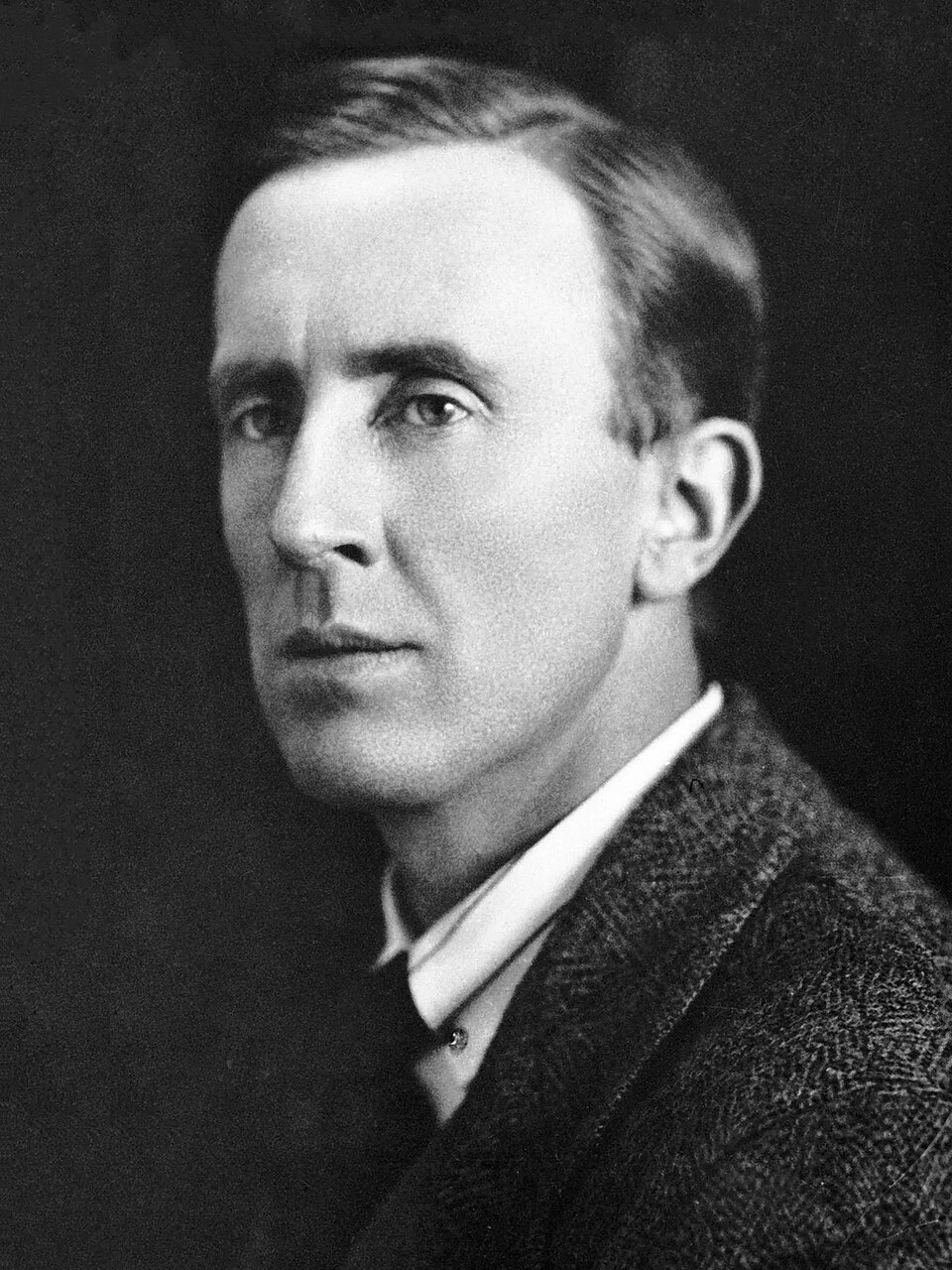
(Contributor Kaleb Hammond offers here an intriguing historical analysis of J.R.R. Tolkien’s small but significant role in the work on the Jerusalem Bible. His translation of the Book of Jonah – modified by editors, for better or perhaps worse – gives a glimpse not only into the abstruse art of translation, but also the great author’s love of Scripture and his Catholic Faith. We will post this in two parts, and here be the first).
Introduction
While his reputation as the greatest fantasy writer in history is well-known, few are aware that J. R. R. Tolkien was not only a master philologist but also a Bible translator. As a lifelong devout Catholic, he had a deep love for Sacred Scripture and jumped at the opportunity later in life to contribute to a new English Catholic translation, one that would eventually become classic among Catholics especially for its beautiful English, on which Tolkien made a special impact. Studying Tolkien’s unique, original translation of the Book of Jonah[1] can help to reveal the famous story’s deeper meaning and overlooked details, as well as its importance within the canon of Scripture and the ways by which its prophecies point to and are fulfilled in Jesus Christ.
Biographical Background
In 1957, Fr. Alexander Jones, Catholic priest and biblical scholar, planned to translate La Bible de Jérusalem, a French translation of the Bible by Dominican and other biblical scholars that was finished the previous year. Although he intended for his translators and editors to consult the original languages, their primary task was to render the French in the best possible English. As a fan of Tolkien’s The Lord of the Rings, published in 1954-1955, Fr. Jones invited Tolkien onto the project, hoping that his mastery of English would guide the overall work of translation.[2] His goal was not to displace venerable English Catholic translations like the Douay-Rheims but simply to give a version that would be more accessible to modern Catholics and reproduce the high-quality study aids found in the French original.[3] As Fr. Jones explained to Tolkien in 1957,
That a translator is at a disadvantage when he has no immediate contact with the originals is a sad truth and I do feel that I am asking too much of all the gallant co-operators. But these disadvantages are comfortably outweighed — or so it seems to me — by the difficulties of any other course. Thus, very few who read Hebrew can write English; of these, fewer still are Catholics; of these fewer few still fewer will attempt it — the Westminster Version from the originals is not nearly half-done (and never will be finished) after thirty years! Secondly, the work of translation from the Hebrew would have to be preceded by an enormous amount of textual criticism for which our few Catholic Scripture scholars in England have not the equipment (not having a theological university is an immense drawback — we are all hacks in seminaries). And so on. So don’t be discouraged. I’m sure it’s work very well worth while. As you know, we are not trying to oust any existing version; we just want to provide a good, reliable alternative. The ultimate issue is in God’s future.[4]
Fr. Jones, like his French predecessors, was partially motivated by Pope Pius XII’s encouragement of textual criticism in his encyclical Divino afflante Spiritu, so long as Catholic principles such as biblical inerrancy were maintained, – not, as some have claimed, simply because the Holy Father wished for Catholic scholars “to translate anew the Bible based on the original languages, instead of the Latin Vulgate”,[5] since the same magisterial document also extols the virtue of the Vulgate, as when it warns, “Nor should anyone think that this use of the original texts, in accordance with the methods of criticism, in any way derogates from those decrees so wisely enacted by the Council of Trent concerning the Latin Vulgate.” Nevertheless, the Holy Father also clarified that “this special authority or as they say, authenticity of the Vulgate was not affirmed by the Council particularly for critical reasons, but rather because of its legitimate use in the Churches throughout so many centuries”, and so, although the Vulgate is “free from any error whatsoever in matters of faith and morals”, this does not “in any way diminish the authority and value of the original texts”.[6] His true goal, then, was to continue the work of Catholic scholars like Bishop Richard Challoner and Msgr. Ronald Knox, who used both the Vulgate and the original languages for Catholic translations, while also incorporating legitimate advances in biblical scholarship, something Fr. Jones tried to put into practice.
Despite his prolific multilingualism, being fluent in Old and Middle English, Gothic, Greek, Finnish, Latin, German, French, Spanish, and others, Tolkien was largely unfamiliar with Hebrew. “[Fr.] Jones makes it clear that he was inviting Tolkien onto the board because of Tolkien’s expertise in English philology and because Jones was taken with The Lord of the Rings, not because of any supposed expertise in Hebrew on Tolkien’s part.”[7] Even so, after his initial draft of Jonah, Tolkien did study Hebrew, and his “Hebrew notes often led to an emendation of his initial translation. He paid careful attention, for example, to the use of the waw-consecutive in Hebrew. Jones called this ‘the wearisome Hebrew co-ordinating conjunction which is often used for subordination too’ (12 March 1957).”[8] After finishing his translation of Jonah, “Tolkien himself had planned to revise it through more interaction with Hebrew, but this revision was something he never completed, like so many of his projects.”[9]
The main reason Tolkien was assigned Jonah is the book’s short length, but it also suits him more than other short books of Scripture, such as Nahum, Obadiah, or the later epistles of St. John (for which his greater knowledge of Greek may have made him even more suitable). This is because as Fr. Jones wrote, “[u]nlike the other prophetic books, this short work is entirely narrative”,[10] and its story of the giant fish swallowing Jonah, as well as God miraculously generating and withering the vine that sheltered Jonah, are both highly mythic narratives suited to Tolkien’s mastery of fantastical literature. In adherence to his principle of Scripture as the True Myth,[11] Tolkien unwaveringly held to the inerrancy of Scripture[12] and never denied the historicity of Jonah,[13] even while treating it as a myth. For this reason, despite his intense dislike for pure allegory, he still offered an allegorical interpretation of Jonah (as we will see below), since, as he explained,
[A]ny attempt to explain the purport of myth or fairytale must use allegorical language. (And, of course, the more ‘life’ a story has the more readily will it be susceptible of allegorical interpretations: while the better a deliberate allegory is made the more nearly will it be acceptable just as a story.)[14]
Although Tolkien was very enthusiastic about joining the project, writing to his grandson Michael George, “I am hoping when I retire to get included in a new Bible-translation team that is brewing. I have passed the test: with a version of the Book of Jonah”,[15] he ultimately contributed little to the translation beyond his Jonah, and the published version “was not the author’s original submission, but a collaborative effort, heavily edited by a style editor who had been employed to standardize the grammar and vocabulary of the various translators who had contributed to the Jerusalem Bible”.[16] This was due mostly to Tolkien’s perfectionism, his wife’s ill-health, his academic obligations at Oxford University, and his fiction writings. For this reason, in 1967, a year after The Jerusalem Bible was completed, Tolkien wrote,
Naming me among the ‘principal collaborators’ was an undeserved courtesy on the part of the editor of the Jerusalem Bible. I was consulted on one or two points of style, and criticized some contributions of others. I was originally assigned a large amount of text to translate, but after doing some necessary preliminary work I was obliged to resign owing to pressure of other work, and only completed ‘Jonah’, one of the shortest books.[17]
Tolkien’s Original Jonah Compared to the Published Version[18]
The following table illustrates how Tolkien’s translation was edited for the final published version of The Jerusalem Bible:
| Passage in Jonah | Tolkien’s Translation | Jerusalem Bible Edit | Takeaway |
| 1:1; 3:1 | The word of Yahweh “came” (היה) to Jonah | “was addressed.” | More literal in Tolkien’s original. |
| 1:1 | The word commands Jonah to “cry to” (קרא) the Ninevites because their wickedness has come up “to my face” (לפני) | Revised to “inform” and “became known to me.” | More literal in Tolkien’s original. |
| 1:6 | “Maybe God will have thought for us and we shall not perish’.” | Revised to “Perhaps he will spare us a thought and not leave us to die.” | The term for “God” is repeated here in the Hebrew, unlike in the revision, and the subject of the second verb is the people on the boat, not God (as implied by “leave”). |
| 1:8 | “to what people do you belong?” | “what is your nationality?” | Less literal/more political and dynamic-equivalent in the edited version. |
| 1:11 | The sailors ask what they should do “so that the sea may grow calm for us” | Revised to “to make the sea grow calm for us” | Tolkien’s original is more accurate. The Hebrew lacks the infinitive or the implication that the sea is not the ultimate subject here. |
| 1:11, 13 | Tolkien’s translation refers to the sea rising “more and more” | The editors say it was growing “rougher and rougher” in the tempest. | The editors better capture the sense of סער. |
| 1:14 | “You, Yahweh, have done as you have pleased” | The editors made an odd revision to “You, Yahweh, have acted as you have thought right.” | Tolkien’s is simpler and more literal. |
| 1:15 | The sea as having “abated its fury” | The sea “grew calm again.” | Tolkien’s is more descriptive and accurate to the Hebrew. |
| 1:17 (2:1 in the Hebrew numbering, followed by the edited Jerusalem Bible); 4:6-8 | Tolkien’s translation of the French reads the verb מנה as “appointed” | The editors render it as “arranged.” | Tolkien’s is more accurate to the Hebrew. |
| 2:2 (2:3) | Tolkien rendered the rough-sounding English “Out of the affliction in which I was I called upon Yahweh” | “Out of my distress I cried to Yahweh.” | The editors improved Tolkien’s translation in a way more reflective of the Hebrew. |
| 2:3 (2:4) | “passed over” | The editors adjusted this to the water imagery to read “washed over.” | Tolkien’s is more appropriate for עבר. |
| 2:6 (2:7) | “raised up” | Edited to the simpler “lifted.” | Tolkien’s translation of עלה is fitting both for its rendering of the hiphil sense here and for its linking with resurrection imagery. |
| 2:9 (2:10) | “From Yahweh comes salvation” | The editors made to better match the Hebrew word order with “Salvation comes from Yahweh.” | In neither case is “comes from” the best way of rendering the preposition ל. |
| 3:2 | “say” | “preach” | The editor’s rendering of קרא is at least closer to the sense of the Hebrew. |
| 3:3, כדבר יהוה | Tolkien simply conveys that something happened “according to the word of Yahweh”. | The first part of this phrase is edited to interpret it (not incorrectly) as the less literal “in obedience to.” | Tolkien’s is more literal. |
| 3:5 | The people of Nineveh “believed the word of God” | the people of Nineveh “believed in God” | Tolkien’s translation obscures the Hebrew, as the editors rightly realized. |
| 3:6 | The reference to the news reaching the king of Nineveh is presented as having reached “the ears of” the king. | The editors rightly removed the three extra words. | Tolkien’s translation translates words that have no equivalent in the Hebrew (even implicitly). |
| 4:7 | “But the day after at the coming of dawn” | Edited to the flatter “at dawn the next day” | The edited version entirely omits the verb (עלה) conveying the dawn’s rising. |
As this chart demonstrates, the Book of Jonah that is present in the final Jerusalem Bible differs considerably from Tolkien’s original translation, for better or worse.
(Part II to follow soon…)
Endnotes:
[1] All quotations of Tolkien’s Jonah are taken from J. R. R. Tolkien, “The Book of Jonah,” American Theological Library Association (2016).
[2] Interestingly, one of Tolkien’s personal heroes and part of the inspiration for his character Aragorn, the Catholic poet Roy Campbell, was also slated to work on The Jerusalem Bible, translating the Canticle of Canticles, but sadly passed to his eternal reward in 1957. See Brendan N. Wolfe, “Tolkien’s Jonah,” American Theological Library Association (2016), 16-17; J. R. R. Tolkien, The Letters of J.R.R. Tolkien, Humphrey Carpenter and Christopher Tolkien, eds. (New York: HarperCollins, 2023), letter 83.
[3] Wolfe, “Tolkien’s Jonah,” 15.
[4] Quoted in Wolfe, “Tolkien’s Jonah,” 16.
[5] Philip Kosloski, “How Tolkien nearly translated the entire Jerusalem Bible,” Voyage Comics (February 26, 2020), https://voyagecomics.com/2020/02/26/how-tolkien-nearly-translated-the-entire-jerusalem-bible/.
[6] Pius XII, Encyclical on Promoting Biblical Studies Divino afflante Spiritu (30 September 1943), §20-21.
[7] L. J. Swain, “Judaism,” in J. R. R. Tolkien Encyclopedia: Scholarship and Critical Assessment, Michael D. C. Drout, ed. (New York: Routledge, 2007), 315.
[8] Wolfe, “Tolkien’s Jonah,” 15. Tolkien’s draft of Jonah also includes “pencil notes of several Hebrew words in the margin, in Tolkien’s handwriting”, as reported in Edward M. Cook, “Did Tolkien Know Hebrew?” Ralph the Sacred River, December 13, 2004, https://ralphriver.blogspot.com/2004/12/did-tolkien-know-hebrew.html.
[9] K. R. Harriman, “Biblical and Theological Commentary on Tolkien’s Translation of Jonah,” K. R. Harriman’s Newsletter, April 22, 2025, https://krharriman.substack.com/p/biblical-and-theological-commentary-438.
[10] Alexander Jones, ed., The Jerusalem Bible (New York: Doubleday, 1966), 1141.
[11] Humphrey Carpenter, Tolkien: A Biography (Boston: Houghton Mifflin, 1977), 147.
[12] As shown by his statement, contrary to most modern biblical scholarship, that both Eden and the Gospels are historical, without thereby losing their mythic character: “in various ways not least the firm guiding hand of Alma Mater Ecclesia, I do not now feel either ashamed or dubious on the Eden ‘myth’. It has not, of course, historicity of the same kind as the NT, which are virtually contemporary documents, while Genesis is separated by we do not know how many sad exiled generations from the Fall, but certainly there was an Eden on this very unhappy earth.” Tolkien, Letters, letter 96.
[13] Contrary to some commentators, e.g. David Alton, “Tolkien: Faith and Fiction – Liverpool Hope University Lecture marking the fiftieth anniversary of J.R.R. Tolkien’s involvement in the translation of the Jerusalem Bible and the link between his faith and his fiction,” David Alton, Lord Alton of Liverpool, November 10, 2016, https://www.davidalton.net/2016/11/10/tolkien-faith-and-fiction-liverpool-hope-university-lecture-marking-the-fiftieth-anniversary-of-j-r-r-tolkiens-involvement-in-the-translation-of-the-jerusalem-bible-and-the-link-between-his-faith/.
[14] Tolkien, Letters, letter 131.
[15] Tolkien, Letters, letter 196a.
[16] Judith Wolfe, quoted in Mike Glyer, “Tolkien’s Translation of Jonah Finally Escapes the Belly of the Estate,” File 770: Mike Glyer’s News of SF Fandom (blog), October 27, 2014, https://file770.com/tolkiens-translation-of-jonah-finally-escapes-the-belly-of-the-estate/.
[17] Tolkien, Letters, letter 294.
[18] The following information is adapted from Harriman, “Biblical and Theological Commentary on Tolkien’s Translation of Jonah.”