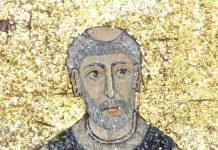

On this 13th day of August, we commemorate a little-known saint, Cassian of Imola, a Christian schoolmaster in northern fourth-century Italy. By edict of Julian the Apostate, he was commanded to offer sacrifice to the pagan gods, devotion to whom Julian was zealous to reinstantiate. Cassian refused, on the basis of the First Commandment, knowing such ‘gods’ were either non-existent, or, if they did exist, demons. Regardless, thou shalt worship the Lord God alone.
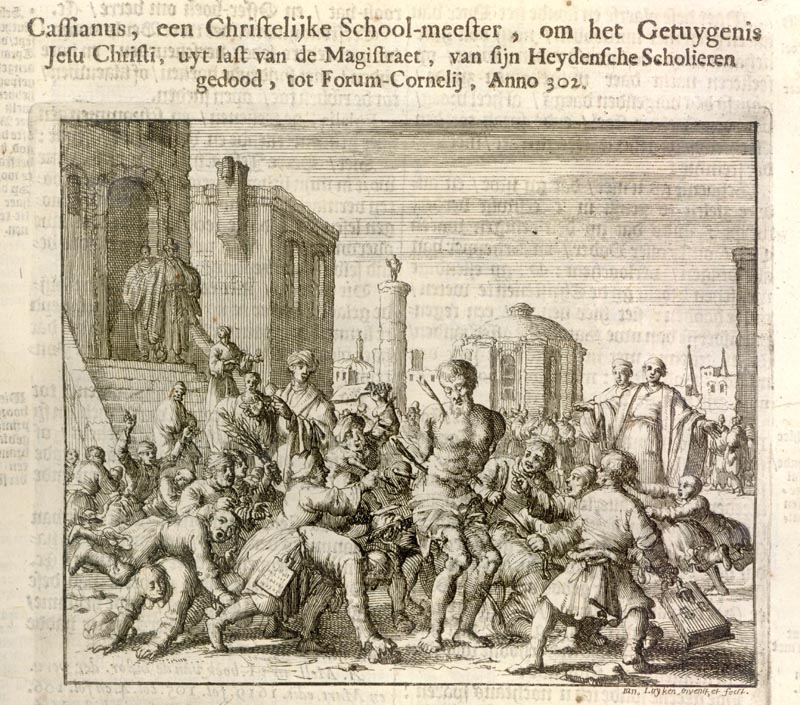
Cassian was condemned to be death, but by curious means: According to the legend, on this day in 363, he was bound to a stake and stabbed to death by his students with their iron styli (primitive writing pens for wax tablets). Said students were only too zealous, in retribution for the punishments Cassian had dealt out to them as part of his pedagogy. This was in the day of corporal discipline, which was the custom – and law – until not too long ago.
(Cassian’s death was not quite unique, for a similar story is told of the mediaeval monk and scholas John Scotus Eriugena in 877, who is not hailed as a martyr, for, whatever the actual manner and motive of his death, it does not seem to be in odium fidei.)
Saint Cassian of Imola is the patron saint of schoolteachers, whose students, we may hope, have more gratitude for the truths that are handed on to them. I have found it so, by the grace of God, and to Him be the glory. The late great Jesuit, Father James Schall, himself a highly regarded teacher, had a devotion to Saint Cassian, derived from discovering him via the character Ignatius Reilly in John Kennedy Tooles’ 1980 novel, A Confederacy of Dunces. Go figure, but God works in all sorts of ways.
We pray for teachers of every sort on this day, many of whom do suffer various kinds of ‘martyrdoms’ in their work, often hidden. May they see that what they offer in the classroom as part in Christ’s mission to evangelize, to go and ‘baptize’ all nations and bring many souls to heaven, along with their own.