

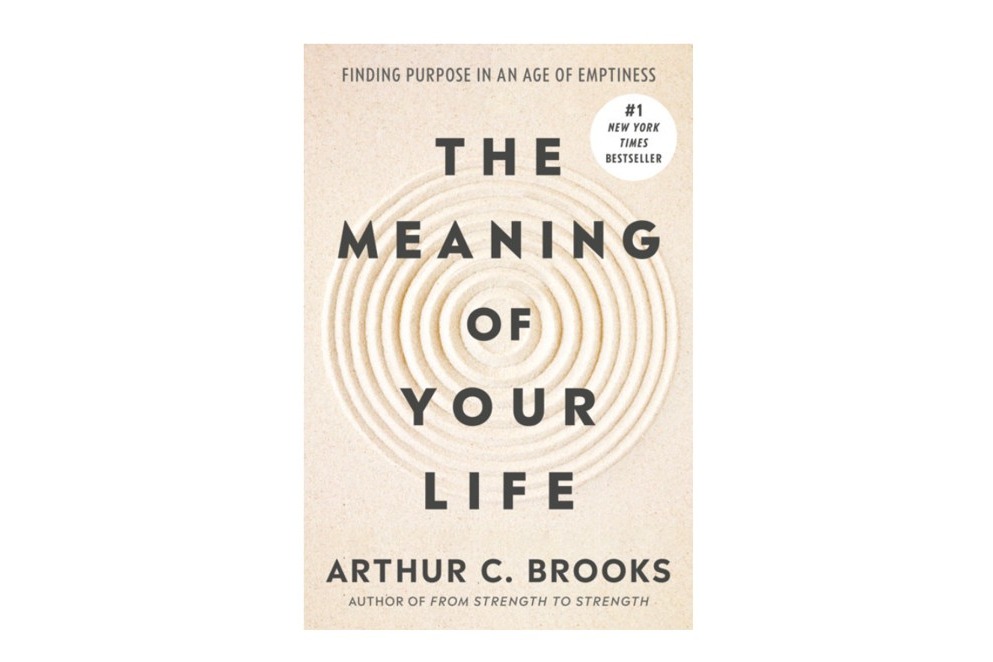
“Your life does have meaning, and you can find it.” – The Meaning of Your Life.
At a time when many young adults are fixated on professional growth and success, there is a parallel sense of emptiness that cannot be adequately understood or addressed. Fortunately, Arthur Brooks’ most recent book, The Meaning of Your Life, arrives as both a diagnosis and a remedy. Already a New York Times Bestseller, Brooks dives headfirst into this realm of absent meaning through an array of research on happiness, psychology, and social science to uncover perspectives and insights that push us ever closer to finding it. More importantly, while Brooks’ book is not rooted directly in religious guidance, it does help shed light on how Christians can approach this challenge and integrate these solutions more deeply into our faith.
A Lack of Meaning
Brooks begins his exploration of meaning by recounting his experience of returning to academia, in which “the atmosphere had darkened. . . [and] depression, anxiety, loneliness, fear, and anger were cropping up everywhere, especially among young adults.” Unfortunately, Brooks’ analysis is not unique.
Across social media platforms, young adults share the exhaustion of trying to find jobs in their fields, let alone ones that offer a sense of meaning. In the season of college acceptances, students often share how their worlds are turned upside down and how meaning in life seems to get lost when they are not admitted to a specific dream school, program, or internship. Even more commonly, Brooks notes that those who appear successful seem to lack a sense of meaning or purpose in their work. Rather, “there is a core emptiness to life as they drift from day to day,” he writes. Moreover, in such a busy world, finding meaning in the walk of faith can become difficult, especially when practices like prayer, reading Scripture, and attending Mass begin to feel like chores rather than integral aspects of our lives.
While this lack of meaning and purpose can be mentally debilitating, Brooks suggests we are not doomed. Drawing on real examples from real people, Brooks highlights how deeply these feelings can resonate with anyone, and how deliberate change can turn someone’s life around. Unlike other contemporary self-help books, Brooks does not reduce happiness to symbols of productivity, optimism, or simple perception shifts. Rather, Brooks’ data-driven approach combines theory with practical guidance and reflections that speak directly to the reader’s experience. However, to find and integrate the solutions, it will involve different forms of thinking and living than those we were trained or taught.
The Meaning Equation
As Brooks identifies the discrepancy between how people seek happiness compared to how happy they feel, he distinguishes the challenges we wrestle with into two categories: complicated and complex. Complicated challenges are hard to understand, but solvable. However, complex challenges are easy to understand, yet impossible to solve.
Brooks breaks down his approach to discovering meaning into an equation:
meaning = coherence + purpose + significance
While this may seem simple, meaning is, naturally, a complex challenge. Brooks suggests that “many big, complicated problems can be solved with knowledge, technology, and sheer intellectual horsepower. But meaning is not one of them.”
To find meaning, Brooks prompts readers to consider how these elements fit into their daily lives. Fortunately, the Christian life directly integrates the elements of coherence, purpose, and significance.
For example, for Christians coherence begins with a sense of Divine Providence in which God is at work in our lives, even when certain circumstances or events are difficult to understand. Purpose provides direction to our actions, whether through our vocations, family life, service, or contributions ordered toward the common good. Lastly, a sense of significance is crucial for feeling valuable. Christians may find that sense not only in our relationship with Christ and the community of believers found in the Church, but also in the charity we exercise towards others.
One palpable example Brooks shares to articulate this message is David Brooks’ (not Arthur’s!) book The Road to Character, which distinguishes “résumé virtues” from “eulogy virtues”. A résumé may be filled with titles, accomplishments, and works, but what is the legacy someone leaves behind? Will they be remembered as a caring and loving child, spouse, sibling, and friend?
As our Brooks notes, meaning cannot be simulated or found on a Google search. Instead, meaning can only be found by living. This realization should sound familiar, as it mirrors the Christian faith experience. A relationship with Christ cannot be simulated or reduced to technique or routine. It requires deliberate practice and exercise of prayer and community that keeps building over time.
Finding Meaning
As mentioned, while the equation for meaning is straightforward, living out the pursuit of finding it can be difficult. For Brooks, this requires us to start by asking questions, including our own “why?” For Christians, our “why” might include a sense of divine mission, such as the belief that God put each of us on the planet for a unique reason. Your “why” might differ from your spouse’s or coworkers’, so to understand your own why, Brooks notes that “you can’t know the meaning of your life if you don’t know yourself.” In this light, Brooks recognizes that while it can be tempting to think that finding meaning comes from the outside, it really begins within.
Brooks identifies love as an important factor in understanding meaning in our live. First, we must love ourselves, as loving ourselves reflects our belief that our lives matter. For Brooks, “if your life does not matter, your life does not have meaning.” From this personal love, outward love abounds. One example is friendships, where Brooks outlines the various forms of friendship under the Aristotelian tradition, such as friendships of utility, pleasure, and virtue.
While many people will experience each of these types of friendship, virtuous friendships bring true meaning as they are rooted in “willing the good of the other.” Christian readers may find a similar message in the Gospels, as Jesus says in John 13:34: “A new command I give you: Love one another. As I have loved you, so you must love one another. (NABRE)” Loving simply, without expecting anything in return, not only brings meaning but also brings peace.
A Lifelong Commitment
The Meaning of Your Life is full of wonderful insights. While some self-help books may fall flat for experienced readers and practitioners who have already heard many of the ideas discussed, Brooks skips the surface-level advice. Instead, Brooks meets every reader where they are at, offering a set of experiences and reflections that resonate directly and provide specific areas of action for those seeking deeper meaning in their lives.
Brooks concludes the book with a brief experience of the Camino de Santiago. He notes that “if you want to find the meaning of your life, you must treat life like the Camino – a pilgrimage that opens your mind and heart.” This wisdom touches home, reminding the reader that meaning is not a dead-end conclusion. Finding it, internally and personally, provides profound benefits, ranging from clarity about the purpose of our work to reasons to love those around us. More importantly, for Christians meaning is not something you find once in life, but something you continue to develop and cultivate throughout life, especially as we grow closer to Christ.