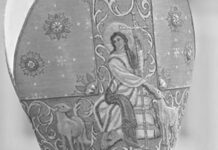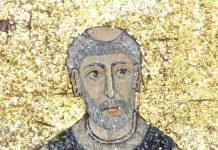

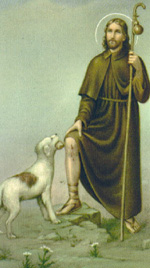
Saint Roch (1295 – 1376?) – also known as Rock, or, in Scotland, Rollox, not to be confused with the luxury watch brand which is almost a homophone. Roch, whose feast we celebrate on this August 16th, was a Majorcan confessor, perhaps originally from Montpellier. On a pilgrimage to Rome, he tended to plague victims, caught the disease, and is usually portrayed with the characteristic bulbo, or suppurating sore, of the plague on his thigh. But he recovered, returned to France, was imprisoned as a spy, since his uncle, who was the governor, did not recognize him, and Roch, perhaps in a desire to suffer as an unknown pilgrim, refused to identify himself. He was only known after his early death in prison by the cross-shaped birthmark on his chest, and miracles soon abounded. Saint Roch once had a widespread devotion in the Church. There is a beautiful church dedicated to him in Quebec City – but few Catholics likely know of him now. Here’s my impression from that pilgrimage of a few years ago:
My first stop was a large church, which I thought had likely been turned into a library or office space or just left abandoned, as so many have. I prayed at the front doors, then went along the side, and there on one of the doors was a paper note that said, in French (everything is in French in Quebec, by decree of draconian law) ‘Adoration from 11 to 2, Tues and Thurs’. Well, it was about 1 pm, so I went in, and discovered one of the loveliest churches I had ever seen, all to myself, in the darkened vast interior. It had everything: beautiful, artistic stained glass; high altar with a sanctuary big enough to hold nearly the entire Curia; double choir loft, with an organ – I discovered – that was one of the finest in all of Canada; and the woodwork, statuary, all profound and pristine. The church was dedicated to Saint Roch, of whom I have written before, but who is largely forgotten now, but there was a great devotion to him through the centuries. Finally making my way to the adoration chapel at the side of the sanctuary, I prayed with the few – again older – people. One of the men had written up a fine booklet on the stained glass, which he gave me; they were very proud of their church. A treasure, indeed.
For reasons that are unclear, he is the patron saint of dogs, and is often pictured with one. My brother has a golden retriever who was born on his feast, who was named, of course, Rocco. Saint Roch is also the patron saint of plague victims, invalids and bachelors, usually distinct groups, but which sometimes overlap, even if bachelors often have dogs, to make up for their loneliness. But, then, so do bachelorettes, perhaps even more so. Perhaps we need a canine-based dating service, and Saint Roch could be the primary intercessor for fruitful and happy marriages, with lots of children, as well as dogs, if they like.
Saint Roch, ora pro nobis! +