
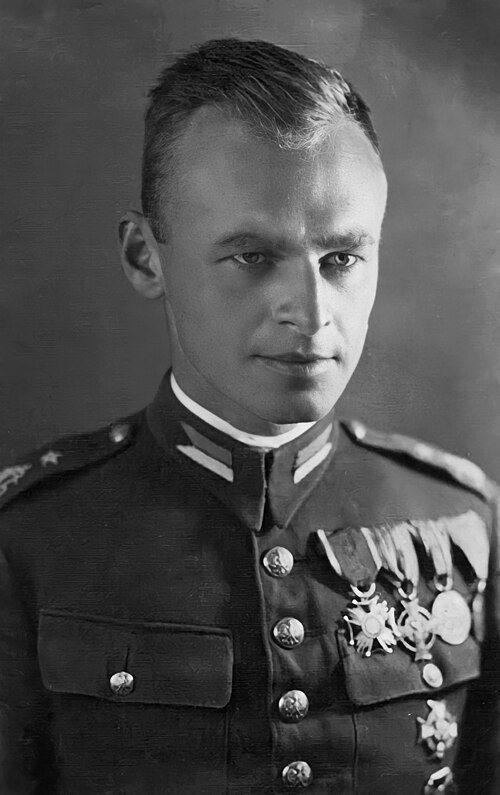
(Esto vir, God exhorts Moses in the Bible – Be a man! And few men were such ‘men’ as Cavalry Captain Witold Pilecki, as recounted here by contributor Paul Suski. A heroic example to us all, as we now face times such as his, where courage is called for)
May 25th marked another anniversary of Witold Pilecki’s death in Poland. Despite a plea for clemency addressed to President Bolesław Bierut, the execution was carried out in 1948 at 9:30 p.m. In this way, he joined the ranks of the “cursed soldiers,” who had died in combat or were murdered at the hands of Polish and Soviet communists.
Childhood and Turbulent Youth
A hero-of-heroes, Witold Pilecki was born on May 13, 1901, in Olonets, a small town near Lake Ladoga. His grandfather was exiled to Siberia by the Russian authorities for taking part in the January Uprising of 1863. It is little wonder, then, that Pilecki grew up in an atmosphere of intense patriotism and Christian values. He spent his childhood in Vilnius, where he quickly became involved in scouting and the independence movement.
When Poland regained its freedom in 1918, he joined the cavalry and fought in the Polish Soviet War (1919-1920), taking part, among other engagements, in the defence of Grodno and in the Battle of Warsaw in August 1920.
In 1931, Pilecki settled down, got married, and had two children – Andrzej and Zofia.
A Passion for Horses
His enduring bond with the military found expression in his regular participation in cavalry courses, notably with the 26th Greater Poland Uhlan Regiment in Baranowicze and at the elite Cavalry Training Centre in Grudziądz. It was there that he cultivated his lifelong passion for horsemanship. In the autumn of 1927, Pilecki purchased a mare, whom he affectionately named Bajka (Fairy Tale), and who remained his faithful companion until the opening days of the 1939 campaign.
Pilecki always marvelled at her extraordinary intelligence, which was proven in deeply moving circumstances. Once, while galloping through the deepening twilight, Bajka suddenly came to a halt. At first, the Cavalry Master could not fathom her resistance, but upon dismounting, he discovered a child lying helpless on the ground.
Tragically, this beautiful relationship was destined for a heartbreaking end. Pilecki later recounted that during the first month of the World War II, Bajka saved his life by taking an enemy bullet in her chest. She perished on the spot, as if consciously choosing to fall in defence of her Master.
The onslaught of the ‘Huns’ shattered his idyllic life and that of his family once and for all.
Bold Decision
In 1940, the German occupying authorities began establishing concentration camps on Polish soil. The growing number of underground resistance members being sent there, combined with the camps’ infamous reputation, influenced Witold Pilecki’s decision to have himself arrested and enter the extermination camp. Inside the camp, Pilecki planned to build an underground network among the prisoners and compile a report on German Nazi atrocities. As it later turned out, no one else, before, or since, ever accomplished such a feat.
Survival in Auschwitz
On September 19, 1940, using the assumed name Tomasz Serafiński, Pilecki allowed himself to be captured during a street round-up in Warsaw. He was sent to Auschwitz in what was known as “the second Warsaw transport”. From then on, he no longer had a name, only number 4859. Very few of those initial transports survived.
In Auschwitz while working as a slave and battling pneumonia, Pilecki organized the Union of Military Organizations (ZOW), which brought together all the political factions of the time. Years later, he wrote that something similar could likely never have been created under peacetime conditions. In the face of death, people were able to forget what divided them. Just a month after his arrival, he smuggled out his first report describing the conditions “behind the wire.”
The core cadre of ZOW consisted of imprisoned former officers and soldiers of the Polish Army. At its peak, the organization numbered between 800 and 1,000 initiated and sworn members. The Union sought to help prisoners survive by using the resistance to supply food, warm clothing, and medicine from outside. Weapons were also stockpiled in preparation for an armed uprising. For his merits, Pilecki was promoted to the rank of lieutenant in the autumn of 1941. Another valiant man whom he personally met in the same camp was Saint Maximilian Kolbe.
They managed to organize several small-group escapes, one of which had a plot worthy of a Hollywood film: On June 20, 1942, a group of heavily armed prisoners—led by Lieutenant Stanisław Jaster, who spoke fluent German—disguised themselves as SS men and drove out of the camp in a car belonging to Rudolf Höss, the commandant of the death factory.
Escape from Hell
Aware, and deeply embittered, that despite his reports neither the Polish Underground State nor the Allies would launch an attack to liberate the prisoners, Pilecki resolved to personally convince the Home Army High Command. Regrettably, the British deemed his report an exaggeration and thus excluded the use of the Polish Parachute Brigade.
They chose Easter Monday 1943, counting on greater laxity among the camp guards. First, through various camp connections, they had to be transferred to a Kommando that worked outside the camp, at the bakery. They volunteered as skilled tradesmen, despite having no clue how to do the work. It was also necessary to procure civilian clothes, tools for unscrewing bolts, shaving equipment, a substance to throw the tracking dogs off the scent, and potassium cyanide in case the escape failed. Ultimately, his two companions carried the poison; Pilecki refused to take it, believing that only God has the right to take a human life.
They had originally planned to escape after the first batch of bread, but reality, as so often happens, turned out otherwise. “The first, second, third, and fourth batches passed, and we were still unable to break out of the bakery,” Pilecki recalled. The hours passed inexorably. Drenched in sweat from the intense tension and suffocating heat, they drank the available water almost by the bucketful. They tried to lull the SS men into a false sense of security, making it appear as though they were utterly absorbed in their work.
Around 2 a.m., as the bakers laboured with superhuman effort, only the fifth and final batch remained. A brief break was ordered. Hardly had the guarding SS man stepped away when the bolts and bars on the steel doors leading outside were unscrewed. It seemed that the road to freedom lay wide open. Suddenly, they noticed that a guard had approached and was standing right on the other side of the door. They froze in absolute stillness, waiting with bated breath for the German’s savage roar. To their astonishment, he stood there for a moment and then walked away. Providence clearly watched over them. They dashed out, armed with invaluable intelligence information, hearing only gunfire behind them. With this, Pilecki gained the title of Polish wartime James Bond.
Once at liberty, he laconically summarized his time in Auschwitz as follows:
When I left, I had a few fewer teeth than when I arrived, and a broken sternum, so I paid very little for such a stay in this sanatorium.
Pilecki then wrote what became known as Witold’s Report, a detailed account of what was happening at Auschwitz for the Allies.
Loyal to His Country Until the Very End
On October 2, 1944, after sixty-three days of heroic, and solitary fighting by the insurgents against German forces and with no prospect of continued resistance, representatives of the Home Army General Headquarters signed an agreement to end hostilities in Warsaw.
Meanwhile, the Red Army stood by outside Warsaw, allowing the Germans to slaughter 180,000 civilians and 18,000 insurgents, while 85 percent of the buildings on the city’s left bank were reduced to rubble.
It should be noted that Pilecki fought in Warsaw’s Wola district, and the insurgent stronghold defended by his unit earned the moniker “Witold’s Redoubt” and was never captured by the enemy. Following the capitulation, Pilecki was sent to POW camps in Germany. His inmates, whom he looked after, remembered him as a deeply caring person, so him “Daddy.”
After the arrival of American troops in April 1945, he was in no hurry to leave the camp, wishing first to write an accurate report so that nothing would escape from memory or be misrepresented.
In July 1945, together with a group of officers from the Oflag, he reported to General Władysław Anders, who was stationed in Italy. There, Pilecki prepared for infiltration into communist-ruled Poland. His mission was to organize an intelligence network to gather all information regarding the situation in the country, including the activities of the NKVD (Soviet secret police) and the UB (Polish security service), the operations of the armed underground, potential electoral fraud, and Poland’s economic cooperation with the Soviet Union.
Arrest, Trial, and Execution
In June 1946, Pilecki received an order to leave immediately for the West due to the imminent threat of arrest. It was the only order in his life that he failed to carry out.
In May 1947, he was arrested and immediately subjected to brutal interrogation. After six months of torture, Pilecki told his wife during a visit: “I can no longer go on; they have broken me. Auschwitz was child’s play.”
On March 3, 1948, the sham trial of Witold Pilecki and the so-called “Witold’s Group” began. There, he dared to tell the Stalinist judge “I tried to live my life in a such a fashion so that in my last hour, I would rather be happy than fearful“.
The prosecutor charged him, among other offenses, with espionage, collaboration with the Germans, and the use of forged documents. The prosecutor allowed no cross-examination of witnesses for either the prosecution or the defence. He demanded the death penalty.
The Suffering of Loved Ones
Zofia Pilecka, his daughter, was only fifteen years old when the communist authorities executed her father. As if this suffering were not enough, the family was never informed of the execution; they could only guess and cling to the hope that their husband and father might still be alive, having merely been deported somewhere to the East.
More than four decades passed before the surviving family members learned the exact date. Furthermore, throughout all those years, they were harassed in various ways by the communist regime. His remains has never been found.
Zofia recalled on the air of Catholic Radio Maryja in 2012: “At one of the last hearings, when it was already known that he was going to die, my father told my mother to make sure to buy the book ‘The Imitation of Christ’ by Thomas á Kempis.” He wanted his wife to read passages from the book to their children every day. “This will give you strength,” she recalled her father saying.
Care for One’s Neighbour
Polish Catholic clergy ministered to and helped to shape the postwar “cursed soldiers,” often risking their lives and facing the threat of brutal interrogation. According to the memoirs of Father Antoni Czajkowski—who, like Servant of God, Bishop Antoni Baraniak a few years later, was also a prisoner in the Rakowiecka torture chambers—reveal that, while defending himself against the death penalty, the priest requested Witold Pilecki’s testimony.
In the courtroom, despite suffering immense pain from broken collarbones that left him unable to hold his head upright, Pilecki stated that he did not know Father Czajkowski, which contributed to the sentence being commuted to life imprisonment. Later, as a token of gratitude after his release, the priest celebrated Holy Mass at St. Stanislaus Kostka Church in Warsaw, vividly describing in his homily the torments Pilecki had endured.
Zofia also recalled an extraordinary story that shows Witold Pilecki’s devotion to his grandson, Mateusz. When her daughter Dorota gave birth by Caesarean section, the newborn was in a very serious condition and placed in an incubator. A doctor approached her and said: “You are the grandmother; please speak with your daughter, because she refuses to consent to disconnecting the child from life support. Please understand, this child will never see, hear, or walk…”
Zofia Pilecka was equally opposed to such, even if the child were to be born disabled. Later, when problems with absorbing food arose, she offered her daughter reassuring words: “Why are you worrying? Let Witold Pilecki worry about this. Leave it to him; do not cry.” Mateusz grew up into a perfectly healthy young man.
Chief Rabii Michael Schudrich of Poland wrote:
When God created the human being, God had in mind that we should all be like Captain Witold Pilecki, of blessed memory.
Conclusion and Epilogue
For Australians, patriotism involves more than a summer’s day at the beach on the 26th of January to celebrate Australia’s National Day. It is a love of country. It is a cherishing of the nation’s shared heritage, which is the legacy of settlers, pastoralists, farmers, miners and so on. And if such a need arises, to sacrifice one’s life. Perhaps young men in danger of becoming emasculated and overly cosmopolitan will find guidance by reflecting upon this real-life superhero, who offers them an example worth following.
About 68 per cent of Australians believe that their country’s involvement in a military conflict within the next five years is likely or nearly certain.
According to the Lowy Institute Poll of 2025, 52 per cent of Aussies said they would be willing to defend the Land Down Under if they were physically capable of doing so. Is it a lot or not enough? Only time will tell. Hopefully, Australia will not have to defend its land on its own.
The Australian Defence Force has been struggling to recruit sufficient personnel to meet its current needs. Indeed, only 20 per cent of Gen Z would be willing to make personal sacrifices to protect the country. Thus, Australia’s youth need to be re-taught how to be patriotic in a way that does not burden them with inherited guilt. Without instilling Christian values, love of country will not be awakened.
Finally, as long as we have ‘woke‘ governments running Australia, we will never regain anything close to what this Nation once was.
As Blessed Cardinal Stefan Wyszyński said: “A nation without history, without past, soon becomes a nation without land, a homeless nation, without future.”