
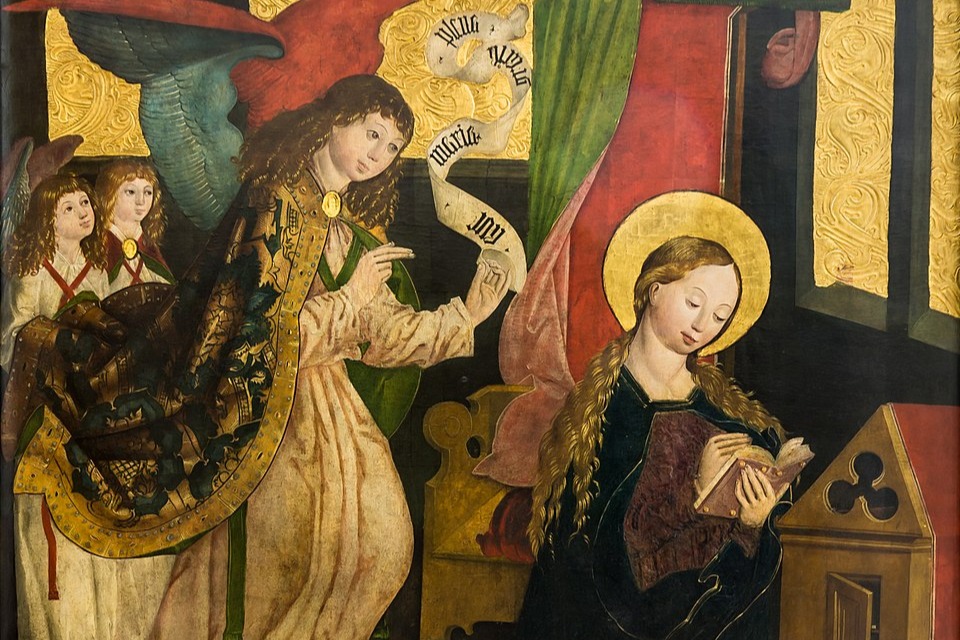
In the quiet village of Nazareth, far removed from centers of power and influence, a young woman named Mary was living what seemed to be an ordinary day. There were no signs that history was about to change. No crowds, no great gathering, no outward indication that something divine was about to unfold. And yet, it is precisely in this hidden and simple place that God chose to enter human history in a radically new way. The Angel Gabriel appears to Mary with a greeting that is both startling and deeply consoling: “The Lord is with you.” These words mark the beginning of the Annunciation—a moment not of spectacle, but of profound silence, where heaven gently touches earth.
Mary is troubled by this greeting, not because she is lacking in faith, but because she is attentive and humble. She does not see herself as extraordinary, and yet she is being addressed as one who has found favor with God. When the angel reveals that she is to conceive a son, who will be called the Son of the Most High, the weight of this moment becomes clear. This is not a small invitation. It is a call that will transform her entire life. And yet, Mary does not respond with immediate certainty. Instead, she asks, “How can this be?” This question is deeply human. It reveals that faith is not the absence of questions, but the willingness to bring those questions into dialogue with God. In Mary, we see a faith that is alive, searching, and open.
The angel’s response does not provide a complete explanation. There is no detailed roadmap, no assurance that the path ahead will be easy. Instead, there is a promise: “The Holy Spirit will come upon you… nothing will be impossible with God.” This is not an answer that removes all doubt, but one that invites trust. Mary is being asked to step into a mystery, to accept a future she cannot fully understand or control. She stands at a threshold between fear and trust, between holding on to her own plans and surrendering to something greater. In this moment, we see the profound respect God has for human freedom. He does not force her. He waits.
And then comes Mary’s response—one of the most powerful and transformative sentences ever spoken: “Behold, I am the servant of the Lord. Let it be done to me according to your word.” This “yes,” often called her fiat, is both simple and immeasurably profound. It is not spoken with full knowledge of what lies ahead. It does not come with guarantees of comfort or success. It is an act of trust, a surrender into the hands of God. In that moment, everything changes. God becomes flesh. Eternity enters into time. And yet, outwardly, nothing seems different. The world continues as before, unaware that the course of history has been altered in the silence of a young woman’s consent.
Mary’s yes is not a passive resignation; it is an active and courageous choice. It is the acceptance of a mission that will involve joy and suffering, clarity and confusion, light and darkness. She will carry within her the mystery of God made man, and she will also walk a path that leads to the cross. Her yes, therefore, is not a single moment, but the beginning of a lifelong journey of faithfulness. It is a reminder that true trust in God is not confined to one decision but must be renewed again and again.
The Annunciation speaks powerfully into our own lives. We too live in ordinary places, often unaware of the ways in which God is present and active. We too experience moments of invitation—times when we sense that we are being called to something more, something deeper, something that stretches us beyond our comfort. Like Mary, we may feel troubled or uncertain. We may ask, “How can this be?” when faced with challenges, responsibilities, or unexpected changes. These moments can feel disruptive, even unsettling. And yet, they may be precisely the places where God is at work.
The message of the Annunciation is that God does not impose Himself upon us. He invites. He speaks quietly, often in the hidden corners of our lives, and waits for our response. Our “yes” may not seem as significant as Mary’s, but it participates in the same mystery. Each time we choose trust over fear, generosity over self-interest, love over indifference, we allow something of God’s life to take root in us. We become, in a sense, bearers of His presence in the world.
In the end, the Annunciation is not only about a moment in the past; it is a living reality. It reminds us that God continues to enter human history, not through grand displays of power, but through humble and willing hearts. And so, the question remains for each of us: in the silence of our own lives, where is God inviting us to say yes?