
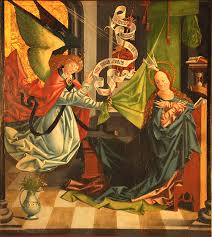
A very blessed Solemnity of the Annunciation to one and all! This March 25th marking the greatest event in history – the Incarnation of the Son of God – goes back to the very origins of the Church, and changed everything. What was lost, is now found, what was dead, is now very much alive. In all British territories until 1752, the Annunciation used to be New Year’s Day, and we still have an echo of that in our calendar, marking ‘Before Christ’ and ‘Anno Domini’, even if secularism has tried to modify that.
Fitting that this day also marks the traditional date of the Crucifixion, and, hence, each year is always a prelude to Easter, offering a moment of great joy in the most sombre days of the liturgical year. Even in Lent, we Catholics are suffused with hope and joy. The battle is won, and we just have to do our small part to gain the fruits of victory.
Anon, ad musicam, to offer some of that joy in an audible way.
The first is a motet by Thomas Tallis, O Nata Lux – the Light Has Been Born, from 1575. Read over the beautiful text in the video, here performed by Voces8:
The second is Bach’s cantata, Wie schön leuchtet der Morgenstern (‘How beautifully the morning star shines’) to mark the Annunciation (as well as Palm Sunday), which fittingly has the BWV number of one. The cantata was first performed in 1725 on this feast. The Lutherans venerated Our Lady, and this was the one day in Lent that festive music could be played:
And the third is Anton Bruckner’s Christus Factus Est, a veritable tapestry of beautiful polyphonic harmony, first performed in Vienna in 1886: