
(This is a longer read from long-time contributor Carl Sundell, which may well be his swan song, even if we hope for more from his delightful pen. Perhaps peruse this in sections, for there is much to be gained in this window of how men used to debate, even those who differed deeply, as gentlemen and scholars, with respect and dignity, taking time to hear the other, and respond to the point at hand and what was actually said. Would that we could return to such dia-logos, conversing and traversing together towards the truth!) Ed.
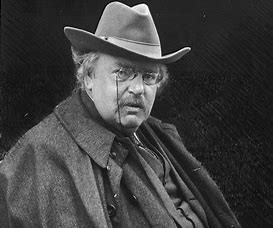
The amazing fact about the great public encounter between two popular giants of influence in their day is that there exists no transcript of the event. Various accounts have been provided by some who attended, and those reviews are substantially consistent with the verdict of the 3,000 members of the audience who were polled at the end of the debate. Chesterton prevailed by a vote of about 2,000 to 1,000. According to some notables who attended the debate and later recorded their observations, the performance of Darrow, who had so brilliantly trounced William Jennings Bryan at the Scopes “Monkey” Trial of 1925, was generally regarded as weak, inept, and uninspired, whereas Chesterton’s characteristic wit and insight were on full display. Moreover, Darrow seemed unfamiliar with and baffled by Chesterton’s references to recent scientific developments. According to economist Henry Hazlitt, who attended the debate, Darrow’s performance was on an “amazingly low intellectual level.”
Though there is no transcript of the debate, it is very possible that one can be reconstructed based upon the published writings of Chesterton and Darrow. What follows is an attempt, however speculative and tentative, to do just that.
(The moderator enters center stage as the lights dim and the audience goes quiet. Two elderly men enter from opposite sided of the stage and take a seat near the moderator.)
MODERATOR: Ladies and Gentlemen, welcome to what should prove to be a stimulating hour of thought, and dare I say entertainment, offered by what I will call two “warriors” of opposing views on a subject of considerable interest in our day: That subject is: Will the World Return to Religion? The rules for this debate are simple. Each party will present opening remarks of five minutes. Following that, each party will have two minutes to present a thought and have it answered within two minutes before going on to the next exchange. Closing remarks of each party will be five minutes.
A coin toss gives Mr. Clarence Darrow the first opening remarks. We look forward to them.
DARROW: First I want to thanks the members of the audience for showing up in such great numbers to hear a debate on a subject that once upon a time would not even be allowed in a public hall anywhere in the Western World. It is a sign of memorable progress that this debate is not only possible, but necessary, because the world is much divided, as it did not used to be, on the merits of religion. My own views are pretty well known, but I will try to summarize three of them briefly for those who may not know them.
First, I think religion has done more harm than good in the world. Infamous religious wars are well known by anyone with a decent education. That includes the wars of Christians and Muslims in the Middle Ages to the wars of the Reformation era between Catholics and Protestants. Then you have the hateful and violent relations between the modern Catholics and Protestants of Ireland, not to mention the Protestant discrimination against Catholics in our own southern states. It’s never ending isn’t it, or rather, it won’t end until religion itself ends, which I consider will be a happy time for the whole world.
Second, all religions presuppose the existence of a Deity who lords it over us all. I think no proof exists for any Deity. I know proofs have been offered, but they are fallacious and therefore not worthy of consideration. Faith is the right word to describe religion, because that’s exactly what religion is: faith, not conviction. All my life I have demanded proof for any extraordinary assertion, and that’s because I am no fool. I will not be led by the nose to worship the Deity of the Old Testament nor the So-called Savior of the New Testament, who has saved us from nothing that I can detect, because the world is a evil as it has ever been, maybe more so.
Third, I think that religion’s fundamental appeal is to answer questions that science cannot answer. For example: do I have an immortal soul? But it has never been shown to me that we have a soul, never mind an immortal one. Yes, we have consciousness, but that is all we have. We have no need of anything else but to improve our consciousness of what is going on in this world, not in some fairy tale world that exists somewhere beyond our dying breath. These are my opening thoughts.
MODERATOR: Thank you. And now, Mr. Chesterton, your opening remarks please.
CHESTERTON: Thank you. I had some opening thoughts prepared, but not the ones I am about to give, because Mr. Darrow’s three arguments need to be answered immediately and to the point.
First, Mr. Darrow, you say religion has brought many wars into the world. The Judaeo-Christian religion I am acquainted with forbids killing. I think that is a noteworthy Commandment that ought to be obeyed. It is a Commandment even worth fighting and dying for. Nine other commandments go with that one, and they also are worth fighting and dying for. That happened in the Middle Ages when Islam tried to sweep through and destroy the religion of Europe. Islam failed in its mission, and a good thing for you Mr. Darrow, for if all of Europe had become Muslim, it is doubtful that you would enjoy the freedom you have today to seek the end of religion everywhere, don’t you think? So then, you might want to rethink your position and thank your lucky stars that the Catholic Crusaders in those centuries stopped the armies of Islam and sent them home so as to preserve for you the right to attack all religion everywhere. I think if you ever attacked Muhammad in the Arab world, you might have to worry that someone might hang you on the tallest tree.
Second, as to whether proof of a Deity exist, there really are such proofs and I think they are more plausible than you allow. Great minds have thought so for many centuries. Such great minds as Copernicus, Galileo, and Newton are among them, so I think it may be unduly dismissive of you to suppose that fools alone can believe in God. Moreover, proofs fall into at least two categories: proofs of the head and proofs of the heart. Proofs of the head are mutable; you can talk yourself into them or out of them. Proofs of the heart are likewise mutable; you can open you heart to God, or you can close it tight as a drum. I don’t mind confessing that I went from a closed heart to an open one some years ago when it dawned upon me at last, that however tentative the arguments for God might be viewed, the arguments against the existence of God do not even exist. You must tell me who has ever proved that God-is-dead notion, as that mad German Nietzsche put it.
Third, I think the soul truly does exist. I think it contains powers that can understand and even tame the universe. I can understand the laws of the universe much as science can discover them, because I believe they come from a Lawgiver who has planted in us all a kind of logic able to approach the mind of God, as I believe Mr. Einstein puts it. We do not have mere consciousness, but also the power of spirit placed in us by God as a lifeline to the holy Spirit of God. Thank you.
MODERATOR: Thank you, sir. And now it is time for Mr. Darrow to challenge Mr. Chesterton for two minutes with two minutes rebuttal by Mr. Chesterton.
DARROW: Now I would like to ask my worthy opponent, would he please be so kind as to address the fairy tales embedded in the Book of Genesis? There are several, aren’t there? Take the one about Adam and Eve and the Serpent. A talking serpent no less. Then there is the absurd account of God taking only seven days to create the universe and everything in it. I can barely stifle my contempt for such childish and moronic tales. How did the author of them, whoever he was, expect people with a brain to believe in them? You should have seen and heard five years ago the hoopla played out at the so-called Scopes “monkey” trial in Tennessee, where I was pleased to defend in court a teacher of biology who was indicted for mentioning Darwin’s theory of evolution in his classroom. The beauty of Darwin’s theory is that it can be understood by anyone, even a child properly instructed. Moreover, Darwin proved his theory by finding fossils of ancient creatures that once roamed the earth but no longer do. And ever since Darwin it has been a clear fact that the Bible and Science must part ways.
MODERATOR: Now for your reply, Mr. Chesterton.
CHESTERTON: I think it will come as a surprise to my opponent that I agree in principle with almost everything he has said so far. Take the term evolution. Any dictionary will define evolution as the movement through time of a simple thing to a more complex thing. This is exactly how Genesis describes the Creation. First we have simple darkness. Then out of that darkness light is created. “Let there be Light!” After which the stars and the planets come to be. The earth is then created, every living thing on it, first the simple things in the sea. After which more complex things arrive. Life then moves from the sea to the air and the land. This is what the book of Genesis says. Then of course through time there was the creation of vastly more complex beings culminating in the appearance of the human race, which is surely the most interesting and complex creature God has made. So yes, I think I am an evolutionist too. I just think that Genesis, given the time in which it was composed, roughly a thousand years before Christ, was obliged to treat the matter of Creation in outline and metaphors, there being at that time no kind of science comparable to modern times. The talking serpent is a masterful metaphor, because the start of all evil in the world comes through the serpent, and we most of us agree that snakes for the most part are dangerous and deadly creatures. And yet, the progress of Creation in Genesis is quite on track with discoveries made in modern times. So I make no excuses for what you call fairy tales. They are consistent, and astronomers I have spoken with agree, For example, the physicist Sir James Jeans says that there is an account of creation in Genesis eerily consistent with discoveries in modern science.
DARROW: (Interrupting) But you see there isn’t really any need to assume a creation event happened. It is entirely feasible that the universe always existed if there is no god to create it, as I believe. We have that same view of no less a scientific authority than Albert Einstein. And by the way, to be consistent, if everything has to have a cause, why shouldn’t God also have to have a cause?
CHESTERTON: You raise a question I have heard before, and it’s an interesting one. The only answer I can suggest is that we need to define our terms more carefully, Everything we know of has a cause. But that principle of causality only applies to this world. The principle had to have been created, not caused. Cause it not the same as creation. If God created the principle of causality, clearly he is not subject to it. So God is not really the First Cause, as Aristotle put it, but rather the Creator of all causes. Being the Creator, God is not subject to causality, and therefore it is senseless to ask who caused God.
MODERATOR: Excuse me, but I seem to feel myself and the rules of this debate being a bit superfluous. I am inclined to let you both go at it at your own pace, so that we can eliminate the two minute rule.
CHESTERTON: An excellent thought. (Turns to Darrow) So let me jump in and answer your remark about Einstein who, I believe you are right, did believe in an eternal, that is to say, uncreated universe. At least until recently. Georges Lemaître, a Belgian mathematician, worked out Einstein’s equations for general relativity and found that Einstein had fudged the math to keep the universe static and eternal, which he and other scientists assumed to be the case. But Lemaître, following Einstein’s math, saw the error Einstein had committed, corrected it, and from that correction deduced that the universe was expanding. Working backward through time, he was able to conclude that the universe must have begun as a very dense Primeval Atom, so to speak. Just last year the astronomer Edwin Hubble with his famous telescope proved that, indeed, the universe is expanding, which argues for a starting point for the expansion itself. In other words, a point of creation. Hubble is an American astronomer. Did the American press not report this remarkable confirmation of Lemaître’s theory?
DARROW: (Chuckling) Well, I Never heard of it. Surely you are pulling our collective leg!
CHESTERTON: (Chuckling) Let me pull it for you again. Lemaître happens to be not only a mathematician, but also a Catholic priest, who of course was not biased against the idea of a created universe, and who therefore was not reluctant to tell the truth that it seems Einstein wanted to avoid. My friends in England tell me that since Hubble’s discovery, Einstein is sure to now admit his mathematical blunder and concede that the universe had to have been started up at some point in time. So it seems that Genesis had knowledge of the creation event thirty centuries before modern science could bring itself to discover that the universe began at a certain point in time.
DARROW: Even so, I find the story of the serpent tempting Eve to be rather ridiculous. How can that be a metaphor for anything that ever really happened?
CHESTERTON: Well then, you know even the theory of evolution has to allow allow for a first human couple, or where else did all the other couples come from? The first human parents presented a new problem for life on earth. That problem is the problem of their being able to relate to a Creator against whom they were free to rebel. All other animals in Creation are quite content to be who they are, and cannot even imagine a Creator never mind raising themselves to equal status with that Creator. But now you have the human, who is tempted by the worm inside him to play at being God, at becoming equal to God, or in the case of those who choose not to believe in God, better than God because they have reduced God to a Zero.
The arrival of the first parents, according to the book of Genesis, is an entirely new phenomenon never seen on earth before. So the lesson of Adam and Eve which the Bible teaches, is that this kind of pride and arrogance, the desire to be as God, will do us no good. We will be undone by our own ambition to be so godlike, and hasn’t that played out fairly well through history? Take, for examples, how the great ones ended their stupendous careers: Alexander the Great, Julius Caesar, Napoleon, all the tyrants of history have in the past and will in the future be defeated by their own ambitions to play God over the rest of us. So I think the serpent in the Garden is a possible temptation within every one of us, the worm that is in each soul, and Genesis is just showing us how that first temptation to be God became possible when humans at their first creation knew not guilt, but then had to learn it the hard way. Does any other animal in all Creation know guilt? If not, why not? Because we alone were gifted at our creation with the knowledge of good and evil, and that opposing the good will wound our conscience sometimes beyond even what it can endure, which can bring on mental illness or even suicide.
DARROW: Your attempt to equate the mysticism of Genesis with the profoundly rational and original science of Darwin is laughably irrational.
CHESTERTON: When God finally got around to creating the first humans on the last day of Creation, perhaps all the other animals on earth did find Man to be weird, but not so laughable, since they all were destined to be useful to man as possible food to nourish his existence, leather to clothe his body, beasts of burden to carry him about and to plow his fields.
DARROW: Well, Genesis aside, you can’t really deny that there is a deep divide between science and religion. The enmity through recent centuries has been spectacular.
CHESTERTON: I thought you would bring that up. The so-called enmity only began after Darwin appeared on the scene. Before him there was no enmity at all between science and religion. Even the case of Galileo was not a policy of the Church persecuting science, but rather an unfortunate personal grudge between Galileo and the Pope. The greatest scientific minds of the pre-Darwin era affirmed the existence of God, including Galileo, Copernicus, Kepler, Newton, etc.
DARROW: I’m sure you heard of the Scopes “Monkey” Trial a few years ago, where I had the pleasure of defending a Tennessee teacher prosecuted for teaching the theory of evolution in his high school biology class.
CHESTERTON: And you defended him fairly well as I recall from Mr. Mencken’s newspaper accounts of the incident. But that was all blown out of proportion by the fact that the citizens of Tennessee regarded the theory of evolution as a direct blow to the Genesis account of Creation. Evolution was actually being used by many to attack religion in general, just as you attacked it several minutes ago. But the enmity began on the scientific side, not the religious side, and I think that if you examine the history of the Vatican’s pronouncements you will find no opposition or condemnation of evolution as a theory, though I’m sure the Church, as did the people of Tennessee, will punch back at any effort to use Darwin as a way to dismiss God’s role in the Creation of the world and our place in it. The Church has in principle always been a friend to science, and even now the Vatican has maintained, since the 16th century, an observatory and an astronomer who studies the stars.
DARROW: Studying the stars is one thing. Being convinced that they lead us to God is quite another. Consider the vastness of the universe and our paltry place in it. No sir, none of the so-called proofs for God are persuasive. I grant you that neither can God be proved not to exist, but I find the existence of a Deity to be irrelevant to me. I am indifferent to whether God exists, whether I have a soul, or if my soul is immortal. I treasure my animal comforts. I am content with them and just as the universe appears to be indifferent to me, I am indifferent to the very idea of God.
CHESTERTON: All the other animals treasure their animal comforts. Can you not see that something in all of us demands more than animal comforting? We cannot imagine a square circle because no such thing can exist. And for that reason I am indifferent to opposing the existence of a square circle. Why is it we can imagine God, angels, and demons if no such things can possibly exist? If they can possibly exist they are not a contradiction, but only a mystery, why not allow that they do indeed at least possibly exist?
DARROW: I put God on a par with Santa Claus and the Tooth Fairy. I might hear you talk about all three, but I, for one, cannot imagine their actual existence, so that is a moot point for sure. Let us move on to more serious matters. As for Christianity, which is the most popular religion in Europe and the Americas, I think that is the religion we both want to talk about tonight. Now the history of Christianity, despite the preaching of love by its alleged founder, is full of violence and terror, so I think anybody who knows about the Crusades and the Inquisitions knows what I am talking about. Surely you don’t deny that the dark ages are full of the sins of wicked churchmen exercising the authority of the Church to suppress freedom of thought and the free exercise of our sexual passions.
CHESTERTON: You may be surprised to hear that I agree with much of what you have just said. The Church did use its powerful authority over the minds and heart of men, but it did so with better effect than you seem to imagine. At the end of the Roman Empire, when things were falling apart because a vicious kind of paganism had elevated military conquest over the conquest of human sin, history reversed course and the Romans gave up Mithras, the god of war, for Christ, the Prince of Peace. As for the sinfulness of Church leaders, that was a given fact of history that was inevitable. Right from the start. one of the apostles betrayed Jesus, another one denied him, a third doubted his resurrection from the dead. Some of the successors of the apostles have shamelessly lost true allegiance to Christ ever since. But that is no argument against Christianity, it is only an argument for the power of the Church to cleanse itself, a power that has lasted 2,000 years and may well endure until the last days. I put it simply this way: corrupt physicians and lawyers are no argument against the professions of medicine and the law, so I hardly can think corrupt priests and bishops can be an argument against religion. Now I have a question to ask that needs a very precise answer: if all religion were eliminated from the world, as I think is your preference, how would that make the world a better place? I mean, how would people feel better about themselves and behave better in such a world? How would they be lifted up in any way by the conviction that the universe has no specific reason for existing, nor are humans designed to serve any purpose in the universe but are mere chance products of evolution?
DARROW: Much time and attention wasted on religion would be better spent elsewhere. By the way, I am not an atheist, I am an agnostic. I agree that that atheism is a dead end because you cannot logically prove there is no god of any kind. But you can doubt the existence of gods because you cannot prove any god exists. For that matter, if you say everything has to have a cause, what caused God? So agnosticism is the belief that you can doubt everything you think you know.
CHESTERTON: May I interrupt you there? If nothing can be known for a certainty, how do you get people to agree on the most important things such as morality? Religion has always been the glue that holds people in agreement to a certain moral code, without which moral anarchy would reign. If everyone can invent his own morality, as Joe Stalin has been doing for some time in Russia and also Mr. Hitler and his Nazi party in Germany, both godless men by any standard, what is to prevent them from becoming the greatest monsters in human history?
DARROW: I think common sense will help us all get to the true, the good, and the beautiful. Yes, agnostics tend to provide many moral compasses that don’t agree with each other, but that can’t be helped. Even religious people don’t agree with each other about right and wrong. Look at the difference between how Mormons and Christians view marriage.
CHESTERTON: As a lawyer, you know that the laws of any nation are rooted in the requirement for moral solidarity, or else anarchy reigns. In court we swear to tell the truth “so help me God,” not “so help me myself,” or “so help the devil inside me.” So there must be compelling truths that we must acknowledge. Only religion compels us to seek the truth and tell the truth. It is the devil inside us, the worm, the serpent, that tries even to devour truth and make it a poison of lies to be told to others and to ourselves.
DARROW: The reasons for agnosticism and skepticism are abundant and compelling. The more we repudiate religion, the more we are free to inquire into the mysteries of nature. Modern science, freed from religion, has built hospitals and done research to cure terrible diseases. Modern science has built universities that pass on the torch that illuminates the secrets nature has kept from us. Through science we have built railroads and bridges, large buildings and small, plumbing for sanitation, methods of agriculture to feed millions, and so many other great things.
CHESTERTON: I would only hasten to add, as I mentioned earlier, that many great scientists have been, and still are, religious, so I don’t see how or why you should say that religion has been an impediment to science. I think of Thomas Jefferson’s warning that science may one day produce weapons so vast in their destruction of life and property that we will have to hold our devotion to weapons in check by the biblical injunction against murder. In this matter surely science and religion ought to find common ground, don’t you think?
DARROW: I would put it another way: science and common sense may find common ground if religion will just get out of the way.
CHESTERTON: Well, it’s a certainty that godless men will not let religion get in their way. Herr Hitler, for example, for I’m inclined to believe what I have been told, that he has neither religion nor common sense. So there is every reason to believe that if he ever gets to lord it over Germany, he will lead the entire world on a wild and furious ride to annihilation. The morality commanded by evil men will always challenge the morality commanded by God, for such men want to command not as if they are God, but as if they were the Devil himself. It was so with ancient emperors and will be so with modern tyrants. They do not have the fear of God in them because they think they are the only supreme beings in the world. .
DARROW: I don’t doubt for a moment that such self-made gods are far worse for humanity than your imagined Christian God. The ancient emperors who declared themselves to be gods were of course insane. They were no better than your Adam and Eve who wanted to become as gods themselves.. It was because they did not doubt the existence of the gods that they could suppose themselves to be gods. If they’d had a healthy skepticism of Zeus and Apollo, they probably would not have been tempted to so ridiculously deify themselves.
CHESTERTON: But here we are with that Marxist atheist Joe Stalin in Russia who declares himself the arbiter of life and death for millions of Russians. That is the madness of an atheist who has a very unhealthy skepticism of Christianity, a madness that I fear has far exceeded already in just ten years the worst and cruelest atrocities attributed to so-called Christians over the past twenty centuries. Stalin has already exerted himself to destroy Christianity in Russia, Hitler, if successful, will do his worst to destroy both Christianity and Judaism in Germany and anywhere else he can do so. These are two godless giants of our century who are going to make a first rate mess of things unlike any other century in human history.
DARROW: Perhaps, but perhaps not. You have to churn up the ground to plant new life. Religion is a dying institution that needs to die in order to give new and better life to the world. Socialism will do that. Just waits and see. No more pie-in-the-sky, just cookies and ice cream here below.
CHESTERTON: What proof do you have that life will be better without religion since the world has never been entirely without it? Good religion should inspire noble feelings and virtuous acts, no? The commands of religion to feed the hungry, clothe the naked, shelter the poor, attend to the sick, visit the imprisoned, and so forth are all the positive products of religion. Add to all that the prohibitions of religion against lying, adultery, killing, etc. The Church, ever mindful that actions have consequences, always reminds us of the reality of heaven and hell. But who who is going to show us how to escape perdition, if not the one who did so by the redeeming power of the cross?
DARROW: I just knew that sooner or later we would have to address this question of the soul and immortality, neither of which I believe in. The existence of the soul is a Christian fiction, the absurdity of which is matched only by the notion that this soul is immortal and will not escape perdition if we don’t obey the dictates of your fictional God. Tell me who has ever died and returned as proof of these invented superstitions?
CHESTERTON: That would be Jesus Christ himself. And he was not an invention, but a person who actually lived, died, and returned to life for the purpose of giving us all hope that there is life beyond death and each of us needs to prepare for that life.
DARROW: Yet another fiction invented by disciples for the fools who would believe them. But even if I grant that the gospels are authentic documents proving the existence of Jesus, they do not prove themselves to be reliable accounts of what he preached and the miracles he supposedly performed. Religious charlatanism is all around us, as I found to be so in Tennessee. They will say anything and promise pie-in-the-sky for the simple folks who are easily conned. The early Christians, I do believe, were easily conned by superbly efficient con artists.
CHESTERTON: It’s because you will not believe in God that you cannot believe in miracles. But the whole of Creation is a miracle. Surely the Creator, who set down the laws of nature, is powerful enough to interrupt those laws by His will. Such interruptions should be called miracles. Nor can you believe that God entered the world in the person of Jesus Christ at precisely the moment the world desperately needed to be halted in its hellish downward spiral toward spiritual entropy and death. The Gospel of John refers to a saying of Jesus that embodies the reason for his presence on earth: namely, no greater love has a man than this, that he lay down his life for his friends. For to Jesus we are all his friends, from Adam to the present day surely, Why shouldn’t we accept his sacrifice to prove his point that we are created friends who are worthy of his suffering and death to atone for the great sin of Adam? The disciples of Jesus, whatever their personal failings may have been, were surely sincere about witnessing the life, death, and resurrection of Jesus. That sincerity was tested by their frequent imprisonment and eventual execution, just for believing that what they did was a mission commanded by Christ to go forth and baptize all who would agree to being baptized in the name of the Father, the Son, and the Holy Ghost.
DARROW: You keep returning to the same two assumptions, that there is a God, and that we are composed of something besides our atoms, namely the soul. I accept neither of these assumptions as proven or even likely.
CHESTERTON: Perhaps you have not read Plato’s dialogue Phaedrus, in which Socrates uses reason to prove not only that the soul exists, but is immortal.
DARROW: I have read it. A more endless trail of painful logic-chopping I have not seen. I should know because in the courtroom I have done plenty of my own logic-chopping. I am an Agnostic because I am not afraid to think. I am not afraid of any god in the universe who would send me or any other man or woman to hell. If there were such a being, he would not be a god; he would be a devil.
CHESTERTON: But that is not Christian theology. God does not send us to hell. We send ourselves. In the case of the atheist who wants nothing to do with God, hell or nothingness would seem to be the preferred options. But my guess is that the average skeptic, at the hour of death, will suddenly find a reason to have doubts about his doubts. The reason is that nothing is more dreadful than eternal nothingness. But I suppose the fellow who has spent his life testifying against religion will find deathbed conversion the most difficult struggle in the world. After all, his disciples, who like him so much because he agrees with them, will not like him so much if his doubts falter and fail to support his conviction that there is no God. I suspect that time and time again deathbed conversions are easily made, openly or secretly.
DARROW: Such last moment betrayals of rational thought prove only that the rationale for disbelief had not been thought through with real conviction in the first place.
CHESTERTON: Well now, that would be part and parcel of the skeptics creed, wouldn’t it, that nothing is certain except that nothing is certain?
DARROW: Yes, that is my creed. In spite of all the yearnings of men, no one can produce a single fact or reason to support the belief in God and in personal immortality.
CHESTERTON: What I hear you saying is that there is no good being religious if you can’t prove God or immortality. I’ve heard you and other agnostics speak of all the bad things done in the name of religion. I’ve not heard you speak at all of the good things done in the name of Christ. But it cannot be argued that the wisdom taught by Christ has had a wicked influence on the world. Christianity has been an enormously positive force in the history of humankind. It has nurtured in us the idea that we exist for a purpose; that we have the free will to manage ourselves with the help of God in attaining that purpose; that we have immortality to strive for rather than oblivion to approach with fear and trembling; and that we have a God who loves us and is willing to forgive our sins if we are but sincere in asking that forgiveness. Christianity has a track record comparable to no other world religion. Until Christ overcame the Roman Empire, there was worldwide traffic in slavery that had been justified even by Plato and Aristotle. But in your country it was Christians who led the movement to abolish slavery before the civil war. The savage entertainment offered by bloodletting Roman gladiators ended only after the victory of Christ over Jupiter. From the time of Constantine on, Christian hospitals were built everywhere in Europe as a visible sign of Christian charity. The Catholic popes helped to unify the culture of Europe by making Latin the universal language of the Church and scholars everywhere were helped by the fact, and thankful too, that they could exchange ideas in a language they all could speak.
In the 13th century, risking the wrath of King John of England, Catholic Archbishop Stephen Langton promoted the Magna Carta, a treaty that began the long movement away from ruthless monarchies toward parliamentary government in England and Jeffersonian democracy in America. Catholic monks invented the medieval university system that paved the way toward the Renaissance and the scientific revolution. A Catholic, Johannes Gutenberg, invented the printing press, making books easy and inexpensive to market, which in turn encouraged the literacy required to read those books and the growing scholarship that followed.
Any competent historian has to admit that before Christianity triumphed there was no spreading empire anywhere in the world whose central, pervasive, and constant moral teaching was, “Love God and one another.” Nor was there ever a religion that so convincingly offered to frail humanity the hope that somewhere beyond this life there is final justice and mercy that cannot always be found in this world. Whenever and wherever in the world Christianity has failed, or gone into gradual decline, or Christians have engaged in bloody excesses, it was always because there was not enough Christianity, not because there was too much. The Christian ideal has not been tried and found wanting. It has been found difficult, and left untried.
DARROW: More delightful pie-in-the-sky I have never heard. Religion makes people happy? So does laughing gas. So does whiskey. I believe in the brain of man. I’m not worried about my soul. If there has been much progress in the world, it is because there is a law of nature that progress is inevitable, with or without religion.
CHESTERTON: But in the Western World there has never been so much progress in many fields of endeavor at the pace measured from the time of Christianity to the present. Your argument seems to be that Christianity impeded all that progress when it was really the escort of progress through every century. But now I have a question for you. Can you explain to me why it is that Darwin’s theory of evolution so radically changed the philosophical landscape to the advantage of atheists and agnostics?
DARWIN: That easy enough to answer. Darwin showed that life has evolved by very slow stages through endless time, and that each new life form was the result not of design, but of the fact that each new form, or mutation, found a way to survive that usual members of the species failed to have. Therefore, the mutation would reproduce itself successfully and from then on the survival of the fittest was the result of chance mutations, rather than some Sky God putting it all together by clever design.
CHESTERTON: But that is an interpretation of what Darwin said, not what he said. I thought I might need to read to you this quotation from Darwin’s autobiography: (Removes a sheet of paper from his pocket and reads aloud: “Another source of conviction in the existence of God, connected with the reason and not with the feelings, impresses me as having much weight. This follows from the extreme difficulty or rather impossibility of conceiving this immense and wonderful universe, including man with his capacity of looking far backwards and far into futurity, as the result of blind chance or necessity. When thus reflecting I feel compelled to look to a First Cause having an intelligent mind in some degree analogous to that of man; and I deserve to be called a Theist.” (Returns the paper to his pocket.) So it still puzzles me that atheists and agnostics cite Darwin as the justifying source of their creeds when Darwin affirmed that he was a Theist. Moreover, in the book of Genesis, doesn’t God say “Let us make man in our image and likeness”? So isn’t that exactly what Darwin said when he talked about a “First Cause having an intelligent mind in some degree analogous to that of man”?
DARROW: You should remember that Darwin was at the front of a revolution in biology. Being a man of great prominence during the Victorian era, he had to be careful about offending the Queen and the Archbishop. He chose to not risk attacks from the traditional quarters, so I think he had a failure of nerve when he wrote what you just read to us. Were he living today in America, I say he would have been much bolder about drawing the conclusions that so many skeptics in our time have drawn.
CHESTERTON: Poor Darwin, another victim of those who want in later times to alter by speculation the sentiments of those who lived long before them. I suspect that writing his autobiography late in life, long after his theory had become a smashing success in scientific circles, that he really had nothing to lose by telling the truth as he saw it. He certainly was a theist, not an atheist or an agnostic, and it is an insult to his honesty to say that he did not really mean what he said
DARROW: Even so, the scientific community has come to accept Darwin’s theory as more truth than fiction, which is more than can be said for the so-called miracles of a legend who supposedly lived two thousand years ago but may have been entirely a fiction.
CHESTERTON: Yes, it’s become something of a national and international pastime among some scholars to doubt that Jesus, and even Moses a thousand years before him, ever lived. That would be, of course, the quickest and easiest way to rid the world of Judaism and Christianity. But the deniers have the crushing weight of 20-30 centuries against them. The memory of the human race in the West has a very important heritage having been shaped first by Moses, and then by Jesus. Those who would like to abolish that memory have quite a task ahead of them.
DARROW: Your entire belief system rest upon the belief that you have a soul, and your soul is immortal. I believe that the soul is a misnomer for something very real, namely the mind, and this mind depends for its very existence not upon God, but upon a collection of neurons firing away for all they are worth in that physical part of us called the brain. These are things we know for a fact: that the human brain, not the soul, begins as almost a blank tablet, grows in its immensity, engages in powerful and world shaking calculations for a time, then begins to relax with old age and finally falls into dementia and imbecility with death just around the corner. But some brains resist this scenario for all they are worth. They imagine an ephemeral part of themselves, a spirit if you will, that guides them here and there with a great destiny in mind, to become immortal at the very point the brain dies.
CHESTERTON: There is a problem with this way of thinking. All the content of the human mind (as opposed to brain) is not physical, nor is it a miniature reproduction of what goes on in the material world. Mathematics, for example, has no mass, volume, or any other physical attributes. That being the case, as Plato noted, how can mathematics exist or be conceived but by a mind that has no mass, volume, or other physical attribute … in other words, the human mind? But isn’t this a definition of soul as opposed to body, the lack of mass and volume? The brain resides in the body, so it must have mass and volume, but the mind resides in the soul. So I conclude the human mind can compose images it has never seen in the material world, and can imagine and even sense a world of spirit that exists but is not visible to the senses. This is the defect of skepticism, that it cannot abide the existence of a thing that cannot be subject to physical measurement or testing. The human mind, one could say, is the halfway house between the physical brain and the soul.
DARROW: I confess, I don’t know what you are talking about.
CHESTERTON: Because you have not opened your mind to the possibility of a dimension of reality that does not conform to your expectation of what is real. Now you said earlier, as I recall, that you are not atheistic, but really an agnostic. Yet I detect that everything you have said so far is against God, the soul, and religion in general. So I wonder if there really is much difference between atheism and agnosticism. If you are not with God, are you not against God, as the Scriptures tell us?
DARROW: Yes, and I also said everything should be doubted except the principle that everything should be doubted. That is certain.
CHESTERTON: But if there can be one certainty, why can’t there be others? The one certainty you allow seems exceedingly narrow.
DARROW: Doubt everything else is what I say. Doubt is at the heart of discovering the impossible to be true. Men said we cannot fly. Ah, but the doubters who doubted that certainty found a way to prove it false. We can now not just fly, but fly across the world! Perhaps one day we will even fly to the moon.
CHESTERTON: I grant that doubting those who say a thing is impossible might be the wrong thing to do in some instances. But across the board, I think not. Would you doubt the moral axiom against the act of murder? That is a basic teaching of religion which does not exist as a basic tenet of atheism, since atheism by itself is not against murder, and actually results in the murder of God.
DARROW: But I believe there is no God to murder. If there is murder at all, it is only the murder of a delusional Sky God. Nietzsche said that God is dead and we have murdered him.
CHESTERTON: I think you are right to say you believe this. You have faith in your disbelief no less than I have faith in my belief. A sort of stalemate there, would you say?
DARROW: Possibly, but we have strayed somewhat from the theme we set out to debate. Will the world return to religion? What evidence if any do you have to offer that it will, because it seems to me that the whole trend of modernity is against religion. I think the rise of modern science has something to do with the continuing fall of religion. I also believe that the rise of socialism is imminent in America, and that will give us a heaven on earth rather than pie-in-the-sky Christianity. What say you?
CHESTERTON: Since the rise of modern science can say nothing to us about God or the soul, and cannot say anything because its methodology is so strictly materialistic, I think what you suggest is only possible if at all in a peripheral way. That is, some people mistakenly believe that science must be more reliable than religion in the art of answering the great questions of life: But look at those questions! Why does the universe exist? Why do I exist in it? Is there a God over all things? Does that God love us all? Does that God love us enough not only to give us life in this world, but perhaps has prepared a life for us in the next world? Science can tell us nothing whatever in answer to these question. We must turn to reason and faith to answer them. Religion is and has to be a mixed bag of reason and faith. Great theologians have proven this to be so when they show how reasonable the doctrines of faith can be as they answer the profoundest needs of our human nature. Now there are many religions in the world, but none so dedicated to answering these questions as the religion of the Jews first, and later that of the Christians. The needs of our human nature are to be found in the desires of the heart. That is why Jesus is so often depicted in art with a flaming Sacred Heart. That is why religious hymns are more beautiful than any other type of music: they resonate with the desire to connect our hearts with the Sacred Heart. There is no other explanation for the power of sacred music than that it brings us closer to God than anything else can. It’s curious, isn’t it, that one never speaks of atheistic or agnostic music?
DARROW: I don’t doubt for a moment that religious music has its appeal to many, but it has no appeal to me. I easily avoid it because it seems to me so much founded upon a sickening preoccupation with the fear of death. Sacred music is a sentimental lie that some desire should be true that is merely pie-in-the-sky wish fulfillment.
CHESTERTON: Again, you are assuming that the desire for God and immortal presence in His company is unnatural. I agree that it is not natural because it is supernatural, which is why your senses cannot confirm the truthfulness of it. Having dismissed God as a reality, it’s easy enough to dismiss what you call pie-in-the-sky. But if God does exist, and did create us for a purpose, why would that purpose have to end in the grave? What would be the point of God making us to live in time but not for eternity?
DARROW: Exactly so. But since there is no God to believe in …
CHESTERTON: Ah, but you believe in Nogod! You said a while ago that you think science will bring about an end to religion. I have to partly agree with you, not so much about the end of religion, but more so about the decline of it in modern times. Science is the parent of all technology. It is technology, more than science alone, that has introduced many avenues of human distraction and travail. All this done in the name of making life easier, faster, more scintillating. Every new toy that is invented seems to bring with it an attraction that draws all our attention away from the matters of the spirit. We become obsessed with movies, motor cars, sports, gambling, drinking, drugs, all those sins of the flesh, the endless distractions that draw us, without our even thinking about it, away from God and into the devil’s orbit. This orgy of distractions cannot end well, either for the person or for society at large.
DARROW: I grant you that the monastic life is perishing along with religion. Good riddance to it. We should live our lives unapologetic to anyone for enjoying the pleasures and joys of the flesh.
It was always the claim of capitalism that men should be allowed to keep possession of all the wealth they wished to obtain. When they did that, they truly did enjoy with a fierce passion those pleasures and very often at the expense of others who suffered the indignity of slave labor. That is why socialism was born. Socialism dedicated itself to spreading the wealth of nations more equitably among the masses. Why shouldn’t they also enjoy the fierce passions of the flesh? Karl Marx was an atheist who recognized that religion among the masses was getting in the way of materialism and spoiling everything for everyone. So, just as democracy was born out of an idea to give all men an equal vote, socialism was born out of an idea that all men should get the benefit of the wealth produced by all men.
CHESTERTON: As if there were no joys and pleasures of the spirit more worthy of us than those of the flesh. So there it is, the joys of the flesh pass away and are buried with our bodies, while the joys of the spirit follow us into eternity.
Socialism is dangerous, not because because it spreads wealth (it doesn’t really), but because it concentrates political and monetary power in too few hands. By trusting in the virtue of the few who manage a socialist society, men will forget to trust more in their own intelligence and their own interests. They will be led by their collective nose to defeat and destruction. The world will find out, as it is already finding out, how the Union of Soviet Socialist Republics ruled by Stalin, and the National Socialist party commanded by Herr Hitler, will not only defy God and religion, but exalt the Devil and human suffering on the way to their insane utopian goals.
I understand what atheism is: the refusal to be held accountable for our sins because there is not one to whom we must answer for them. I understand what the agnostic, thinks; he doesn’t like to think about what religion is calling him to be. But I am struggling to understand the nearly universal phenomenon of indifference to God and the vocation of holiness that God must be calling us to have, or why would God have bothered to create us at all?.
DARROW: Yes, I think there is much indifference to religion because it is not in our nature to be religious, No other animal on earth that I know of is religious. Religion is unnatural, made-up theories to satisfy some twisted desire to survive the death of the body that is inevitable for all living beings. A dog does not worry about heaven or hell. Neither do I.
CHESTERETON: But that is because the dog does not have a soul to worry about. Doubt that you have a soul all you like, but you cannot escape the worry about ending in nothingness.
DARROW: Why should I worry? I came from nothing, I shall return to it. I’m good with that.
CHESTERTON: But if your soul came from God, why should it not return to God? Since you are not an atheist, you must hold to the possibility that God does exist. And if when you die you return to your Maker, how will you acquit yourself of all your doubts, never mind all your sins? I am of course assuming that, like the rest of us, you have a few sins to account for.
DARROW: We have beaten around this bush long enough. If there truly is a God, he cannot hold me accountable for concluding that he did not make his existence self-evident enough that I should believe in him.
CHESTERTON: That would not hold if Jesus Christ was indeed the very clear way God chose to make himself amazingly self-evident to us.
DARROW: But of course I never met Jesus Christ in person, so how would I know?
CHESTERTON: He is present and self-declared in the Gospels should you care enough to take a look.
DARROW: As you said earlier, I am indifferent and agnostic.
CHESTERTON: So it is with the world
MODERATOR: And so it is with this dialogue, which I’m afraid has run its course.
Mr. Darrow, please take five minutes or so to summarize your position.
DARROW: Thank you. I don’t believe the universe had a beginning. I think it more likely that it is eternal, and if so, what need do we have for a so-called Creator?
I don’t believe in God because I don’t believe in Mother Goose. Some people say religion makes people happy. So does laughing gas. So does whiskey. I believe in the brain of man. I’m not worried about my soul. I believe the world drifted for a very long time into its various superstitions, but I think it will drift for a very much shorter time away from them. As the wonders of science grow, the mystery of religion surely will fade into well deserved obscurity. It is no wonder that modern man is indifferent toward, or even hostile toward, the sway of religion over individuals and societies. For the present, religion has survived just barely, but as a reluctant prophet I can see a time not many decades in the future when an army of atheists worldwide will mount a fierce charge against faith, and I believe that is going to be the final straw that will break the back of religion.
I take it that one of the dominant functions of religion is to promote moral values. When religion finally does disappear, we may well ask how our morality will fare. I answer that it will carry on with common sense and the agreement among people of good will as to what that common sense should be. We do not need popes and priests doing our thinking for us. That is the lazy way out. But there is right and there is wrong. Conscience is natural to humans, so natural that we must honor it by putting together laws and principles and traditions that can be carried on from one generation to the next so that morality will never go away. There must not only be laws, but punishments for the infraction of such laws. I have defended in court a number of people accused of horrible crimes. But I did so because I believe it is important for every person to have the best defense against false charges of criminal acts, and I know for a fact that such false charges are more common than most people think.
In our time men have doubted the primitive conceptions about religion, and no longer accept the literal miraculous teachings of ancient books. We want to understand nature. We no longer cure diseases by casting out devils. Rather, we study the human body, build hospitals and treat illnesses in a scientific way. Science is responsible for the building of railroads and bridges, of steamships, of telegraph lines, of large buildings, of plumbing and sanitation, of the food supply and the thousands of useful things that we now deem necessary to life. Without skepticism and doubt, none of these things would have been given to the world,
The fear of God is not the beginning of wisdom. The fear of God is the death of wisdom. Skepticism and doubt lead to study and investigation which is the beginning of wisdom. The modern world is the child of doubt and inquiry as the ancient world was the child of fear and faith.
MODERATOR: Thank you, Mr. Chesterton, your turn to close us out.
CHESTERTON: Mother Goose, being an alleged physical being, does not deserve our belief because we can theoretically prove she does not exist. But we cannot theoretically prove that God does not exist.
You can suppose, if you like, that the universe is eternal. But that is a supposition without proof, isn’t it? Since God exists outside time, there is no reason to suppose that God cannot create an eternal universe.
God, defined as a spiritual Being who cannot be proved not to exist, requires faith. That’s true, but it’s a rational faith, not a faith in something impossible. That faith on many occasions throughout my life has lifted me from the doldrums into which I have fallen. So my personal experience of God proves to me that I am a child of God who needs to recognize, love, and thank his Father for showering upon him so many graces. Now you have asserted that science and faith are enemies, but you say this without proof, I believe, on the contrary, that though scientists cannot prove the existence of God using the scientific method, they can and will, now and in the future, find pointers to the existence of a First Cause that religion calls Creator.
I agree with the proposition that the world has very much turned away from religion in modern times. But I believe that much of tonight’s talk has been about the wrong things. Modern religion is in trouble for a reason other than many of those we have discussed. Modern religion fails only when people have ceased to know what kind of questions they should ask, questions that science and even philosophy cannot answer. We have not a failure of mind or body, but rather a failure of the spirit to desire and hope for answers to those questions that people cannot avoid asking: What am I here for? What is my destiny? How shall I fulfill my destiny? Is there Something bigger and better than the material universe to which I should bend my knee and my will? Science and philosophy alone are powerless to address these questions. But the questions are in our nature. They persist in haunting us and will not go away. So I think the world will return to religion once it has tired of so many trivial distractions of the world, the flesh, and the devil.
The attacks upon the life and teachings of Jesus Christ can only be legitimate, in the mind of the atheist, because he does not believe in the existence of God. Indeed, the atheist looks for God as a thief looks for a policeman. He can legitimately, in his own mind, deny Jesus because he has already denied God. But if there is a God, the atheist can hardly justify denying Jesus, because it is only reasonable that it would be in the power of God to see to the birth, teachings, miracles, death and resurrection of Jesus as a very possible and believable way for God to manifest himself in human history. Are there any other man/gods of history that have so declared themselves to be God in person? If there are any such, have they done so with the same force and conviction as we find in the person of Jesus Christ?
So far as saving morality for the human race, Mr. Darrow insists that will come from individual common sense and good will. But we must look around us. Too many people are without common sense and good will. So how will morality without religion be saved? Of course, by the dictates of human dictators, and if we look to Russia and Germany for such people, we will find them in great numbers both stupid and insanely criminal. As I’ve already said, and it’s worth repeating, Mr. Stalin and Mr. Hitler have already shown us how socialism, which Mr. Darrow admires so much, will ruin everything. Some day, I strongly believe, these dictators will bring the world crashing down upon themselves and a so-called world paradise of socialism will reveal itself as the snake in the grass that it really is.
So here’s the rub. The atheist and the agnostic, before denying the possible divinity of Jesus, must take it as an objective fact that God does not exist. This is a very difficult thing for them to do, because you can never prove by any scientific or logical way that God does not exist. It is the modern pretense of scientific thought that if you cannot prove something is likely or even possibly false, then there is no way to persuade anybody that this something is definitely true. The nature of God, scientism insists, is that God cannot be subjected to testable laboratory proof that he exists; therefore God is not worthy of serious consideration.
This, of course, presumes that all knowledge must be in the head. This also presumes that knowledge not in the head, such as all intuitions or instincts that originate in our feelings or desires, may certainly be acknowledged, but because they are subjective and vary from one person to another, they cannot ever come to be regarded as objective truths that all people are obliged to accept. For Mr. Darrow, who is such a deeply convinced skeptic, it is as if objective knowledge of God must require actually being in the physical presence of God. This is mot possible because God is not a physical being. But we can be in the spiritual presence of God because God is Spirit. Since the materialistic skeptic dogmatically denies spirit, he cannot even allow himself to be in the spiritual presence of God, and benefit from that presence as so many in the world have benefited from comfort and joy in His presence.
I further argue that God made us the way we are, intending to give us a choice, the choice being to accept or reject him. Theologians call it free will. Well, I am not sure it’s all that free, because its a decision we have to make, whether to want God’s friendship or not to want it. There is no third choice. So that brings us to another question too profound to discuss this evening, though a question that needs deep diving into: The question is this: Why are some people open to the idea of God, and others so closed to it, not only intellectually, but in their hearts? When that question is resolved for the millions who might find faith but flee from it with all their might, we will see whether it is reasonable to suppose, or not to suppose, that the religion founded by Jesus Christ has not only a past, but also a future more grand than the world has ever seen.