
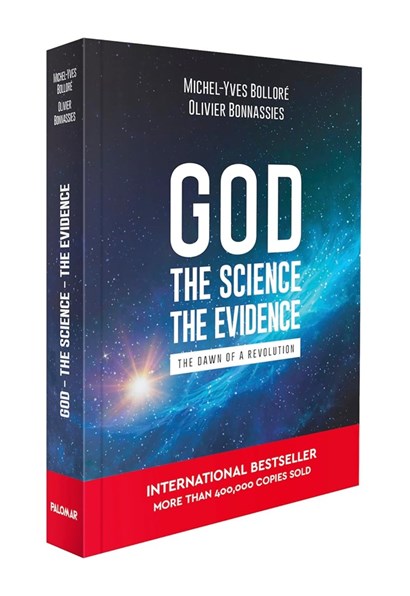
God: The Science, the Evidence, by Michel-Yves Bolloré and Olivier Bonnassies, is an intriguing book, not quite what I expected when asked to review the new bestseller. I suppose it would fall into the genre of natural theology, and the burgeoning field of intelligent design. When one first picks it up, it seems like a tome and a half. But once you delve in, the print is large and legible, the chapters short and to the point, with multiple headings, almost like bullet points. (The book even has its own website).
This eclectic endeavour weaves together science, commentary, theology and history. There are two main sections: Evidence Within the Sciences, and Evidence From Outside the Sciences, with ‘evidence’ here, of course, being evidence for God. We move from the beginning of the universe to the miracle at Fatima, and beyond.
The ‘sciences’ of the first half are spent on cosmology and the Big Bang, but with forays into chemistry, biology and the origins of life. This is not too in-depth, and those without a background in science can easily follow along. Much of the focus of this work is on the history of scientific discoveries – especially in cosmology. Before the Big Bang, most believed in an ‘eternal universe’. (Some still do, by other means, and much on that also), and most scientists were atheist, or at least agnostic.
But then Father Lemaitre’s proposed his theory, based on Einstein’s General Relativity, that the universe began with a ‘primeval atom’ of quasi-infinite density, and has expanded outwards ever since – the aforementioned ‘Big Bang’. It is enlightening to read of the initial rejection, even antipathy, for the theory not only by most scientists, but also by various powerful figures in the atheistic communist and socialist regimes of the twentieth century, Hitler and Stalin amongst them. This was due, of course, to the fact that the Big Bang implied a beginning to all things, allying closely with the doctrine of creation and a divine Creator. As Hitler cried out, belying his two primary hatreds, Jewish science is perverting thinking about the universe and is trying to convince us that it has not existed forever!
The numerous quotations offer a window into their minds, and the zeitgeist in which they lived. (The book is invaluable even for this collection of sources). To offer but one more example, as a contrary to Hitler’s mad ranting, Paul Dirac, known for any number of discoveries in quantum physics, including the prediction of antimatter, and himself an atheist, but marveling at the precision of the cosmos, admitted: One could perhaps describe the situation by saying that God is a mathematician of a very high order, and He used very advanced mathematics in constructing the universe.
The second half is more theological and exegetical, providing evidence for God from the Bible, refuting various alleged ‘errors’ in Scripture, the life and nature of Christ, all good and true. But the authors segue into the return of the Jews to the Holy Land, attributable to their (apparently) miraculous growth and military successes. This is a controversial and to my mind unnecessary section. Could not one posit that the growth of Israel owes just as much to the billions in military aid from the U.S.A, and the stalwartness of Israeli soldiers? I suppose that is one way of looking at divine providence).
This second half then recounts the miracle at Fatima on October 13, 1917, with the supernatural ‘dance of the Sun’, before ending off with a run through the moral and philosophical proofs for God.
All in all, God: The Science, the Evidence, although eclectic and somewhat vagarious, offers a welcome resource for the general reader, to demonstrate even more fully that those who peer into the beautiful, complex, highly ordered secrets of nature and the cosmos, are also in some way peering into the very mind of God, the Author thereof. This book could almost be called God, the Scientist, Who gives evidence of Himself in His work.
As the Psalm cries out in words that should inspire not only scientists, but all of us who marvel at the beauty and order of creation: The heavens are telling the glory of God, and the firmament shows forth His handiwork. (Ps 19:1)