
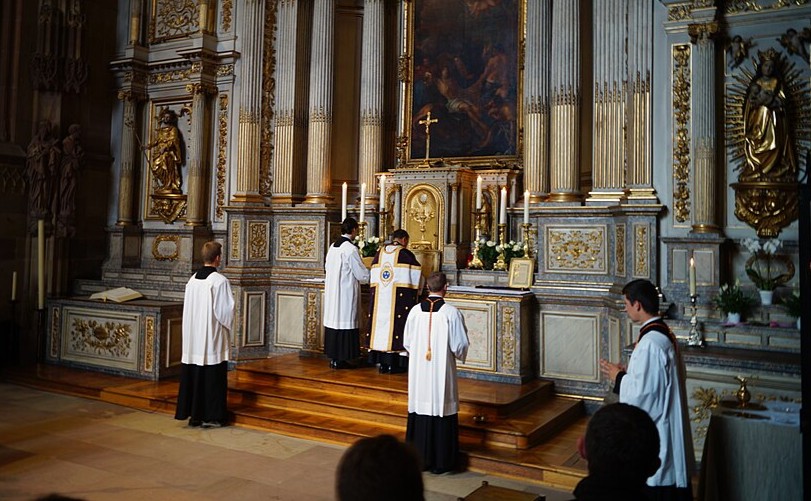
Editor: Contributor Joseph Woodard offers a perspective on the ongoing ‘liturgical wars’ – or, to be less polemical, liturgical debate – as one who has lived through the era before Vatican II. His points are worth considering, even if all may not agree in how they may be put into practice. May the Holy Spirit continue to guide the Church, and inspire those tasked with overseeing, offering and participating in the Holy Sacrifice of the Mass with ever-greater devotion and reverence.
—
Many faithful Catholics, patiently awaiting liturgical reform, desire a wholesale return to the Tridentine Rite. It would seem that at least on grounds of catechesis and congregational engagement they may have a point. But what types of reform, if any, should be considered?
Many of the current criticisms of the 1969 Novus Ordo are justified. A significant problem is a lack of real context for the claims presented, especially among new converts. This provokes a sometimes self-righteous lack of realism. This lack of realism is both historical (human limits in any age) and ontological, the reality of the Mass itself. Given the inescapably human and historical character of liturgy, any complete return to the old rite cannot be the universal norm for our times. Pope Benedict XVI was right, not merely prudent, to encourage a mutual enrichment, nurturing a synthesis and new unity at some indeterminate (patience!) future.
What follows here—be warned—are the reflections of a theological amateur, but a realist. When I grew up in the Fifties, what ordinary Catholics experienced in the pews was nothing like the curated, elite liturgies that traditionalists enjoy today. In reality, most Catholics always get any sustained catechesis from the Mass itself, and back then, there was none. None. Folks in the pews got brief, formulaic sermons on Catholic morality, a speed-read Latin canon (10 minutes?), and a vague impression something mystical happened beyond the altar rail. That was it. Had it been otherwise, a poorly formed, yet earnest clergy might never have forced a radicalized version of the new liturgy upon us, “for our own good.”
Certainly, in the Fifties, a small percentage were responding attentively to the Mass, “peering through the veil” at the invisible presence of the Heavenly Worship. But reverentially, most Catholics today are only slightly worse off than their grandparents. This does not excuse any “popular” (banal) changes, but it puts them in some context.
The Really Real
Most important is the reality of the Mass itself. It is not something we do. Jesus Christ does it, and fortunately, He makes it easy. The validity of any Mass is a very low bar to clear. Saigon’s Cardinal Van Thuan, imprisoned 13 years by the Communists, could only rarely celebrate Mass, holding a fragment of bread in his fingers, and a drop of wine in his palm. He violated every rubric of the Roman Rite, but it was valid, and the Lord showed up. So my wife prods whiners: “If Jesus shows up, I think I should keep him company.” Christ showed up at Calvary, history’s most tasteless liturgy, so our refusal to attend a hackneyed but valid Novus Ordo Mass seems a little precious.
If liturgical validity is a low bar, reverence is an infinitely high one, described haltingly in St. John’s Apocalypse. The aged apostle was saying Mass on Patmos, when suddenly “the veil parted,” and through his own liturgy, he saw the unending glory of heavenly worship. In this context, if every valid Mass gets a pass, the difference in reverence between a typical Novus Ordo and most precise Extraordinary Form is maybe D- to B+. Wherever we are, we face the same call to peer through the veil ourselves. If we find that hard, that’s on us. Jesus shows up.
Human, Somewhat Human
There are inevitable, historical tensions in any liturgy. Every liturgy is the co-creation of Christ’s timeless, sacrificial obedience to His Father, and our effort to join ourselves in His worship. Our worship is Communion in the body of Christ, the source and summit of the Church’s life. Like our existence as rational animals, this paradoxical reality is never resolved in time. Given the infinitely perfect humanity of Jesus Christ, the sanctity of the greatest saints is spectacularly idiosyncratic: choleric Jerome, romantic Francis, willful Teresa, or shrinking Therese, all partial responses of Love to diverse historical demands. Likewise, this tension between Christ’s perfect sacrifice and our imperfect Communion will persist until the eschaton.
As Aristotle says, virtue is the mean between extremes. In the generation before Vatican Two, Ressourcement theologians like Henri de Lubac criticized the Mass of Trent for an exclusive emphasis on the transubstantiation of the Eucharistic species as Christ’s body and blood. In contesting Protestant skepticism, Trent leaned into the Thomistic motif of accident and substance, a propositional defense of the miracle. Trent did this, though (de Lubac claimed), with some neglect of our consequential, intrinsic Communion in the Body of Christ. Over time, this allowed our reception of the Eucharist to drift into an individualistic, me-and-Jesus gift of salvific grace.
De Lubac blamed the implicit individualism of the Tridentine Mass for opening the Church to Liberal individualism. So Ratzinger student Joseph Fessio, SJ, recently said, the Communion of the faithful is the most important part of the liturgy. He did however imply a distinction between most important in itself, and most important for us, in a Mass that, per se, has no “parts.”
In reality, the Mass as the Son’s worship of the Father and our Communion in His Body is all one moment. As Christ said, “When I am lifted up from the earth, I will draw all people to myself,” as all one act (John 12:32). As creatures in time, however, our liturgies are unveiled sequentially. Given limited attention spans (or my ADHD), some of us experience a hiatus in our seamless participation in both Consecration and Communion. At theoretical extremes, that pesky distinction leans toward celebrating either the “vertical” sacrifice of the Son, or “horizontal” wedding banquet of the—ahem—People of God. But it’s still one moment.
Virtue abides in holding this moment together—the “diagonal.” So Pope Benedict XVI later criticized as banal ecclesiology Vatican II’s (now) unfortunate description of the Church as the People of God (LG 2). Aristocratic ages assume a people united behind its leaders, but in a democratic age (our historical context), the People of God was inevitably interpreted as an electorate, empowered to choose its rulers. A more timeless ecclesiology, Benedict insisted, is the Church as Communion, uniting us in the Body of Christ, in both our own, idiosyncratic sanctification and our tiny own missions in salvation history. The source of both is the Eucharist.
Biased as Charged?
Is de Lubac’s charge of bias in the Tridentine Mass justified? A Me-and-Jesus solo reception of the Eucharist? Not formally. The old form was open to organic development, beginning with St. Pius X’s recovery of the laity-friendly Gregorian Chant (versus elite baroque settings) and the 1962 missal’s optional Dialogue Mass and readings in the vernacular. The Tridentine Mass’s capacity for organic development is perhaps the best argument for its timelessness.
In the event, Vatican II’s Sacrosanctum Concilium gave pride of place to the Latin Canon, while seeking to enrich the propers and readings, and encourage active participation. What they meant was mandating the laity to join the servers’ responses and schola’s chant, what the ‘62 Missal allowed. Unfortunately, these words later permitted our sanctuaries to be overrun by cosplaying laity. Pope Benedict later criticized the emphasis on pedagogy, at the expense of worship, but expanding the Liturgy of the Word need not have had that result.
Nevertheless, it is an entirely different question, whether the Tridentine liturgy now allows or even encourages a drift toward adherence in a me-and-Jesus salvation. In an individualistic and egalitarian age (historical context again), might its implicit separation of the presbyter from the laity encourage an individualistic, exclusionary understanding of Eucharistic grace?
Our family attended a diocesan Tridentine Mass from 1996 to 2012, and loved our first decade. Three successive priests insisted (against lay resistance) on the 1962 Dialogue Mass, in which the laity in the pews—once silent—audibly voices the servers’ Latin responses. Unveiled girls and even tattooed punkers felt welcomed. Later, though, their replacements, with lay support, suppressed the Dialogue, discouraging any participation in the pews. Slowly the culture became veiled and stink-eyed. Finally, our latest pastor announced, “I don’t want pagans at my Easter Vigil.” With great regret, we moved to the new Anglican Ordinariate.
We were later visited by an old friend, a traditionalist diocesan priest, saddened by our decision. We complained to him about being excluded even from the Pater Noster—the Our Father. In rebuttal, he praised the symbolic beauty of the priest, facing Liturgical East, arms outstretched, intoning the Pater Noster for a docile laity, whom he’s leading toward the Second Coming. That is an argument; in an egalitarian age, the hunger for authority is rampant. At some point, though, our liturgy must acknowledge the common priesthood of the laity, for conversion of the world. The “sending out,” the Ita Missa Est closing a Tridentine Mass, isn’t enough. We can’t think of ourselves as docile sheep, sent out no farther than our family pens.
Last summer, we had occasion to attend again our old Latin Mass. It was still beautiful, but veils seemed mandatory. The active participation of the completely silent laity comprised stand-kneel-sit-stand-kneel-approach… The priest quietly intoned the Pater Noster, and a bell signaled his Communion. Then what most frustrated my wife: the priest turned ad populum, raised a host and quietly intoned for the laity, Domine, non sum dignus…Lord, I am not worthy. She growled quietly, “That’s my Domine, non sum dignus…” Indeed, the one moment when we laity must speak for ourselves is our division in sin. Are we unworthy to declare ourselves unworthy? If Jesus thought that, having us eat His Body and Blood is a strange way to show it.
Destruction? Or Creative Destruction?
What’s the point? The historical movements of the Holy Spirit in liturgy are beyond our personal comprehension. It is equally false and uncharitable to condemn the vices of today, touting the virtues of yesterday (traditionalism), as it is to condemn the vices of the yesterday, touting the virtues of today (progressivism). Our only issue is to worship reverently as possible, to the best of our—ahem—attention, since any valid liturgy infinitely transcends its rubrics. We all can’t simply return to the Mass of Trent. We’re no longer Counter-Reformation Catholics. It obviously serves—and should serve—those responding to its unique resonances, but that’s not everyone.
Vatican II’s catechetical intent needn’t have been at the expense of worship. Old Testament readings, keyed to the Psalms and Gospels, is sublime (though Marcionists bristle at that Covenant). The Responsorial Psalm can be sublime, as the Church’s perennial prayer. Bespoke antiphons for each feast day encourages affection toward our saints. Multiplying Prefaces might animate our year, though there’s too much variety for variety’s sake. Still, even in the crazy 1980s, even in Los Angeles, we attended a Novus Ordo with a Palestrina choir and Latin Canon.
Despite its defects (like a misplaced Sign of Peace), the Novus Ordo’s real problem was its execution by autocratic clerics, imposing popular reforms with oppressive methods. Wielding the slaphappy Spirit of Vatican II, they forced us to be free with optional solemnities, unsanctioned ad populum prayers, Communion in the hand, a ubiquitous Second Eucharistic Prayer, ordinary Extraordinary Ministers, etc., etc.—while ignoring the tears of devout old ladies. The joke of the day: “You can negotiate with a terrorist, but you can’t negotiate with a liturgist.”
We cannot overestimate the pain this caused, precisely for the faithful most devoted to the miracle of the Mass—the few already peering through the veil. They understandably drew their wagons in a circle against the savages. Yet that risked stifling their zeal for souls, their own call to evangelize the world. For some, it meant withdrawing into Tribalism, a perennial temptation of the most devout, breeding a sort of reverence of exclusion.
That first, post-Vatican II generation, painfully betrayed, handed on its Tribalism to some of the next generation, lacking context, yet grasping the beauty of the Latin Mass. So some may be less appreciative of the miracle of any valid Mass. But note: only some of the young. Note: extremely often, we now see TLM-raised youth migrating to a reverent Novus Ordo, once they marry and have (many) kids. They seek more accessibility in the liturgy, and vote with their feet.
Prognosis?
The 1960’s effort to move from an overly clerical Tridentine Mass, lock-stock-and-barrel to a more popular worship was catastrophic. Pope Benedict said as much. But the mounting trend now is toward a more reverent Novus Ordo. Our local FSSP parish is happily full, as tragically is the local SSPX chapel. Yet after forty years, they’re only one congregation each. Meanwhile, our diocese has a dozen parishes with orthodox young priests, slowly adopting beautiful rubrics, with the enthusiasm of their young families.
Mutual enrichment may someday see the convergence of the Ordinary and Extraordinary Forms, but our real diversity (benedicite the Anglican Ordinariate) should be unobjectionable. Our major obstacle is the liturgical calendar. Vatican II’s intention to expand the Gospel readings resulted in the adoption of A (Matthew), B (Mark), and C (Luke) years, with the John scattered through major seasons and solemnities. Despite an appeal to Christ’s three earthly years, however, humans live years, not triennials. The culturally all-important calendar celebrates joyfully in worship the seamless harmony between nature’s cycles, human seasons, and salvation history. Our liturgy should be annual.
Regardless, we cannot begin to transform our culture, until we take seriously all our obligatory solemnities and major feasts. Our most damaging, entirely ignored liturgical disaster was gutting our Holy Days of Obligation, ignoring or shifting them to public days-off. Our prelates did not want to inconvenience our work week. As Christopher Dawson and Josef Pieper insist, any culture’s backbone is its calendar of sacrificial feasts. Subordinating our worship to our jobs really showed who’s boss. We now “number our days” with quarterly clearance sales (like Halloween), and we really need to restore the authority of our calendar with obligatory feasts: the Ascension on the fortieth day—Thursday, the Annunciation as the true Incarnation, etc., etc.
The vast majority of new young priests are solidly devout. Surveys say as much. In diocesan Novus Ordo parishes, they’re implementing processions with well-trained altar boys, incense, cantors with chanted propers, ancient hymns, Expositions, and occasional Masses ad orientem (the bugbear of our fading Boomers). In twenty years, they’ll be solidly orthodox bishops. Despite continuing aberrations, “where sin abounds, there all the more has grace abounded.” And any valid Mass, anywhere, still abounds in infinitely more grace than we’re capable of receiving.