
I’ve been mulling over lately the role of the artist, and how much art costs the artist. I recently watched Hamnet, which is a beautiful film based on the historical fiction novel by Maggie O’Farrell. The story is about William Shakespeare, his wife, Agnes (Anne) Hathway, and the death of their son Hamnet. There is a part in the movie near the end, their son has died while William away in London. Agnes, out of grief, blames William for not being there, even though there was nothing he could have done. As a good husband, he writing to provide for his family, which is something she supported. William handles this anger well; he does not rage against her, but he accepts his wife’s emotions and is himself devastated, not only at the loss of his son but also of the growing divide between his beloved wife and himself.
You feel real sympathy for both characters, but especially William, since Agnes is taking out her grief on him. However, shortly after their son’s death, William says he needs to leave for London again to finish the theatrical season. Agnes is understandably very hurt by this and questions how he thinks his call to write at this time could be more important than his family. As the audience, you’re now feeling frustrated with William and wondering why he is leaving his wife and two daughters at this time of grieving.
The film shows William perfecting his play Hamlet in London. It then shoots back to Agnes at their home in Stratford. She receives a letter from William begging her to go to London to see his latest play. She doesn’t want to, but her oldest daughter encourages her to go. Agnes and her brother attend the play, and William plays Hamlet’s father. Agnes at first is angered by the story, at her son’s name being used as the basis for the title character. However, there comes this moment where she starts seeing her son, and his dreams of wanting to be in the theatre and work with his father. You see both William and Agnes process their grief through the play. In a critical moment, William is backstage watching his wife as Hamlet dies, and it’s beautiful. For me, this was one of the most heartbreaking moments of the film, other than when little Hamnet actually dies. Because we see the relief of William, almost like a prophet, William knew he had to write this play to process his son’s death, and he also felt that this would allow him and his wife to reconnect. He didn’t have certainty; he just sort of knew that this play was the only way he and his beloved Agnes could find their way back to each other after their son’s tragic death.
This all reminded me of how God acts in our lives. The artist who conforms himself to his call is like God; through his art, he reveals to us something we could not understand on our own. Like God, the artist often gives us something we did not know we needed.
St. John Paul II, in his Letter to Artists (1999) explains that seeing God through faith and through art are two different experiences, even though both reveal the Creator. He says of artists,
The intuition itself springs from the depths of the human soul, where the desire to give meaning to one’s own life is joined by the fleeting vision of beauty and of the mysterious unity of things…..All artists experience the unbridgeable gap which lies between the work of their hands, however successful it may be, and the dazzling perfection of the beauty glimpsed in the ardour of the creative moment: what they manage to express in their painting, their sculpting, their creating is no more than a glimmer of the splendour which flared for a moment before the eyes of their spirit.” (6)
The pope goes on to explain,
the knowledge conferred by faith is of a different kind: it presupposes a personal encounter with God in Jesus Christ.
We could argue that many artists, indeed, have not lived a life of faith. Great singers like Elvis, Whitney Houston, and Michael Jackson had lives that were in disarray, plagued by drugs, alcohol, abuse, sexual indiscretions, etc. Not to say that they are lost, but sadly, their lives became very disordered. These vices have not found only victims in modern artists. We can look at the lives of Mozart, Tolstoy, Hemingway, or Vincent van Gogh, men of incredible genius, yet they were often living in poverty, dealing with mental illness, and, shall we say, ‘extracurricular activities’ that hurt their wives and or themselves, very similar to their modern counterparts. In ballet, you see eating disorders; in opera, inflated egos, and often narcissism. So how do artists avoid becoming consumed by their own art to their detriment? How does the artist like Shakespeare in Hamnet use his gifts to speak truth and help his fellow man?
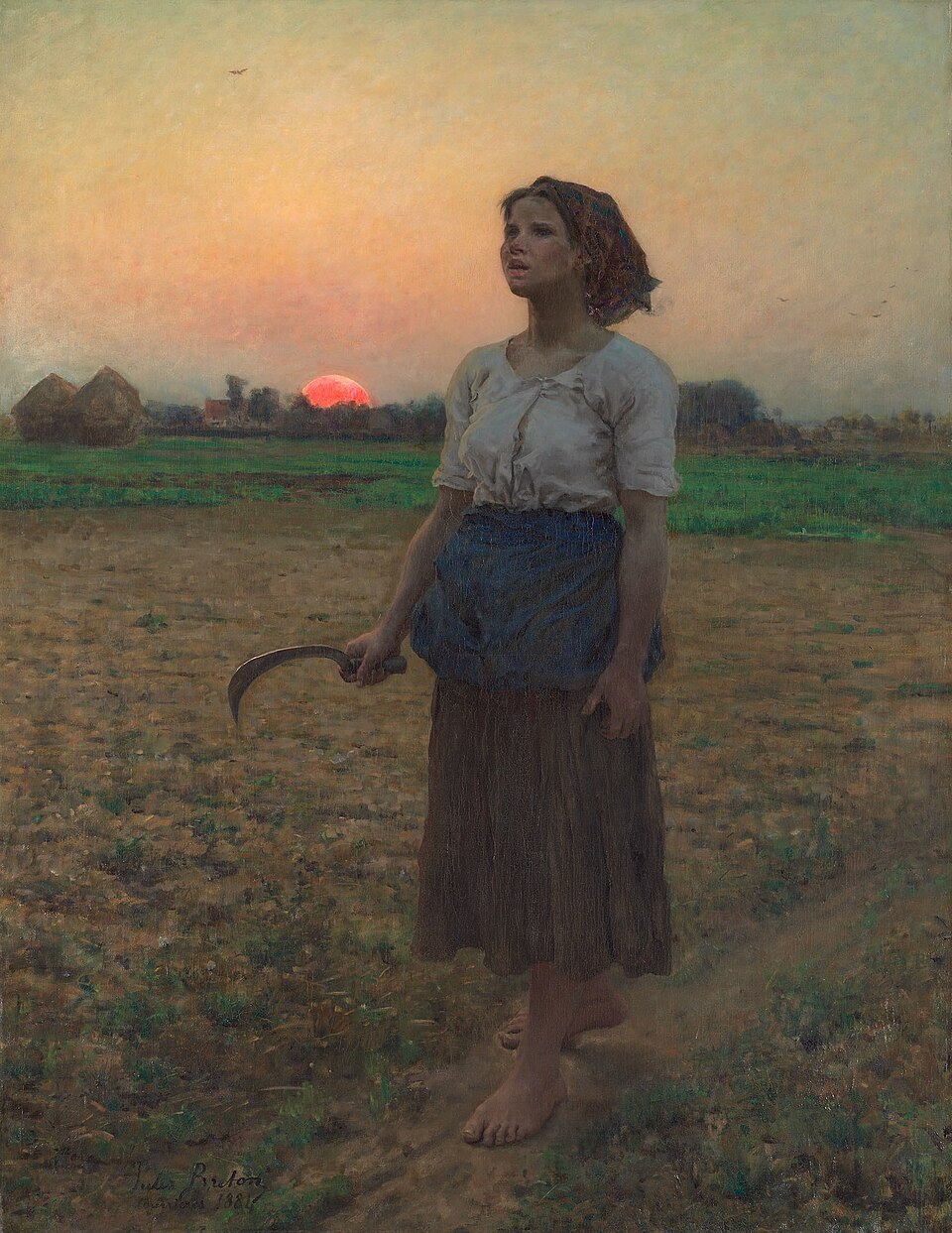
I was thinking about this plight of the artist, as I recently reread The Song of the Lark by Willa Cather. The novel follows the story of Thea Kronberg, whom you first meet as a young girl growing up in a lower-class home in Colorado at the beginning of the novel. She has an exceptional voice and is allowed to study voice in Chicago. Cather, in her masterful way, takes you on the journey of a self-made artist. While studying in Chicago, Thea visits the Art Institute, which is a turning point for her becoming an artist. She enjoys the paintings and sculptures, but is struck by The Song of Lark, a painting by Jules Brenton.
Cather writes,
That was her picture. She imagined that nobody cared for it but herself and that it waited for her. That was her picture indeed. She even liked the name of it, “The Song of the Lark.” The flat country, the early morning light, the wet fields, the look in the girl’s heavy face, well, they were all hers, anyhow, whatever was there. She told herself that that picture was just right. Just what she meant by this, it would take a clever person to explain. But her word covered the almost boundless satisfaction she felt when she looked at the picture. (Part II Chapter IV)
Interestingly, this encounter with the painting helps develop the lack of depth that Thea needs for her own artistry in voice. People throughout the book comment that Thea is not particularly quick or interesting in and of herself, and yet she has a magnificent voice and innate ability to know what to do with it. Her first encounter with the painting The Song of Lark, is a pivotal moment in shaping her own art, even though it’s a completely different medium. It seems to be a testament of artists to know one another through any art form. It harkens back to Shakespeare’s moment in Hamnet, that his own art not only healed himself but his wife.
In fact, comedian Bill Murray said in an interview that when asked if art had made a difference in his life, he recounted that when he first started in comedy, he was quite terrible at it and intended to kill himself after a dismal set. He was also in Chicago and was walking towards the lake, intending to drown himself. He saw the Art Institute of Chicago and decided to walk in. There he saw the same painting, The Song of the Lark, and he said it saved his life. He saw in the painting a girl who didn’t seem to have a lot of prospects, and yet the sun was rising behind her, and she had another day, and he said he realized he, too, was a person with a fresh start each time the sun comes up. It’s not a coincidence that Murray’s description of The Song of the Lark echoes the same sentiments as Cather. Cather chose this painting to be the title of her novel; obviously, this painting enriched her own work, and so she writes that it enriches her character, Thea, on her journey to artistry. Years and years later, this painting is once again recognized as exceptional and uplifting by a completely different kind of artist. Again, an artist recognizes another artist and is transformed by their work, and their own work is enriched.
The artistic life and temperament seem to be a challenging one. Cather, I think, perfectly sums it up when she says, artistic growth is more than it is anything else, a refining of the sense of truthfulness. The stupid belief that to be truthful is easy, only the artist, the great artist, knows how difficult it is.
I think that sums up the curse and blessing of being an artist. I think many toxic artistic work environments are not helping the artist, like the young actress used and abused by actors and directors, the ballet dancer or model who feels they have to have an eating disorder to succeed, the singer picked apart for their looks, tone, volume, range, etc. However, just because environments are bad, I don’t think we have to throw away the art form. But I think we need to recognize that artistic temperaments have a real tendency to extremes. Because they are seeing more of the ‘picture’ then their non-artistic counterparts are seeing, it can feel isolating, further contributing to a sense of anxiety and need for dissociation – hence addictions. It’s hard to see the truth, almost like the prophets of old. The artist is not only expressing this truth but has others slowly processing it back to them through their art, while also being misunderstood or picked apart. I think of the scene in Hamnet when Shakespeare leaves after the death of his son, feeling compelled to write Hamlet to help himself and Agnes process their grief. He tries to hold Agnes before he leaves, and she lashes out and hits him. I think so often great artists become plagued by addiction or depression because their art is revealing the divine to themselves and others. The artists are trying to bring balm to a hurting humanity, and like Christ, they often get hurt for it. Hailed by the people one moment, who turn on them the next. The artist and the truth of their art haven’t changed, but the people have.
So what is the answer for the artist? I think it’s humility, being rooted in the truth that they are – or should be – bearers of truth, not truth itself. I think artists who think of their art as themselves instead of as a gift, become destroyed by it. Because it’s not something meant to elevate one person, but something to be shared to alleviate many.
The role of the artist is to serve, and it’s a hard gift to give, even if the artist is compensated if they allow themselves to be healed by the beauty and divinity of their own work. I think a modern example of this is the phenomenon of Noah Khan or Lewis Capaldi. These singers are writing songs that are very vulnerable about their own experiences of life. Millions of people are connecting to their music and swarming their concerts. But they also pay a price; they are visibly shaken sometimes when they sing one of their songs, and it takes a toll on them. Yet both men have said in interviews that they are healed by their music and performance; it’s a cathartic experience. Similar to William in Hamnet, performing as Hamlet’s father in his own play. It’s a gift to the creator and audience when both are rightly oriented towards it as a gift and service. I guess a good description that comes to mind of the life of an artist is L.M. Montgomery’s Emily of New Moon. She describes her character Emily as someone who will love deeply—she will suffer terribly—she will have glorious moments to compensate. That’s the role and gift of the artist, to know and make present the beautiful and true. Yes, that knowledge will cause suffering, but if properly processed, it will also cause healing and growth. That is, if the artists recognize they are servants of truth and their art, instead of gods.