
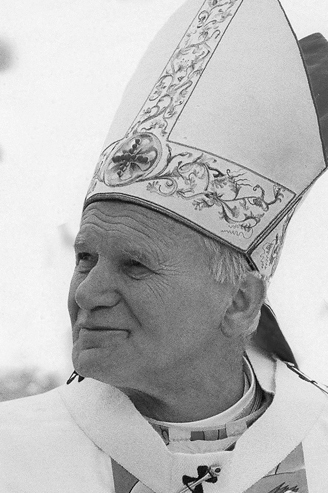
Today marks the memorial of Pope Saint John Paul II, who was beatified on May 1st, 2011 by Pope Benedict XVI, and canonized three years later by Pope Francis on April 27th in 2014. This October 22nd was chosen as his feast, for it was on this day in 1978, after the unexpectedly brief reign of Albino Luciano as John Paul I, that Karol Wojtyla, Archbishop of Krakow, having been elected in conclave on October 16th, was installed as the 264th successor of Saint Peter.
To readers of a certain age, this likely seems aeons ago, a different era without Internet, Facebook, smartphones, universal surveillance, and, now, AI. It seems scarcely imaginable, even to those who experienced it. This memorial was added to the calendar by Pope Francis, a welcome addition, not least since I happen to share the name he adopted, by my own parents’ choice.
The greatness of such a man – a true spiritual and universal father – can only really be measured in broad historical terms: His saintly life, forged in early suffering with the loss of his father, mother and brother; his own self-formation, cooperating with the grace of God by disciplined habits; the great love he had for God’s creation, and, far more so, God’s people, leading and forming legions of young people by his teaching, mentorship and example; his love of the great outdoors, hiking up mountains, kayaking Poland’s lakes and rivers. When, later in life, someone once remonstrated with him, that it was unfitting for a cardinal of the Church to ski, he replied, it’s unfitting for him to ski badly.
This physical training allowed him to maintain his heroic schedule of indefatigable missionary journeys, with those half his age scarcely able to keep up; his obvious love for each person he met by the attention he gave them; his voluminous writings, of a spiritual and intellectual depth that defies description. There is his own work – encyclicals, addresses, constitutions, letters, homilies, books – but he also oversaw the promulgation of the new Catechism and Code of Canon Law, all fo which will guide the Church, and all of our own consciences, through history until Christ comes again, an eschaton which seems a lot sooner now than it did in the late seventies.
After a long and varied life, we had the noble example of his death, accepting the suffering sent to him by God, whose depths we may never know, with a calm and serene resignation to the will of God. He lived what he taught, not least his profound meditation on this mystery in the 1984 Letter Salvifici Doloris.
All I can recommend is that you delve into his writings, his audiences and addresses, his encyclicals and letters, all of which which are truly transformative. I know it changes the lives of the students with whom I lead through them, year by year.
We Catholics should be people of hope, not focusing on the travails, follies, even the evils of this world, the form of which is already passing away. With JP II, we should be an Easter people, with Alleluia as our song – our eyes not cast downwards, but looking up to our heavenly homeland, towards which we are all on pilgrimage:
Prayer can truly change your life. For it turns your attention away from yourself and directs your mind and your heart toward the Lord. If we look only at ourselves, with our own limitations and sins, we quickly give way to sadness and discouragement. But if we keep our eyes fixed on the Lord, then our hearts are filled with hope, our minds are washed n the light of truth, and we come to know the fullness of the Gospel with all is promise and life.
His own prayer life was deep indeed, and the great Pontiff was profoundly devoted to the Virgin Mother – his papal motto was Totus Tuus – I am all yours, and all I have is yours, adopted from Saint Louis de Montfort’s consecration.
We should, with Karol Wojtyla, say a small fiat to God for what he wants to do with our lives – which means saying yes to each inspiration of the moment – we will soon be with him and all the saints in the heavenly Jerusalem. You may be surprised at what fruits may be borne along the way. As the great Pontiff put it, we should not be afraid to be holy, to become saints, and that life with Christ is a wonderful adventure.
Pope Saint John Paul II, ora pro nobis!