
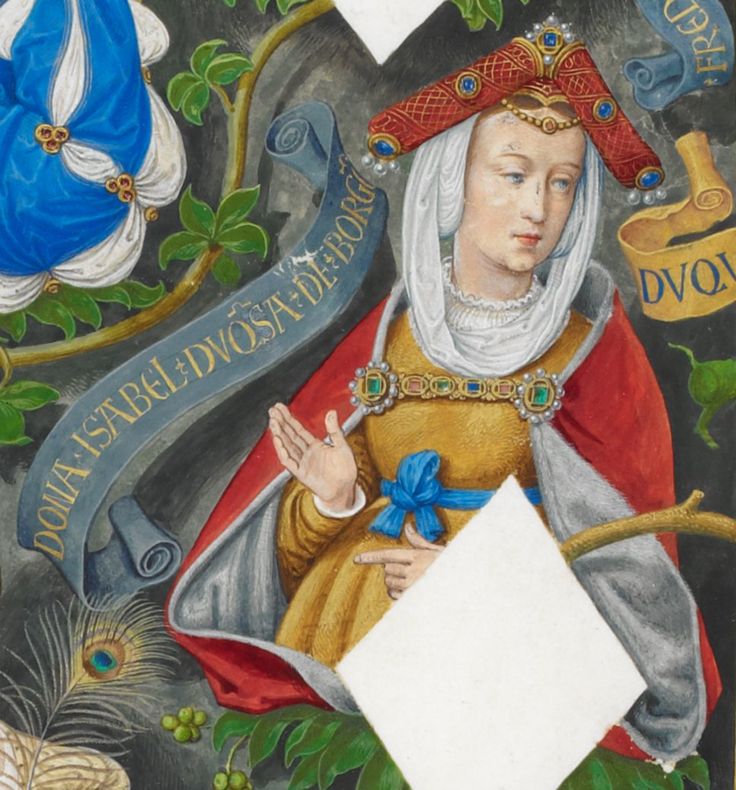
Elizabeth of Portugal (+1336) was of royal descent, the great-niece of the ‘other’ Saint Elizabeth, of Hungary. Like her great-aunt, she was a queen, wife, mother, widow, peacemaker and Third Order Franciscan. After her husband’s death, she retired to an hidden life of prayer and penitence in a convent, feeding the poor and tending the sick.
Her life was not an easy one, even in her salad days as queen. She was married off at a young age to Denis of Portugal at the age of 17 (he was 26), with the union arranged when she was 11. Not much choice back in those days, but she did choose to marry freely. Unfortunately, Denis, like most male monarchs, proved to be an adulterous philanderer. He was also suspicious of her charitable endeavours. When he confronted her one time bringing bread to the poor in the middle of winter, Elizabeth opened her apron, and – like Juan Diego two centuries later – beautiful roses fell out. Denis was left speechless, and let her continue. The wayward king was gradually converted by his pious wife, giving up his wandering ways, and we may hope died a good death. She bore him two children, a daughter, Constanca, who became queen of Castille, and Alfonso, the future Alfonso IV, King of Portugal.
wikipedia.org/public domain
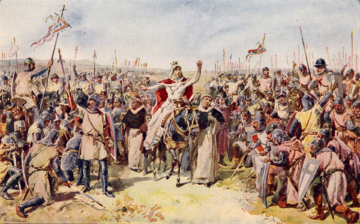
Elizabeth twice had to place herself physically between her warring family, first, between her husband’s forces against those of his son (who himself was aggrieved at the privileges given to one of his illegitimate offspring – shades of Abraham and David!). The second time was, again, between her own son and this time his nephew. Both resulted in peace, preventing much bloodshed, which such civil wars always bring. But the latter intervention proved too much strain for the ailing Elizabeth, bringing on a moribund fever. Elizabeth died at the age of 65 on July 4th in the castle of Estermoz and was immediately hailed as a saint.
She was canonized by Pope Urban VIII in 1625, the same Pontiff who would condemn Galileo seven or so years later. But it was also Urban who sent the Jesuit missionaries to New France, later named, of course, Canada – eight of them future martyrs, Jean de Brebeuf and his companions. These included the lesser-known Saint Antoine Daniel, who was put to death on this July 4th in 1648. His courage echoes through the ages, as he stood before his church near what is now Mount Saint Louis, confronting the attacking Iroquois in his stole and surplice, so that his beloved flock could escape. His body was pierced with arrows, then thrown into the burning church. A priest and I visited the site years ago, now long forgotten in a farmer’s field. He said that school buses used to visit regularly on pilgrimage, but no more. Such are the vagaries of history.
May we remember the example of these glorious saints, and beg their intercession for all of our own needs, for Canada, for Portugal, for the world and for unity and peace in God’s holy Church.