

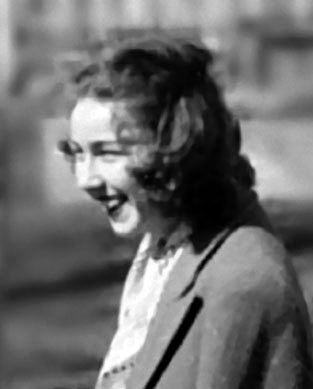
I recently reread Daniel Deronda, by George Eliot. What does that have to do with Flannery O’Connor, you might ask? Well, bear with me. There is a part near the end of the book (spoiler alert!), where Daniel finds out his parentage. He finds out his grandfather was a fiery Jewish scholar. Although his grandfather has passed away, he meets with one of his grandfather’s friends, who says he was a man who used to say, “Better a wrong will than a wavering; better a steadfast enemy than an uncertain friend; better a false belief than no belief at all. What he despised most was indifference.” (Chapter 60) This reminded me of Flannery’s famous quotation about the Eucharist, “If it’s a symbol then to hell with it.” Indifference is something you don’t see in Flannery’s writings or in the reaction of her readers. Either people love them, or they hate them; her stories leave no room for indifference. I think she is distasteful to some because she makes us confront the grotesque within ourselves, and she prompts us to think about the suffering of others, two things people don’t like to face, myself included.
When I watched the terrific movie Wildcat, starring Maya Hawke, based on Flannery O’Connor’s life and writings. I was struck by the overwhelming and never-ending passion of Flannery. The movie is a rich tapestry that interweaves scenes from her life with scenes from her stories. At times, you are not quite sure if you are watching her life, or her writing, which I thought was artistic genius. In the film, we are reminded that her body was physically deteriorating from the debilitating effects of lupus. Yet, her mind and soul were burning so bright, her own family and community sometimes felt uncomfortable around her. There is a wonderful moment in the movie where she is speaking with her priest. She is bedridden from an episode of lupus. She asks about grace, love, and a relationship with God, all things she feels she is not experiencing. If there was one thing Flannery didn’t want to be, it was indifferent. She tells the priest that the only thing she seems to be good at is writing, but no one seems to like her writings. The priest encourages her to continue writing, saying that this is her gift. It’s a moving scene, where you can tell two people have faced misunderstanding, loneliness, and deep suffering because they refused to be lukewarm in their faith or daily life. The priest tells Flannery we do not need to feel God’s love or grace constantly, to know they exist around us. This same theme is peppered throughout Flannery’s writings.
I’m reminded of Flannery’s short story A Good Man is Hard to Find. A family consisting of a mother, father, two young children, and a grandmother are on a road trip (spoilers ahead!). The immediate family members’ personalities can be described as cardboard, and the grandmother’s resembles more of curdled milk. They are plagued with indifference, evinced by their lack of love for one another, their insipid interactions and conversations. This family has lost a sense of purpose, but they are presented as a nice Christian, southern family. A serial killer called the “Misfit” is on the loose in the area. You might have guessed it, they encounter him, and are eventually murdered by him and his henchmen, right down to the baby. It’s jarring, it’s violent, it leaves no room to be indifferent as a reader. The grandmother is the last to die. As the Misfit is about to kill her, she has been pleading for her life, telling the Misfit that she can tell he is from “good blood” that he won’t kill her because “she is a lady.” She thinks the masks of nicety and family values will protect her. She is terrified because there is no actual connection to the Divine; her manners, her Christian values have all been a show, like a dress she puts on to look nice. She knows she is about to die, and finally stripped of her masks and comforts, she encounters the Divine. “Grandmother’s head cleared for an instant. She saw the man’s face twisted close to her own as if he were going to cry, and she murmured, “Why, you’re one of my babies. You’re one of my children!” She reached out and touched him on the shoulder. The Misfit sprang back as if a snake had bitten him and shot her three times through the chest.” After this, one of the Misfit’s gang members says, “She was a talker, wasn’t she?” The Misfit replies, “She would have been a good woman, if there had been somebody there to shoot her every minute of her life.” Flannery confronts us with our own mediocrity. When we are tempted to believe we are a “good person,” she shows us characters like the grandmother, who was complacent, who hid behind illusions of nicety and social manners, to avoid her sins and lack of relationship with God. Flannery’s writing forces us to confront the comforts we cling to, our hypocrisy, and our lukewarm pursuit of God and holiness.
Flannery’s writings never shy away from the ever-present question of why a merciful God allows suffering. How can suffering and even the grotesque lead to our salvation? The cross and redemption are woven throughout all her writings, deriving from her own struggle with doubt. She suffered internally and externally from her battle with lupus, loneliness, and being constantly misunderstood in her life and in her writings. Flannery creates stories that don’t invite us in or create a world for us; they jolt us, they rip our ideas of self and comfort apart. They are, in a way, like the Gospel; they call us out of ourselves, out of our self-conceited ideas of comfort, charity, and our inclination to self-pity and indifference. Her stories lead us on a path of grace, of reconciling free will and God’s love for each of us. How might we respond and participate in grace, in the love of God and of our neighbour? It’s messy and in need of constant relationship with God. What it isn’t is indifferent.