
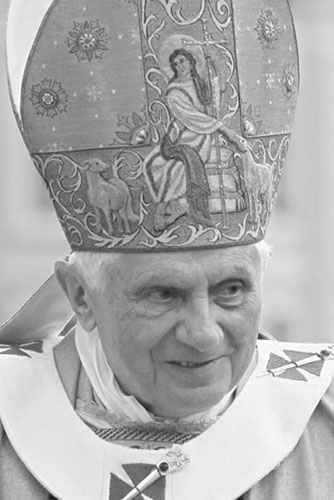
Hard to believe that it was a fateful thirteen years ago on this February 28th that Pope Benedict XVI resigned the papacy, the first Pope to do so since Gregory XII, who voluntarily stepped down towards the close of the Council of Constance (1415) to end what has come to be known as the ‘Great Western Schism’, and the era of three (alleged) popes. A few others popes had resigned previously – Celestine V being the most notable, and the first canonically to do so, at whose tomb Benedict prayed a couple of years before his own resignation). There were a few other disputed resignations in the early Church of popes sent into exile (Martin I amongst them).
In light of recent claims of sedevacantism, there are still some don’t believe Benedict really resigned, or, if he did, he didn’t really resign the ‘munus’. My own take on this is two-fold: First, until there is clear canonical evidence that his resignation was invalid – and Benedict himself always claimed it was free, informed and not coerced – we should accept it so. As his original letter stated:
After having repeatedly examined my conscience before God … well aware of the seriousness of this act, with full freedom I declare that I renounce the ministry of Bishop of Rome, Successor of Saint Peter, entrusted to me by the Cardinals on 19 April 2005, in such a way, that as from 28 February 2013, at 20:00 hours, the See of Rome, the See of Saint Peter, will be vacant and a Conclave to elect the new Supreme Pontiff will have to be convoked by those whose competence it is.
Canon law is also clear that the resignation of a Pope need not be vetted or approved by anyone else:
Should it happen that the Roman Pontiff resigns from his office, it is required for validity that the resignation be freely made and properly manifested, but it is not necessary that it be accepted by anyone else. (Can. 332.2)
Hence, we must accept it so, barring some new revelation and a canonical inquiry by panel of cardinals. It is not our role to interpret what may have been the Pope’s mind and his hidden intentions. Josef Ratzinger does not come across as one who would lie or be deceitful and underhanded. Second, God would not so abandon His Church and His flock. Chaos would reign, and Satan would triumph.
The same holds for the current pope, Leo XIV. We may hold with faith and hope that the office of the papacy is intact, even if those who occupy the chair of Peter are, like that first eponymous pontiff, are in many ways imperfect. Deo adiuvante. As we wrote recently, the barque of Peter is ultimately divinely guided, and the Holy Spirit will ensure she stays on course.