
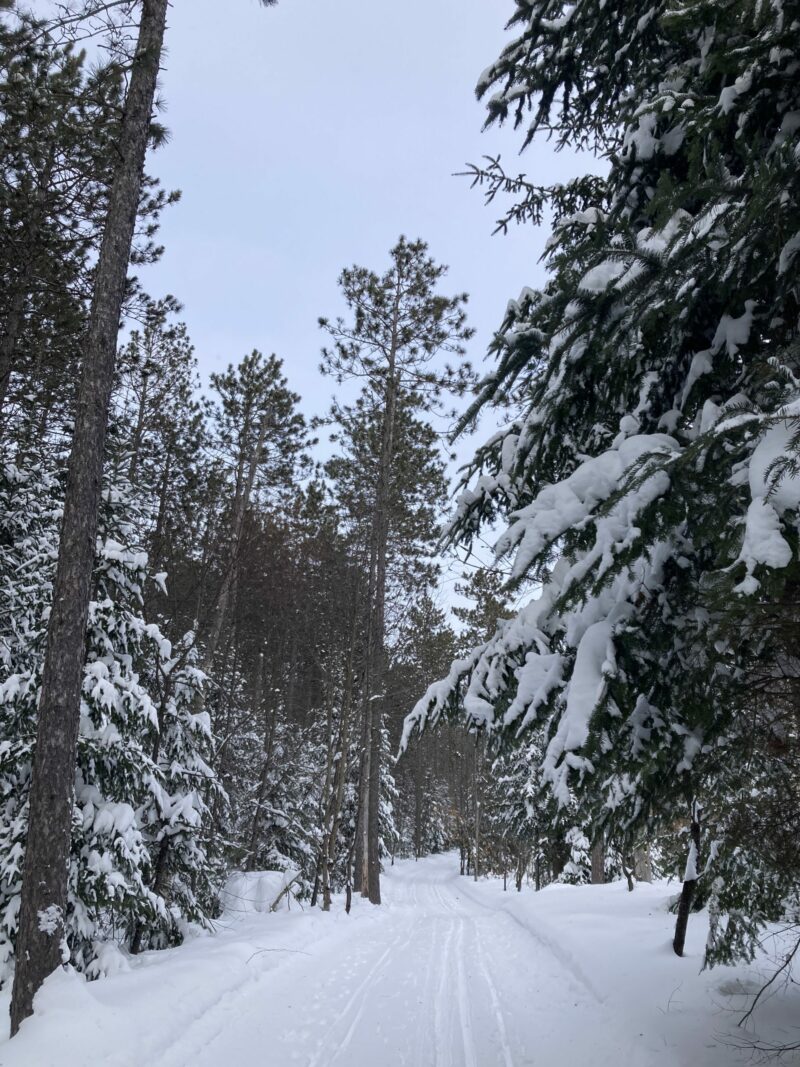
The snow will soon be falling in the surrounding forest here in northern Ontario. I keep a wood fire burning every day, and try to exercise patience whenever the wind storms and ice storms knock out the electric power (which they have done several times during the past month). Early winter and early spring are usually our chief storm times. I hate it when the e-umbilical cord connecting me to the world is cut. This impatience of mine whenever nature disrupts my busy, busy, busy life, is teaching me something about myself. That the lesson is relearned each year in Advent and Lent is an interesting coincidence.
As you know, the period of history during which we live is a time of waiting for the final return of Christ. Advent is anticipation, a re-enactment of waiting for the first coming of Christ, which is the prefigurement of his final coming. Our present state of incompleteness is a time of trials and tribulations. Until the final restoration of the world in Christ, it will remain so. Until his return, we will suffer.
Suffering, strictly defined, usually means pain in its several manifestations, ranging from physical to mental-emotional to spiritual. Accompanying them all is a profound sense that our situation is not as it should be. Whether we are in mild discomfort or intolerable pain, we learn and relearn that we are not in Paradise. This is to state the obvious. But what we so often forget is that man’s transitory condition in this world is a passage through time toward eternity (within the fathomless embrace of eternity), culminating in total reunion with God our Father. Then He will dry every tear from our eyes and bind up every wound, as the prophets expressed it, and bring us into everlasting joy. Our destiny, should we choose to accept it, is eternal communion.
When we live in Christ, Paradise is already within us, and we are in it, and who can explain this mysterious confounding of our normal mental constructs of how existence is ordered! For example, whenever we receive the Holy Eucharist worthily, for a brief time Paradise is a sweet fire within us (felt sensibly or not) and eternity is within us.
Jesus showed us from the moment of his conception and the difficult circumstances of his birth, and onward to the ultimate sacrifice on Calvary, that pain is not the end of things; indeed it is only a prologue. But pain can mesmerize us even as we struggle to avoid it or to escape its net. It becomes unbearable whenever we slide into an attitude or a conviction that our sufferings are interminable and meaningless.
Ours is an affluent age. And a deadly one. It conditions us from cradle to grave to avoid suffering at all costs or to apply costly remedies to it—especially anodynes and anesthetics. It goes without saying that no one should seek suffering. But the reality is, until our final breath in this world we will continue to experience trials and tribulations. It is God’s holy will that we do not go through life as if safely sealed in an expensive tourist bus, but instead we must live exposed to the dangers of human existence. He knows that ultimately this is very good for us, if we do not lose heart, if we do not run from it. He knows that we are stronger than we think we are. He knows that we are strongest of all when He lives in us and we live in him. When we understand this at last, we will no longer be haunted or hypnotized by evil, nor paralyzed by discouragement. We can stand up and penetrate the darkness of a fallen world with confidence in the ultimate victory of Christ. Then, pessimism and shallow optimism alike are swept aside by the real thing, which is Christian hope.
Advent is a time to learn how to do this with grace. It is the season when we can learn to bear with greater dignity our weakness as creatures, and to discover unexpected victories. Not always easy, as we are parachuted into a unique time and place in history, a cultural matrix that saturates our consciousness and redefines reality at every turn. One of the negative consequences of the internet, for example, is that our perceptions of both time and eternity can too easily be deformed. We are flooded with extremely powerful stimuli of a kind that is unprecedented in the entire history of mankind—in the entire history of the human brain. This quantum leap has occurred within a single generation, and is now deep into the second generation. One might call it the internet generation, for whom the exterior world is mainly perceived and experienced inwardly. Cyber-interaction. Intimate e-relationships. Avatars and spammers and firewalls and blockers and bloggers and twitterers—with disconnects spreading in every direction, all justified by the illusion of human connection—which is based in the longing within each of us for human communion, which in turn is a foretaste of the complete and eternal communion of Love which we will know fully only in Paradise.
Does the apparent connection to a global community offered by the internet give us an experience of genuine communion, or does it offer us a dangerously misleading pseudo-communion? Does it disconnect us even as it tells us it is connecting us? Is it merely a new tool of communication, or is it a palantir, the “seeing stone” in Tolkien’s The Lord of the Rings, opening the portals of mind and soul to the eye of the Dark Lord at the tap of a computer key? The palantir was all about communication, all about transcending the limitations of human sight and hearing, dissolving distance, dispelling separation, and promising to dispel ignorance. But what is our newfound power, this instant knowledge of good and evil, really about? Why has it appeared so swiftly, and spread everywhere, and why does it engender so much addictive behaviour in its devotees? That it is a tool with potential for immense good is undeniable. That it is a tool for immense evil is also undeniable. The internet is neither good nor evil in itself. Evil cannot be created. No created thing is evil. As the Lord says, it is not what goes into a man that is evil, but what comes out of him. Even so, we must always consider whether our tools and powers are disposing us toward good or inching us ever so subtly toward evil. Do they make it easier for us to live the good, or more difficult? Are there unseen consequences of an omnipresent e-culture that is swiftly becoming a global monoculture, including the present meta leap into the world of artificial intelligence (imagine, if you will, a word entirely ruled by algorithms)?
We have been conditioned to believe that individually we are still in control. But does the user of one or more of the multitude of near-miraculous devices available to him actually function with full human freedom? Does the controller shape the work of the mechanism, or does the mechanism shape the controller? Or both? Is the near-totality of this latest stage of the ongoing technological revolution gradually altering everyone’s consciousness? If so, in what way?
Perhaps we will have a clearer understanding of these questions, and the answer, when we turn off the electronic devices and go out into the cold clear air and walk among the marvels of nature’s universe. Perhaps as we walk we will meet a family traveling across snow-covered hills in vulnerability and need, seeking a stable under an unexpected star. Let us go with them.
Yes, let us go with them, and let us stay with them all the way. Let us find shelter together, and in that place of holy silence we will see birth and revelation and holiness made flesh. We will kneel before this “ordinary” man and this “ordinary” woman and their “ordinary” baby. We will awaken to the fact that we have been desensitized to the truly glorious, that we have subtly become numb to the meaning of this gift. We will understand that with all our riches we have not yet learned poverty of spirit. As never before, we will know our need for our Saviour.
Let us gaze at this little child and accept our poverty as creatures, as he accepted the poverty of his own life. Let God incarnate show us that we do not need to “be like gods.” Let us see a crucifix over the crib, and beyond the crucifix an empty tomb. +++