
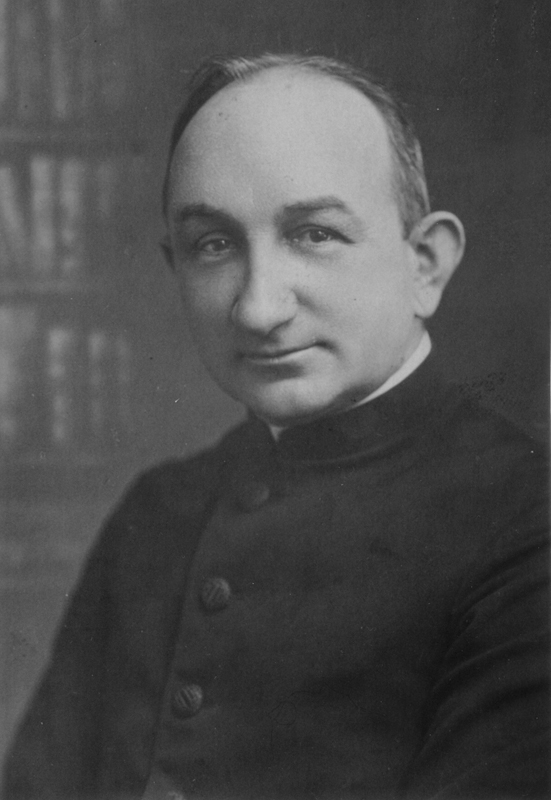
Poland stands as one of Europe’s most spiritually rich destinations, where faith and history intertwine seamlessly.
On 23 April 2026, Archbishop Tadeusz Wojda, Metropolitan Archbishop of Gdańsk, issued an official edict declaring his intention to commence the beatification process of Father Johannes Paul Aeltermann.
Archbishop Wojda said: “Today, more than ever, we need witnesses to the faith like this. […] This is a priest who bore the ultimate witness to his faith. I think that matters. […] We want the beatification process to be completed, so that he can be raised to the altars.”
Last Sunday, 22 November, marked the 87th anniversary of the heroic death of the Servant of God, Johannes Paul Aeltermann. On that bitterly freezing day in 1939, Father Aeltermann was forced to dig a mass grave for around fifty other people and witness their executions before he too was murdered. He was the only German among the victims. In a further act of humiliation directed at the Catholic priest, the executioners threw the carcass of a cow over his body before covering the grave with earth.
Regrettably, empty pews can still be seen in churches, and the vocations crisis continues to deepen. Can “lite Catholicism” stem the tsunami of secularisation? Or is it, perhaps, an attempt to adapt the Church to the expectations of the modern world, in which a Christian becomes nothing more than a pious humanist, a philanthropist or a church functionary in a clerical collar?
At the heart of the Christian faith is a deep, personal bond with Christ: a voluntary sharing in the lot of the Crucified and Risen Lord, as Father Aeltermann demonstrated throughout his life, much like his fellow priest, Saint Maximilian Kolbe. We must therefore cling wholeheartedly to the Cross, allowing Him to do with us whatever He wills, so that we may become authentic witnesses to the Gospel.
Woe to us when everyone speaks well of us and greets us on street corners. That is how they treated the false prophets, too (Luke 6:26). A threefold woe to us when the enemies of the Church praise us!
We must therefore become a clear sign of contradiction, a prophetic voice in the world, following Father Johannes the martyr.
PRIESTLY LIFE
Born in Gdańsk in 1876 into a German family, Johannes Paul Aeltermann was baptised at St Nicholas Church, now in the care of the Dominican Order. Remarkably, it was the only church in Gdańsk to survive the Soviet bombardment of March 1945.
In 1904, Father Aeltermann celebrated his first Mass in the chapel of the Hospital of the Blessed Virgin Mary, before being appointed to a parish in Tuchola. Notably, Aeltermann did not speak a word of Polish until the age of twenty; he began learning the language only after entering the seminary.
In 1912, Father Aeltermann was appointed parish priest in Meisterswalde (renamed Mierzeszyn in 1945), where he stayed for the next 27 years. Yet he was far from being a priest detached from the everyday realities and genuine needs of his parishioners. Alongside his pastoral duties, he took an active interest in social initiatives, extending his efforts to the Protestant community, which constituted a clear majority of the local population.
The priest was convinced that almsgiving alone was insufficient to address the underlying problems. Accordingly, he organised a range of educational courses for young people from rural and working-class backgrounds and worked to improve access to medical care. He was remembered for having treated everyone with respect, regardless of their nationality or religious beliefs.
When the Diocese of Danzig was established on 30 December 1925, the parishes of Meisterswalde (Mierzeszyn) and Mariensee (Przywidz) became part of the new diocese, and Father Aeltermann became a priest of the Diocese of Danzig.
In 1929, he celebrated the silver jubilee of his ordination. The celebration was attended not only by Catholics but also by local Protestants.
As Father Leszek Jążdżewski, the biographer of the murdered priest, recalls: “He did not divide people according to the language they spoke or the surnames they bore. To him, every person remained an image of God.” It would seem, then, that his view of others was close to that of the Creator of the world.
DARK CLOUDS GATHER
During this period, the Free City of Danzig was increasingly falling under the sway of National Socialism (Nazism). This godless ideology was beginning to infiltrate schools, government offices, and cultural institutions, while also making inroads into religious life.
As Nazi hostility intensified, Father Aeltermann defended the Poles and Jews living in his parish. In the early 1930s, the Nazis insulted him by calling him a “Pole” and a “friend of the Poles”. Nevertheless, he retained the confidence of the local bishop, who appointed him rural dean of the Danzig-Countryside deanery.
On 30 April 1933, an SA stormtrooper threatened him: “If the Catholic priest does not stop getting involved in politics, we will burn his house down. There are already letters of complaint lodged with the local Nazi Party branch leader, calling for him to be removed from office after the election.”
A week before the May 1933 elections to the local parliament, Father Aeltermann delivered a sermon and published his now-famous pamphlet, Hakenkreuz oder Christenkreuz? (Swastika or the Cross of Christ?), which was subsequently read not only in Germany but also in Poland and Switzerland. It was like throwing a hand grenade into a hornets’ nest.
He uses the simplest arguments, ones that go straight to the heart:
“The swastika is fundamentally at odds with the basic principles of Christianity. (…) Some people say: ‘I reject this movement’s false teachings against my Church, but I can see the political direction it is taking and the good it could achieve.’ Oh, how clever you have suddenly become! Surely, you are, and will remain, responsible for all its consequences! (…) Just imagine you raise your arm wearing the swastika armband, then take off your cap before a cross standing by a country road and pray, ‘Praised be Jesus Christ.’ Surely that is absurd! In one house, a crucifix stands surrounded by flowers, while a swastika flag flies above the house. Is that not absurd?!”
From then on, Father Aeltermann was kept under constant surveillance by the Gestapo. The regime’s newspapers launched a sustained campaign against him. Much like Blessed Father Jerzy Popiełuszko decades later, he was accused of meddling in politics.
Yet, as the priest repeatedly made clear, he was not taking sides in debates over economic policy or party politics. Those who stood up for their parish priest also began to face intimidation and harassment. The Nazis even enlisted children in their campaign against him. The local schoolteacher, Gabert, an ardent supporter of National Socialism, stirred up his pupils against him. Whenever Father Aeltermann walked past, they spat at him. Sadly, just a few years earlier, those same children had respectfully taken off their caps whenever they saw him.
In 1935, Father Aeltermann was arrested for “insulting Chancellor Adolf Hitler”. He was released a week later, following intervention by the Bishop of Danzig, Edward O’Rourke. His parishioners welcomed him back with immense joy. Not long afterwards, unknown assailants attacked the presbytery and vandalised the building. Father Aeltermann managed to escape and seek refuge for a time on the Polish side of the border. By the time he returned, however, only a small number of parishioners dared to attend Mass.
In 1937, the mission cross outside the church was destroyed, along with two roadside crosses at the entrance to Meisterswalde. For the local people, it was a deeply upsetting sight. Before long, another incident followed. The family of a member of the SA demanded a Catholic funeral complete with Nazi flags, swastikas, and other party insignia. Father Aeltermann refused, explaining that Christian worship could not be turned into a prop for a Nazi political spectacle.
Increasingly, people were heard saying that “something had to be done about that priest once and for all.”
THE FINAL MONTHS AND THEIR AFTERMATH
In early September 1939, his name appeared on a list of people marked for arrest. When the Nazis came looking for him, his nephew happened to be staying at the presbytery. The young man looked remarkably like his uncle. The wrong person was arrested, and Father Aeltermann managed to escape once again. Yet his final Calvary was still to come.
He went into hiding again for several weeks. He could have waited, hoping that the situation would settle down. However, in mid-November, he returned – not out of ignorance of the danger, but out of a sense of responsibility, like a shepherd returning to his flock.
On 21 November 1939, the Gestapo and the SS appeared at the door of the presbytery in Meisterswalde. They had come for the parish priest. This time, according to witnesses, Father Aeltermann made no attempt to flee. He remained calm. The following day, he was taken, along with a group of Poles, to the forest at Neu Fietz (Nowy Wiec), where his earthly journey came to an end.
Following the end of the war, the remains of those who had been murdered were discovered. The coffin containing the priest’s body was then transported to the parish of Mierzeszyn. It was placed on public display, with Polish Army soldiers forming a guard of honour.
On 26 June 1945, the very day he would have celebrated his 70th birthday, Father Aeltermann was laid to rest beside the church, beneath the very same cross he had once fought to defend.
The memory of this steadfast priest was kept alive from the very beginning. People came to his grave to pray, light candles and lay flowers. A particularly significant role was played by the parish priest, Father Gerard Borys, who cared for his predecessor’s grave for decades and ensured that his memory and legacy were passed on to future generations.
In 2003, the local school named Father Johannes Paul Aeltermann as its patron. History has a way of coming full circle. It was here, in this very building, that attempts had once been made to sow hatred of the priest and the Church in the minds of innocent young people. Today, the same place honours his courage. The ceremony was attended by representatives of Poland’s Institute of National Remembrance (IPN), the Archbishop of Gdańsk, Tadeusz Gocłowski, and the Consul-General of Germany.
CONCLUSION
Regrettably, empty pews can still be seen in churches, and the vocations crisis continues to deepen. Can the “lite Catholicism” I mentioned at the very beginning of this essay stem the tsunami of secularisation? Or is it, perhaps, an attempt to adapt the Church to the expectations of the modern world, in which a Christian becomes nothing more than a pious humanist, a philanthropist or a church functionary in a clerical collar?
At the heart of the Christian faith is a deep, personal bond with Christ: a voluntary sharing in the lot of the Crucified and Risen Lord, as Father Aeltermann demonstrated throughout his life, much like his fellow priest, Saint Maximilian Kolbe. We must therefore cling wholeheartedly to the Cross, allowing Him to do with us whatever He wills, so that we may become authentic witnesses to the Gospel.
Woe to us when everyone speaks well of us and greets us on street corners. That is how they treated the false prophets, too (Luke 6:26). A threefold woe to us when the enemies of the Church praise us.
We must therefore be a sign of contradiction, a prophetic voice in the world.
Let the words of Father Aeltermann, who lived in far more perilous times, bring this reflection to a close.
“Holy Cross, be our banner in battle and in every misfortune. You spur us on; You admonish us to remain faithful to You unto death. Be glorified by our lips and hearts, O Cross of Christ, my Lord.”