
The tone of these final days of the liturgical year fits that of the world of late, with wars and rumours of wars, AI bots and downed systems, Costco prepping and radical ideologues elected to office. The readings at Mass and in the Office focus on the four last things – death, judgement, heaven and hell – what is summed up in the term the eschaton.
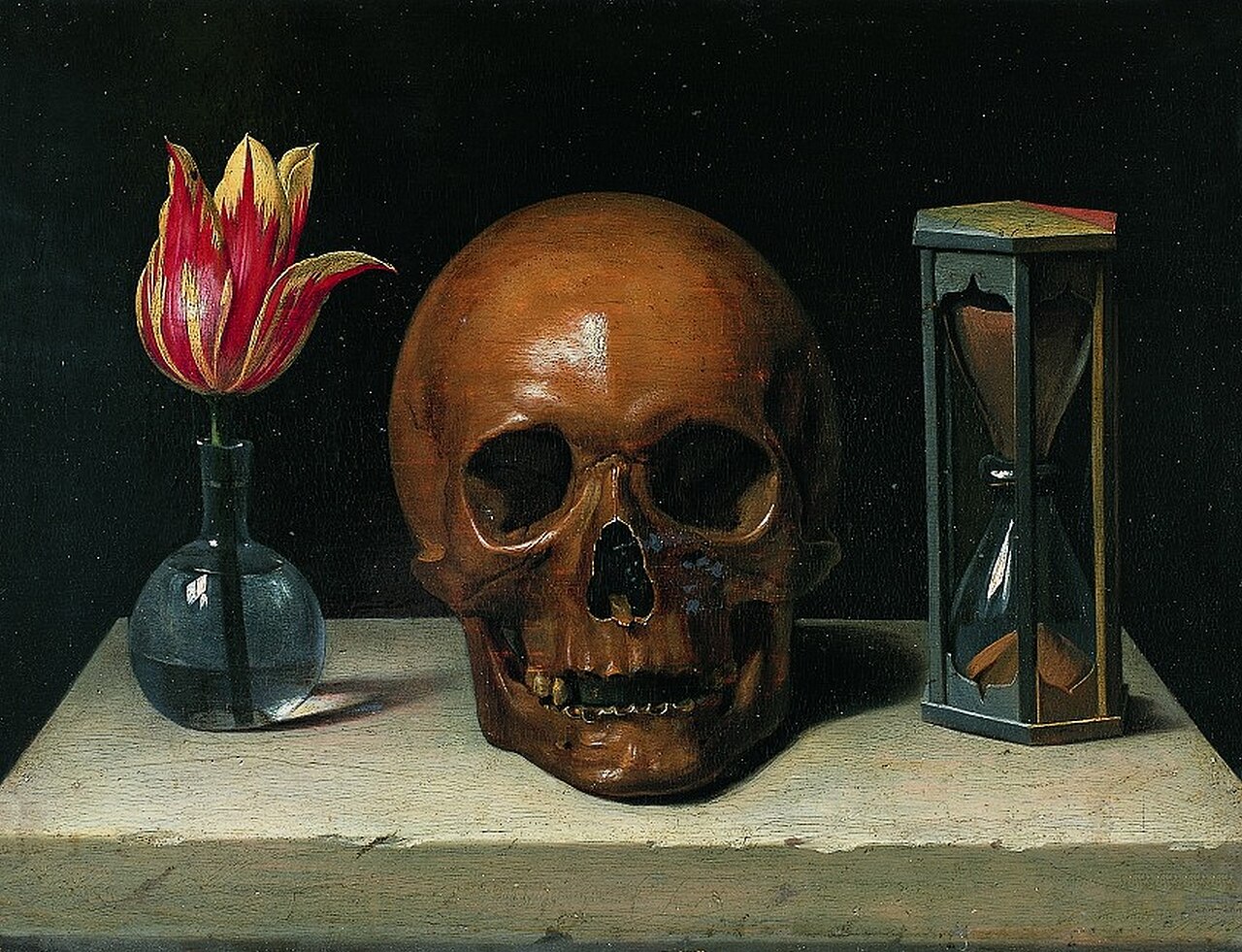
We are reminded of the ancient Latin phrase memento mori, literally ‘remember to die’, concretized by a skull, which saints (and innumerable others not so holy) often kept on their desk to remind them of their impending and inevitable death.
This may at first seem odd. After all, we’re all going to die, are we not, so what’s the point of remembering? Will we wake up on our eleventy-first birthday like Bilbo, and think, well, glad I forgot to die?
Rather, I suppose, we forget that we’re going to die, for at some level we suppress that truth, and perhaps don’t really believe it, do we? But is not thinking constantly of death somewhat morbid? As one 80’s band sang, ‘we’re here for a good time, not a long time, so have a good time, the sun can’t shine everyday’. Not exactly Christian wisdom, but they have a point, that we’re all moribund, and the law of entropy is inexorable. As soon as we are conceived, we are doomed to die. Alas! Who will save us from this body of death, as Saint Paul cries out! But we should not despair, for the Apostle continues:
Thanks be to God through Jesus Christ our Lord! (Romans 7:24)
Yes, we’re here ‘for a short time’, a blink of an eye when measured with eternity, but not so much for a good time, but a time in which to do good, as the recent Gospel parables exhort. Saint Ambrose, in the Office of Readings, writes:
Let death do its work in us, therefore, so that life may do its work also: a good life after death, that is, a good life after victory, after the battle is over, when the law of the flesh is no longer in conflict with the law of the mind, when we have no more battles with mortal flesh but in mortal flesh we have victory. I wonder if this death might not have more power in it than life. St Paul’s authority certainly suggests it when he says Death works in us but life in you…
…One man’s death has laid the foundations of life for so many people! And so St Paul teaches that we should seek that death in this life, so that Christ’s death should shine out in our bodies. That blessed death, in which our outer nature falls away and our inner nature is renewed, and our earthly dwelling is dissolved so that our heavenly home is laid open to us.
Our ‘earthly dwelling’ is always ‘dissolving’, and so many strive to hide from the fact, and hide it from others. We live in a cult of youth – youth-ism, if you will, or, to use the Latin, iuventutism. We hide from death and the suffering that accompanies it. We flee it, lock it away in nursing homes and hospices, and hurry it along by euthanasia; all clinical, detached, hidden. Cremate the body, so you never have to see it.
The grand nobleman Saint Francis Borgia in 1539 was asked by Charles V to escort the body of Empress Isabella to her burial in Granda. Seeing the decayed corpse of the once-beautiful queen, he cried out ‘sic transit gloria mundi!’. He vowed he would never again serve an earthly master for earthly glory and wealth. When his wife died in 1546, he gave away his wealth, and joined the newly-founded Jesuits, becoming their second founder.
The best way to prepare for our death, paradoxically, is to remember to die – memento mori! – always ready with our lamps lit, for our end may come at a time we least expect, knowing neither the day nor the hour (Mt 25:13).
Three examples in the news of late, with some of their names, to remember that they were real people, and at the very least to pray for their souls:
On October 17th, Father Patricio Alfredo Sánchez Molinari, a 53-year-old Redemptorist priest, was fatally struck by a falling crucifix, while celebrating a livestreamed Mass at Our Lady of Perpetual Help Church in Guayaquil, Ecuador. He had just finished a homily in preparing for death.
On October 28th, a high-speed train crash in Spain, in Toledo province killed 69 people, and injured dozens more.
On Nov 1st, a Learjet crashed, plummeting from the skies at full speed, hitting the ground at nearly the speed of sound, at 600 miles per hour. On board were Jeff Gregory, 55, the pilot-in-command; Nathalia Gadelha Filgueiras, 20, the first officer and co-pilot. The seven passengers were Adam Robinson, a tech entrepreneur; Helen Sharp, Robinson’s wife; their two young children, Emma (4) and Charlie (2); the children’s caregiver, Anita Maria Cetina; and friends Rachael Reed and Charmi Fehr.
Examples could abound. One made famous by the writer Voltaire was the All Saints’ earthquake, also on November 1st of 1775 which shook the faith of many. The French philosophe Voltaire used the death of so many of the faithful to ‘disprove’ a good and provident God. After all, why would He let the disaster happen when so many of the faithful were inside the church, which collapsed upon them? Then those who were outside and did survive, went to the shore to witness the strange spectacle of the sea receding, only to be overwhelmed and drowned by the consequent towering tsunami.
Christ makes a mysterious reference to such tragedies, in Luke chapter 13 (3-5):
There were some present at that very time who told him of the Galileans whose blood Pilate had mingled with their sacrifices. And he answered them, “Do you think that these Galileans were worse sinners than all the other Galileans, because they suffered thus? I tell you, No; but unless you repent you will all likewise perish.
Or those eighteen upon whom the tower in Silo’am fell and killed them, do you think that they were worse offenders than all the others who dwelt in Jerusalem?
I tell you, No; but unless you repent you will all likewise perish.”
Perish? What does our Lord mean? That sin leads to such a death? As Pope John Paul II alludes in his 1984 letter Salivifici Doloris – on salvific suffering – there is a complex and mysterious connection between sin and death, but one that we cannot fully discern from our temporal, earthly perspective. For too often the good suffer and die young, while sinners prosper and live to a ripe old age.
It’s what happens after death that really counts. Hence, our Lord’s point is that we must prepare for death, by a good and holy life. Memento mori. We will all ‘likewise perish’ unexpectedly, if we don’t. Make friends with Sister Death.
For we may view the end of this life more or less in four ways:
We die and cease to exist, like we were before we were came to be. All goes dark, like a candle, snuffed out.
Everyone, rather, goes to some vague ‘heaven’, regardless of how they lived. Such universalism, of whatever sort provides little comfort. (Some perhaps believe in a contrary version, of all going to hell!)
There is also Calvin’s doctrine of doom. We’re predestined – or doomed, as Hilaire Belloc put it – to either heaven or hell, and can do nothing about it.
Finally, there is the Catholic way, that life is an adventure, requiring a choice on our part, or, rather, many such choices, to follow Christ or the devil, life or death, for we cannot serve two masters.
It’s in this light that Christ’s seemingly dire words are in fact words of hope, for our Faith tells us that this life is a ‘test’, but one of love. In the time we have, we are asked to return the love with which God first loved us, as Saint John puts it. The Catechism reminds us that as death puts an end to earthly life, so too it is the end of our opportunity to say yes to God, to accept His invitation to the ‘marriage feast’ of heaven. So why not accept the divine rsvp, and live an eternity of joy?
Even long before Christ, this hope was evident, to those who lived in God’s grace. Here is Job, crying out in the midst of his own mysterious affliction:
For I know that my Redeemer lives,
and at last he will stand upon the earth;
and after my skin has been thus destroyed,
then from my flesh I shall see God,
whom I shall see on my side,
and my eyes shall behold, and not another. (Job 25-27)
Pope John Paul’s Veritatis Splendor, on the principles of the moral life, may also be seen as a primer on how to prepare for death. He quotes the prophet Sirach, that God left man ‘in the hand of his own counsel’. (Sir 15:14). We shape ourselves with each moral decision we make, for better or for worse. We must make ourselves ‘apt for heaven’, as Saint Thomas puts it. Saint Alphonsus Ligouri later puts it in his usual pithy way: we die as we live, and as we die, so we will live forever.
The saints have always pondered everything sub specie aeternitatis, under the aspect of that same eternity, living a liminal life, one foot here on earth, the other in heaven. However near or far off the Apocalypse may be, our own ‘apocalypse’ will happen at any time, so here’s some traditional advice in light of those ‘last things’, to stay always awake and prepared for that fateful moment, not meant to be exhaustive, or exhausting, but exhortatory:
- Make a morning offering, and continue that colloquy with God throughout the day, especially when the going gets tough. Meditate, and ponder divine things.
- Do the right thing, especially when it costs. Dig deep, et esto vir.
- Attend the Sacraments regularly. Daily Mass, if you can. Make a regular confession, with a purpose of amendment. Get a little bit better each day.
- Avoid sin like the plague, especially any occasions of grave sin.
- Commune with the saints, especially the saint of the day.
- Pray for the souls in Purgatory, for many do not die prepared. God in His mercy sees the goodness that is often buried beneath ‘much filth’ – to use Benedict’s phrase – and that disorder must be purified.
- Finally, be joyful, for why should we not? The day of a saint’s death is called their dies natalis – the day of their birth into eternal life, and is almost always the day we commemorate them. Live in that hope, striving for the good that may seem difficult, but with the help of God’s grace, made easy. Heaven does seem ethereal from our perspective, but it is real, far more real than this world, the form of which, like our own bodies, is passing away. What awaits us is life to the full, brimming over, full measure.
Be of good cheer, I have overcome the world. (John 16:33)