
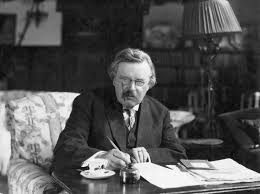
Recently I returned to an unsigned New York Times review of the Darrow – Chesterton debate in 1931. In that review the author quotes verbatim a remark by Darrow which I should have included in my earlier reconstructed version of the debate, for Darrow makes an interesting point that deserves rebuttal. The reviewer does not give Chesterton’s reply. In the following remarks I have supplied such a rebuttal that I think would be consistent with how Chesterton might have answered..
Here is the text of the Darrow quote:
“I know no man who fully believes in his religion. No matter how widespread the belief in life after death, I never knew a person of any consequence who was ready to give up this life to get another. I have known religious persons who suffered from cancer, who traveled all over the world allowing themselves to be cut to pieces a little at a time. They believed in a life after death, they said, yet they were ready to undergo terrible suffering a little longer, even in pain, instead of letting go to go to heaven and eternal bliss.”
Several other extensive direct quotations are given for Darrow, but very little for Chesterton. This raises an interesting question. Was the debate actually recorded, but the recording controlled by those who favored Darrow, and was later hidden or destroyed when it turned out that Chesterton overwhelmingly won the debate according to an audience vote? How was the NYT reviewer able to put quotation marks around extended quotes if he did not have access to the exact remarks? Did a stenographer accompany him to the debate?
Whatever the case, below I have constructed a lengthy reply that I think Chesterton might have offered if he was up to it. No way of knowing, but some kind of reply is worth pondering.
CHESTERTON: You have a notion that people really don’t believe in an afterlife because they will fight death tooth and claw to avoid the end that is closing in on them. I think I have an answer for you that is both reasonable and biblical.
When God finished His creation of Adam and Eve, he saw that what He had done was good. Adam and Eve must also have seen that it was good when they were created. They did not know death was in the offing when they sinned mightily against the Creator. But Christianity teaches that life is a gift, never to be squandered. Christians treasure that gift, and that’s why the Church opposes the practice of abortion, which is a denial of the inherent goodness of life, all life. It is in our nature to hold on to the most precious gifts we have ever been given. That is why Christians naturally hold on to life and resist death. But there is another gift in the offing, greater than the gift of this life if we would but have it. It is eternal life. Believing that judgment is bound to come after we die, it is a natural fear that we may have one way or another spoiled our chances of future life in the presence of the Creator. That fear is not a sign that we do not believe in the future life, but that we fear not deserving the life that we hope and believe God has prepared for us.
There are, sad to say, many who have that hope and faith but have not spent their lives as they should have, mainly perhaps because they have not loved as they should have, have not practiced the charity that Jesus called them to practice. They have good reason to fear dying because faith and hope are useless without charity. But the Christians who have lived well tend to die well, content in the hope and belief that eternal bliss lies ahead. This, of course, is a hope and belief that skeptics deny themselves, and so I’m sorry to say they are more likely to enter their eternity of nothingness with fear and trembling, though of course there’s always the posture of whistling in the dark.
Lacking faith and hope, there is decidedly more reason for skeptics to fear and resist death than for Christians who have made honest peace with their Creator. It is one thing to fear the other side of death as a place where you might get rewarded or punished. It is quite another thing to look at the other side of death as a place where you will get nothing. Deathbed conversions are rampant for a reason.
I further argue that God made us the way we are, intending to give us a choice, the choice being to accept or reject Him. Theologians call it free will. Well, I am not sure it’s all that free, because its a decision we have to make, whether to want God’s friendship or not to want it. There is no third choice. So that brings us to another question too profound to discuss this evening, though a question that needs deep diving into: The question is this: Why are some people open to the idea of God, and others so closed to it, not only intellectually, but in their hearts? When that question is resolved for the millions who might find faith but flee from it with all their might, we will see whether it is reasonable to suppose, or not to suppose, that the religion founded by Jesus Christ has not only a triumphant past, but also a future more grand than the world has ever seen.