
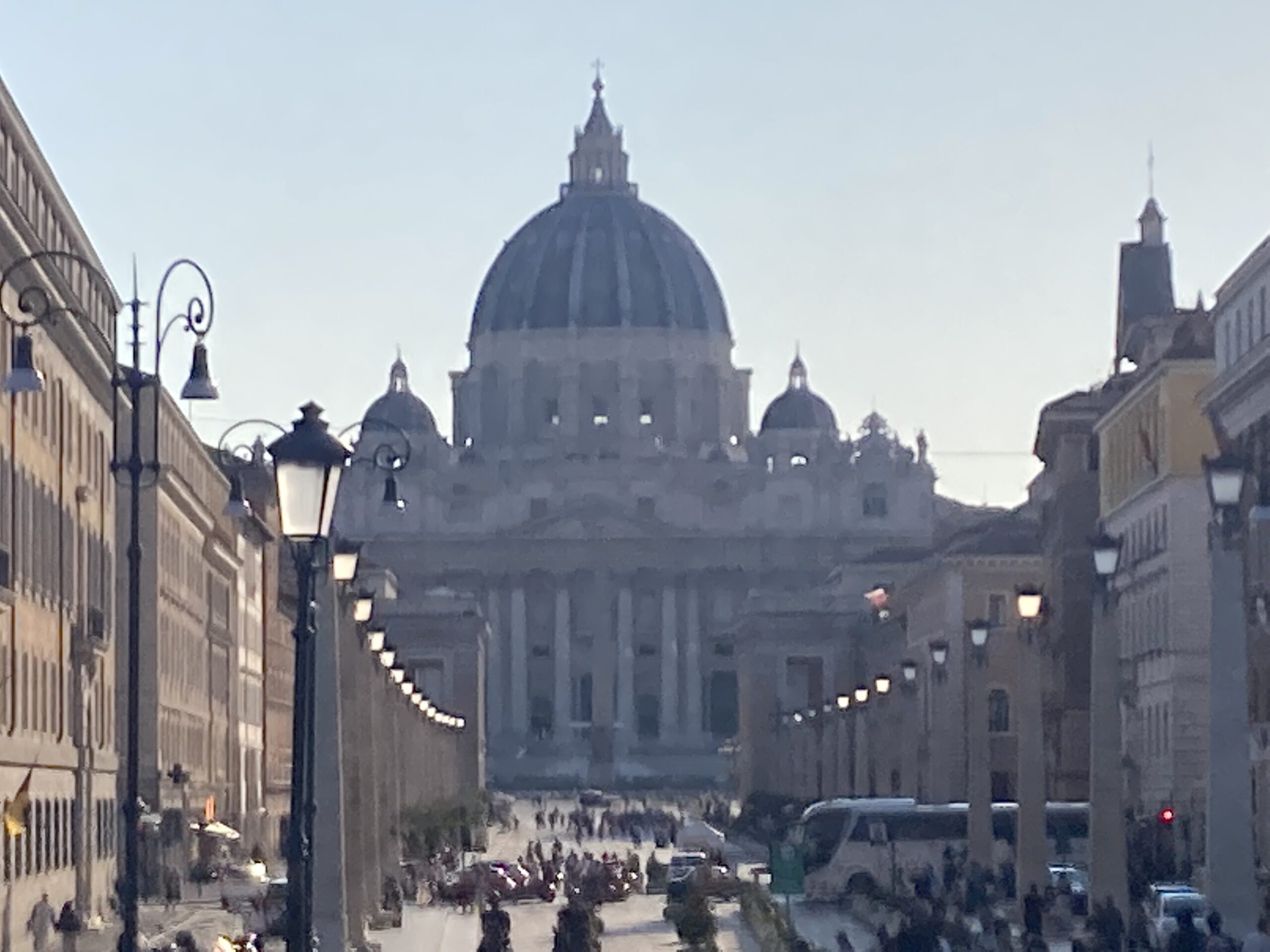
How strictly should we interpret Saint Cyprian of Carthage’s dictum extra ecclesiam nulla salus – outside the Church, there is no salvation? After all, it’s quoted in the 1992 Catechism, and is a dogma of that same Church. Boniface VIII included it in his 1302 Apostolic Constitution, Unam Sanctam.
The ‘Profession of Catholic Faith’, by the SSPX under Father Davide Pagliari, to the Holy Father is a lengthy document, which we have briefly discussed.
Here, we will focus on one point, and an important one at that:
I profess that God willed to make the Church the necessary means of salvation; just as there is under Heaven no other name given to men than that of Jesus Christ by which we must be saved, so there is no supernatural salvation independent of the Catholic Church. For all salvation comes from Jesus Christ; and every saving grace is either given in and through the one Church He has founded, or orders the one who receives it to that same Church.
This truth means that no one can be saved without Christ and His Church, through a false religion as such, nor be assured of His salvation outside the visible structure of the Church. If men are saved without belonging to the visible society which is the Church, the Mystical Body of Christ, it is by a supernatural ordination to the one Church of salvation, and in spite of the errors of the false religions in which they find themselves, from which they free themselves by not refusing the grace offered to them and by corresponding to it.
All quite true. But this raises the perennial question of the distinction between a ‘spiritual’ Church and a ‘visible’ Church. In other words, can one be saved ‘outside’ the visible Catholic Church?
Father Leonard Feeney (+1974) interpreted this in the strictest sense, claiming that one had to be a baptized Roman Catholic to be saved. Everyone else was damned, including every pagan who existed before and after Christ, and every Protestant who existed after the Reformation.
The Church rejected this position, and Feeney was excommunicated (even if he did reconcile before his death). As the Catechism puts it:
God has bound salvation to the sacrament of Baptism, but he himself is not bound by his sacraments. (CCC, 1257)
Distinctions must be made, which are outlined in two key Magisterial documents: The 1943 encyclical Mystici Corporis of Pius XII, and the 1964 Dogmatic Constitution of the Church, Lumen Gentium, of Vatican II.
Pius XII wrote that the Church that Christ founded is the Catholic Church. The only way to heaven is through Christ, Who founded a Church, which continues through space and time – unto the end of time – as His Mystical Body. To that Body we must belong to attain salvation.
We belong to Christ primarily through the theological virtues of faith, hope and charity, particularly the last and greatest of these. Love – agape – is the foundational virtue, without which we are lost, all of our actions null and void, and we are cast into outer darkness. Hell is state of eternal hate, heaven, of unending perfect charity.
The Church is the sacramental means by which we belong to Christ by charity, with her teachings on natural and divine law, and the life of grace through the sacraments. This is the point of the three ‘visible bonds of unity’ by which we belong to the Church: unity of Faith, the sacramental life, and apostolic succession, which includes submission to the Roman Pontiff. By living out these bonds of unity, we live a life of Christian charity, in the grace of God.
Yet there are still elements of the Church found ‘outside’ the Church, which, although less perfect, may still be salvific for those who are not fully professed Catholics.
Lumen Gentium, the Dogmatic Constitution on the Church from Vatican II, developed the teaching of Pius XII, stating that the Church that Christ founded subsists in the Catholic Church. Some traditionalists – including the SSPX – have rejected, even ridiculed, this term, claiming it dissolves the Church into a vague concept.
Yet the verb chosen by the Council Fathers is a perfectly scholastic one, used by Saint Thomas, who, would have supported its use.
Simply put, ‘subsists’ makes clear what the Church has always taught, that although the fullness of the means of salvation is found in the one, holy, Roman and apostolic Church, some of these means also exist ‘outside’ the Church.
We should clarify the term ‘outside’, for, strictly speaking, any such means of salvation already belong to the Catholic Church. Any true moral teaching, sections of Scripture, other sacraments found in any other religious community is ‘Catholic’, flowing from Christ and back to Christ. In fact, there is nowhere the Church is not. Every salvific truth, indeed, everything ‘true, good and beautiful’ belongs to the Church, for it belongs to Christ, and, in turn, to God in His eternal existence
To understand ‘subsists’, we may take an analogy: We ourselves subsist in our bodies; it’s where we may be found, or, we may say, found most fully. But there are aspects of us that exist outside of the ‘visible confines’ of our body. There are photographs, writings, memories, anecdotes, obiter dicta and memoirs – all the traces we leave as we go through life. Such is still ‘us’, even if it’s not fully ‘us’. If someone held up a photograph of your aunt, and asked if this is your aunt, you’d reply in the affirmative. Only the obtuse would say ‘no…it’s just a bunch of pixels’.
People can find out a lot about us without actually meeting us.
The same with the Church: All that she is subsists in the hierarchical, sacramental, visible entity, centred in Rome under the Pope, governed by bishops throughout the world. But she also exists – in a limited way, to be sure – in other faiths and religions, which may be a path to the fullness of truth.
What this implies may be found in paragraphs 14 to 16 of Lumen Gentium: The surest and most certain path to salvation is through the visible bonds of unity to the Catholic Church. The full creed and all the dogmatic teachings, all the sacraments – not least the Holy Eucharist – and submission to the hierarchy under the Pope.
The further we go from this fulness, the more fraught and uncertain things get, but not impossible. One can be saved through some of these means, if one is invincibly ignorant of the Church.
Lumen Gentium puts it this way:
Those also can attain to salvation who through no fault of their own do not know the Gospel of Christ or His Church, yet sincerely seek God and moved by grace strive by their deeds to do His will as it is known to them through the dictates of conscience.(19*) Nor does Divine Providence deny the helps necessary for salvation to those who, without blame on their part, have not yet arrived at an explicit knowledge of God and with His grace strive to live a good life. Whatever good or truth is found amongst them is looked upon by the Church as a preparation for the Gospel. (Lumen Gentium, 16)
We may go further: Just as all grace flows from God – the one and only source of grace, a participation in His own life – so He wills that these graces are mediated by His chosen ones, His saints. Our Lady, Saint Joseph, and the myriads of others, including ourselves, who are – or should be – saints in the making.
To bring this back to the Mystical Body, which Pius XII says is no empty metaphor, we may think of the saints as the main source of the Body’s vital energy and lifeblood which, again, is first and foremost charity, by which the rest of the body thrives. To gain heaven, we must be in a state of grace, members of Christ, remembering that some are more fully members than others.
We should remember that all we need is a spark of life – a drop of divine grace – to attain eternal life. One conversion, one act of true contrition, and heaven may be gained.
We Catholics should be those ‘sparks’ setting fire to the world – to speak – as Saint Paul exhorts in his Letter to the Philippians:
for God is at work in you, both to will and to work for his good pleasure. Do all things without grumbling or questioning, that you may be blameless and innocent, children of God without blemish in the midst of a crooked and perverse generation, among whom you shine as lights in the world (2: 13 – 15)
We will all be judged on what we have been given – from those to whom much, much will be demanded. Each individual soul knows this in the depths of the conscience, what truth they have received, and what they have rejected. They must follow the truth to where it ultimately leads, to Truth Himself, in His Holy Catholic Church, if the opportunity is presented to them.
Again, to Lumen Gentium:
In explicit terms He Himself affirmed the necessity of faith and baptism and thereby affirmed also the necessity of the Church, for through baptism as through a door men enter the Church. Whosoever, therefore, knowing that the Catholic Church was made necessary by Christ, would refuse to enter or to remain in it, could not be saved. (14)
Even those of us who are fully professed Catholics should not rest easy and not reduce our practice of the Faith to the bare minimum of the five precepts or even the commandments – see the story of the young man who went away sorrowful – but rather give as much as we have been given, so as to give to others, that they too may be saved.
All the Church’s children should remember that their exalted status is to be attributed not to their own merits but to the special grace of Christ. If they fail moreover to respond to that grace in thought, word and deed, not only shall they not be saved but they will be the more severely judged. (ibid.)
Words upon which to reflect and ponder. All our works, and ultimately our own salvation, is first and foremost the work of Christ, Who leads each soul as He wills. Should we resent those who may get into heaven with but a sliver of the truth? Would we not be like the angry workers who laboured in the vineyard all day, who looked with an envious eye at those who only worked one hour? Or the elder brother who refuses to join the feast at the return of his prodigal younger sibling?
Should we not rejoice, and not resent, that they were lost and now found? Keep in mind that the labourers who came into the field at the eleventh hour wanted to, and would have, worked the whole day. And had Dysmas somehow survived his own crucifixion, he would likely have been a lifelong penitent, a male Magdalene if you will. We all must carry our cross in whatever time we are given.
How many of us in the Church make full use of the fullness of the means of salvation and the graces we’ve been given? Daily Mass, Rosary, Scripture, the saints and feast days, pilgrimages, confession, contrition and meditation? This life is but a blink of an eye in the light of eternity, and all our work will seem a drop in the bucket, or more to the point, the ocean.
And, on the contrary, how many of those outside the Church, who have only part of these means, make far fuller use of them, and whom God may bless for their own zeal? Readers may peruse Father Paul Quay’s book, ‘The Mystery Hidden for Ages in God’, of which we wrote some years ago, whose subtitle was ‘Why Aren’t Catholics Holier Than They Are?’. A good question, that.
Only God knows the individual conscience, in the depths of which He speaks to each soul. Yes, it’s tragic that some, even many, seem to reject the truth, to harden their hearts against grace, the tragedy of which cannot be overestimated. As Solzhenitsyn put it, the line between good and evil runs through every soul. The further we are from the Church, the more vulnerable we are to the deceits of the world, the flesh and the devil. The Council Fathers were quite aware that hell remains a real possibility, and missionary work imperative:
But often men, deceived by the Evil One, have become vain in their reasonings and have exchanged the truth of God for a lie, serving the creature rather than the Creator. Or some there are who, living and dying in this world without God, are exposed to final despair. (Lumen Gentium, 16).
We don’t ultimately know how many are saved and how many damned, nor even who is and is not in a state of grace in this life, even if there are signs thereof, and by our fruits we shall be known. Would we want to know? I think it was Saint Therese who said that there is nothing so beautiful as a soul in grace, and nothing so repulsive as a soul in mortal sin. Some saints could ‘smell’ the latter, especially sins of impurity.
There was a b-schlock film made back in 1988, ‘They Live’, whose premise was that aliens, appearing as humans, had taken over the world. The protagonist, played by Rowdy Roddy Piper (yes, I know) finds a pair of sunglasses that allows him to see the aliens as they really are, in full bug-eyed, skeletal horror. If we had such ‘glasses’ to see the true state of souls, and who really is ‘in the Church’, would we put them on? Would we – gulp! – look in the mirror?
The historian Will Durant quotes a mediaeval theologian – unnamed – who claimed one in a hundred thousand get to heaven, which would certainly make one wonder about the efficacy of Christ’s salvific work. Pope Benedict in his 2007 encyclical Spe Salvi surmised that most souls go to Purgatory and ultimately saved (cf., par. 44-48).
God keeps that mysterious, and for good reason, for He wants to us work, hope and pray, for our own salvation, and to help save those souls on the wide and easy path that leads to destruction. Christ tells us that many travel thereon, but He does not say how many finish their descent. After all, is that not the whole point of the Church, to rescue souls in peril of being lost? Christ came not to destroy, but to save (Lk 9:56), so that we may have life, and have it to the full.
Why so many (seem to?) deliberately choose evil is a manifestation of that mysterium iniquitatis of which Saint Paul writes. But we don’t know and won’t know until the end of time who persists in that choice. Our primary concern is our own response to God’s grace in the depths of our own souls, and then those over whom we have care.
Revelation (7:9) says that ‘a great multitude, which no man could number’ will be standing before the Lamb in heaven, and there are many rooms in the Father’s house. In that we may take comfort – to strengthen ourselves for the pilgrimage, as we follow the via Crucis, of Christ, Our Lady and all the saints, which is also the via Salutis.
We hope, even against hope. Let’s not limit a priori the salvific power of the Church, radiating outwards as the light of the world, the pillar and bulwark of truth, nor our own participation in the work of leading others to that fullness of truth, which should be a joy. As Saint Philip Neri was wont to say, when shall we begin to do good? Today, and tomorrow will take care of itself.