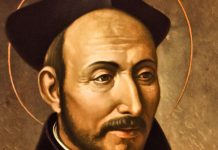

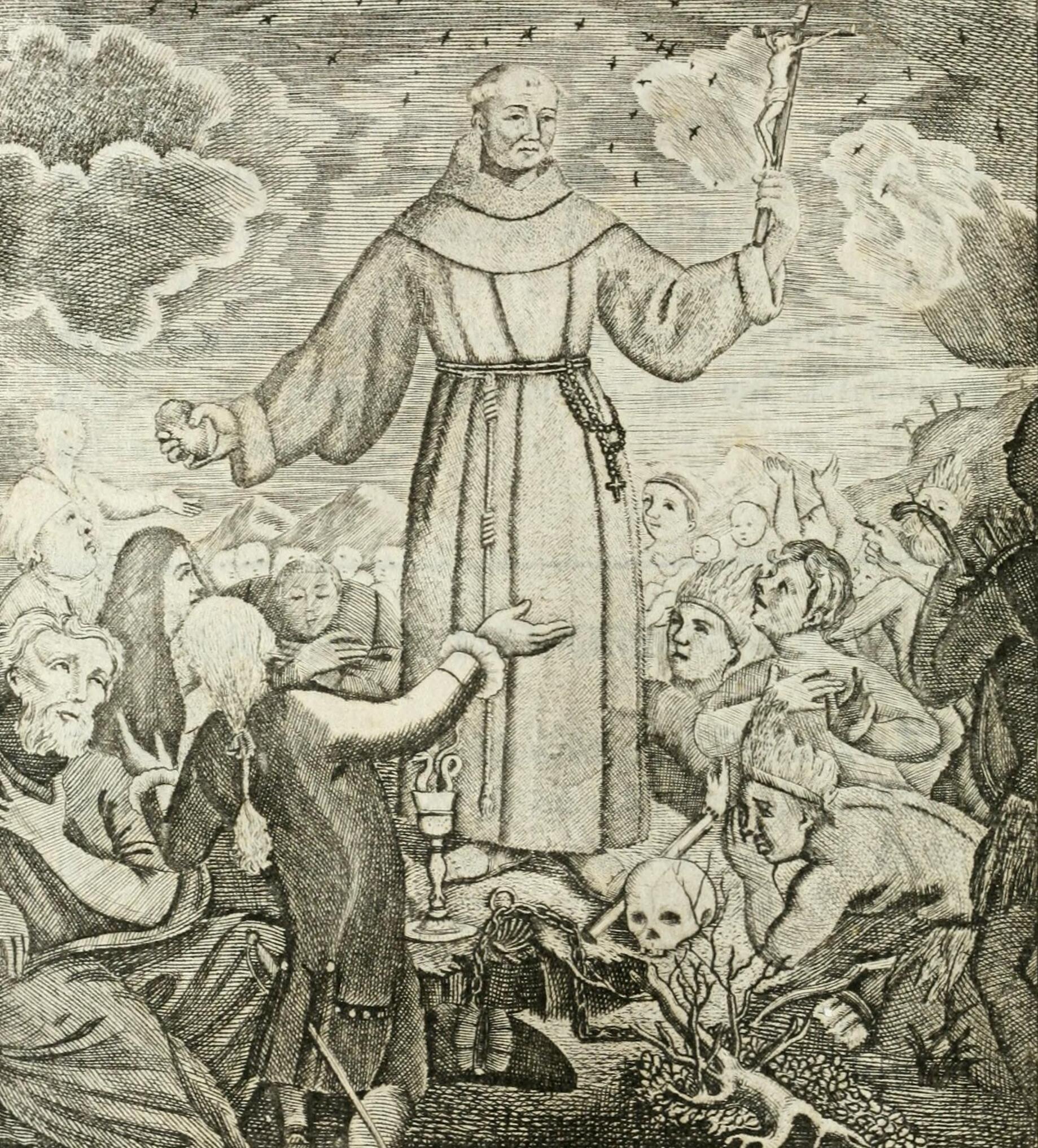
(July 1st is the traditional feast of Saint Junipero Serra, the great missionary founder of California, which, believe it or not, was once fully and vibrantly Catholic, as the link to the biography of our saint demonstrates in no uncertain terms. Here is a re-post of my thoughts from a few weeks ago, after my own pelegrinage to the Golden State. Canada was also once a Catholic nation, in its origins – the pioneers, habitants, missionaries, martyrs and countless doughty families who braved the long winters and myriads of mosquitoes to build the nation we now have. May Saint Serra intercede for us up north, to bring us back to where we’re meant to be!).
During my time in the golden state, I was reading an old biography of Saint Junipero Serra by H.M. Finch. I must confess I knew rather little of the saint: vague notions of a Franciscan missionary in California, whose reputation is now tarnished by woke culture, his statues toppled up and down the golden coast. The good priest has been smeared a ‘colonialist’ who foisted Spanish-Western values on the pristine paradise of the Indigenous Californians.
Of course, when one reads actual history – unbiased, from primary sources, with verifiable witnesses – the truth is otherwise. Junipero Serra was a saint, in all that term meant, a man filled with the love of God, committed to His holy and perfect will, and from that will he did not deviate. Of all the many saints’ lives I have read, rarely have I come across a man of such focus and courage, a true missionary to the ends of the earth. Even in the harshest of conditions he displayed a charity, goodness and patience, the fruit of supernatural grace building on nature, his ascetical practices disciplining his mind and will.
His historical significance should also be lauded. Without him, there would be no ‘California’. Father Serra’s mission was to bring all the benefits of Christianity and culture – natural and supernatural – to the wild and untamed land, come hell or high water, and both nearly stooped him.
Reading through the history, one appreciates how capricious and uncertain what we now take for granted really was, and how things might have turned out differently, and for the worse – far worse.
He could have had an easier life, even one that would have brought him to heaven, but the promising young man of high intelligence chose the ‘better path’, entering the Franciscans, and volunteering for the missions overseas. As a bright and promising academic, he was at first refused, but the Franciscans who were chosen quailed at the sight of the roaring Atlantic, and the (relatively) small wooden boat that was supposed to take them across the vast expanse of those mountainous waves.
Fra Serra, almost against his very nature felt impelled to go overseas, and was not so easily discouraged. Filled with apostolic parrheisa, he trusted that God would protect him and his merry band.
He was by nature neither hardy nor adventurous, possessing little, if any, of that passion for travel, that burning desire to visit strange lands, which has distinguished the labors of many a good and zealous missionary. He was a student, eminently fitted both by nature and inclination to remain in the peaceful shelter of his convent, absorbed in theological and dogmatic studies, preaching on Sundays and fete days to the people of the town. Yet out of an unutterable compassion for his fellowmen, he deliberately left this peaceful life he loved to travel many thousands of miles across seas and unknown lands, to endure hardships and unceasing toil. Second only to his spiritual grandeur, was his intellectual greatness. Modest monk as he was, he was yet a born leader of men. Had nature framed him for a soldier instead of a friar, his men would have followed him into battle as devotedly as his loyal brethren followed him into exile in strange lands.
Others did indeed follow, at first a few, later many. And those that did had an undying loyalty to this charismatic friar, so full of the love of God, and zeal for souls.
Landing in Mexico, Junipero immediately – some might say imprudently – set out on foot across the unknown and uncharted desert land to what we now know as California, a journey that nearly killed him, the sores on his feet and legs that made him lame and footsore for the rest of his life. One would not have guessed, for he traversed thousands of miles across the roughest, driest but with the occasional nearly-impassible rivers, mountainous, mosquito-ridden terrain – never complaining, always joyful and hopeful.
After a journey whose difficulty almost defies description, Fra Serra reached the west coast. We won’t go into all the details of his setting up the various ‘missions’ along the shores, from Baja California, up through Alta, San Diego to San Francisco, and many points in-between, many of which are still standing. Even seasoned and hardened explorers and sailors turned around in despair at the difficulties – near-starvation, isolation, attacks from man and beast. As is said of Father Serra:
During the remainder of his lifetime he made periodical visits to the missions and always on foot. Forcible contrasts have been drawn by several writers between the strength and endurance of the men of the present and that of the hardy pioneers whose memorable journeys of hundreds— nay thousands—of miles were all performed on horseback. But if those riders of the past command our admiration, what can we say of the man whose indomitable spirit and untiring energy enabled him to cover the immense distances of the Californian coast on foot? Lame, footsore and immensely weary, he traversed the wilderness, buoyed not by the glory of discovery or the lust for gold, but by love and pity for his fellowmen.
What strikes one most is the bitter isolation so many of the missionaries suffered – along with the soldiers and commanders. Letters took months to go back and forth, if they arrived at all. Visitors were few or non-existent, ships and supplies doubtful as winds and vague maps took them off course. To give but some idea, Popes came and went, and the whole American revolution and independence movement happened on the other coast, an epochal event of which Junipero and his companions remained blissfully unaware. A world hard to picture in our age of instant communication, and modern California thronging with people and traffic. That said, one does get a glimpse of that lost world on the edge of the desert, heading east outside the coastal cities.
In the midst of it all, Father Serra carried on, knowing that God wanted this land to be consecrated and converted to Him. Junipero loved and cared for the natives, who, shall we say, varied in their levels of hostility and receptivity. Father Serra was a man of his time, as are we all, and imposed law and coercive measures. Joining the missions was voluntary, but once one did, one had to obey the rules, along with natural and ecclesiastical law:
He refused to overlook, even in the newest converts, the slightest lapse from the strict code of morals he insisted upon, nor would he pardon the least carelessness or neglect in church attendance or observances. In spite of this severity the neophytes were devoted to him. They saw that he exacted from them no duty which he did not exact from himself with far greater rigor, that the punishments he inflicted upon his own delicate body surpassed in severity anything to which they were subjected. An intuition which belongs alike to children and savages, taught them that in Junipero they had, not a teacher only, but a friend, a brother, and a champion.
Junipero saw this as the only way to maintain a modus vivendi. The natives were taught many skills – gardening, sewing, weaving, milling, carpentry. And the good padre and his confreres always protected the natives from abuse by some of the Spanish, defending their rights and their dignity. His one desire was to bring them to the fullness of Truth, and save their souls, but also to give them a better life here and now, freed from the evils that always follow upon superstition and idolatry, into which we are now devolving.
But hope abounds. As I wrote upon my departure, there are oases of Faith in the golden state – in parishes and families – which may well be keeping the fragile coastal state from plunging into the sea. God bides His time to give all the opportunity to come to repentance.
In the end, Junipero succeeded, an instrument in God’s hands in the Christianization of California, and, ultimately, the United States. Junipero Serra died on August 1, 1784, worn out in body, but his soul vigorous to the end. He was canonized by Pope Francis – yes, Pope Francis – on September 23rd, 2015. If the vile rumours attributed to Serra were true, Francis would not have done so. Junipero Serra’s personal holiness shines through the historical mist:
He never spoke ill of anyone. He hated lies and all manner of hypocrisies. Neither in his youth nor manhood did he succumb to the temptations to which he, like other men, was exposed. He was full of tenderness, of genuine simplicity, of sincerity. If in enforcing the rules of the church, in punishing moral laxity, he was often severe, he was none the less a gentle, kind man, quick to note the good traits in others as he was quick to admit faults in himself, which may be said to be the only time he ever bestowed a thought upon himself.
As Finch puts it in the final words of his biography:
The early history of California is necessarily that of Junipero; he was the heart and soul of the conquest; whatever was done to further the cause of civilization in California during his life, was done by him. He had brought into existence nine missions, four presidios and two pueblos. The resources of his own internal force accomplished for California what the combined efforts of his contemporaries in the province could not have succeeded in accomplishing.
He contended with official blunders and official ignorance, with narrow pride, with petty jealousies of rival authorities, with disheartening failures, and he contended successfully. Had he been civil governor instead of president of an order only, his executive ability would have been known in high places. As it was, being but a simple friar, he was California’s greatest pioneer, the first civilizer of our western coast.
At the end of the day, as the sun sets on what we once knew as Christendom, and California suffers under a new legion of failed secular leaders, ‘petty jealousies’ and failures, may Father Serra’s heroic example inspire us all in our more meagre efforts to reinstantiate the full salvific truth the Church offers, and convert all souls to Christ, not least our own.