
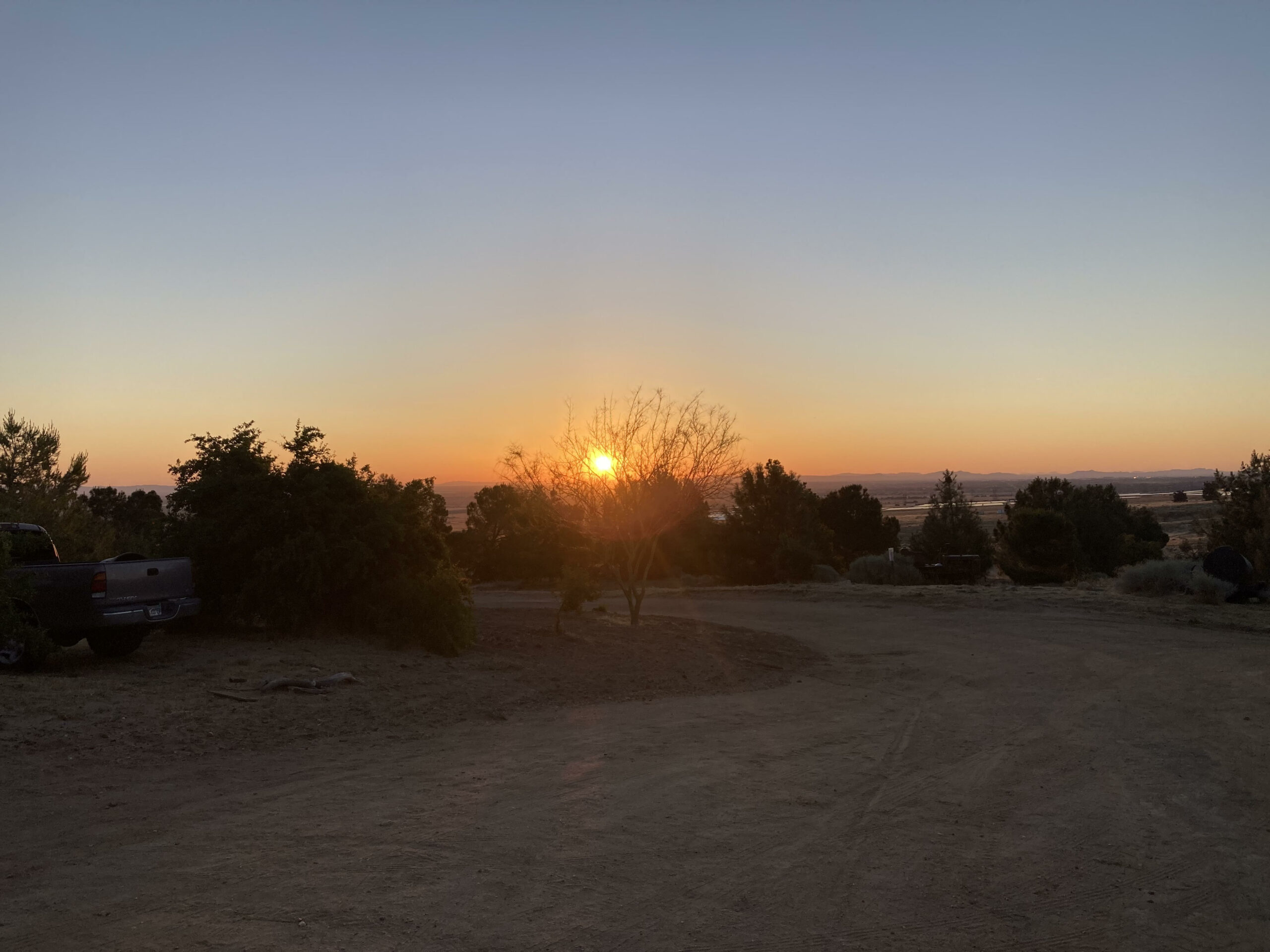
There’s the old saying about ‘going west’ that appeals to the soul of the wanderer. Why this should be, I wonder, as I myself wander west’ to California, in part for the wedding of a former student, but also to see the famed Golden state, whose aura has lost some of its sheen. More on that, perhaps, although my experience with the pathologies of the inner city were brief – crumbling infrastructure and so on – as I quickly departed – well, ‘quickly’ was more interior, for my physical motion was slowed significantly through the traffic in an over-priced rental car with balding front tires. Caveat emptor, occulta pretia. It is quite the feat, I pondered, and one not to be repeated, to drive through rush hour in two of the most congested cities in North American on the same day.
Things improved as I made my way into the quasi-desert outback north of Los Angeles, with an unexpected route through the San Gabriel mountains with roads designed for Tom Cruise on a motorbike or James Bond in his Aston Martin, to lovely property where the family I’m visiting live, which has been in their family since one of their great-grandfathers himself ‘went west’ from Quebec. I hope on my return loop to drive the famous ‘PCH’ – Pacific Coastal Highway – and that the car has enough grip to stay on the road, and I avoid an unexpected swim.
‘Going west’ has something to do with the age of exploration, of settling the ‘new world’. We humans have restless hearts, never satisfied, always pushing our frontiers edge and beyond, to the ultimata Thule – the very border of the known world and beyond. If we take as our reference point Europe, as the cradle of Christian civilization, the ‘east’ was the vast region of pagan hordes, ancient cultures that were inimical to Christianity. To the west was the ocean – and what lay beyond that mysterious expanse of water?
In the age of Columbus, they initially thought it was a waterway back to the East, without having to go over thousands of miles of rugged terrain, or sail around the vast landmass of Africa. When the ‘new world’ was discovered by Cartier, Columbus and others, it was settled from east to west.
Here in Canada, where the age of cities gets ever-younger as one goes from further west – Quebec settled in 1608, while Calgary was not founded until 1894 (it was an RCMP outpost in 1875). In this fair Dominion, there is still a notion of ‘go west, young man!’ – or woman, for that matter. Many of our alumni do so, not so much to seek the unknown, but to escape the baleful effects of socialism here in ‘eastern’ Canada, into the land of milk and honey of actual work and some governmental sanity in Alberta.
Yet now everything seems discovered, so the ‘west’ is more metaphorical, or perhaps personal: We seek to go not so much where no man has gone before, but where we have not gone, to those lands and landmarks yet unknown to us. The young people I teach long to see Europe, the mediaeval cathedrals and cities, while those in Europe seek the untamed wilderness of Canada and America.
In the end, Columbus was sort of right when he thought he would find Asia by sailing across the Atlantic. You can indeed go so far west, you start going east. Or, at least, you hit what is considered ‘east’ from your starting point, which you could arrive at by going west.
This morning, in the golden sunshine overlooking the valley, I sat plucking some tunes an old, well-made four-string banjo with the Dad of the family, as he strummed and picked quite expertly on the guitar. This evening, we hope to play and sing with the whole family, as a prelude to the wedding celebration on Saturday. Travel is more about people than sights, although new locales and terrain are themselves a fine accompaniment. Chesterton writes of the man who went looking for a new land, and ended up back where he came from, discovering his ‘home’ all over again, seeing what had become all-too familiar from a new perspective. We travel to see the world upside down, from east to west, north to south. Even if you cannot go far, a walk will do. For we’re all going ‘there and back again’, as Tolkien put it in his subtitle to the Hobbit. From God, and back to God, exitus-reditus, discovering who we are in His eyes, and how much He desires our homecoming, as we wander through that great pilgrimage of life.