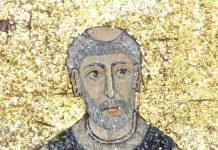

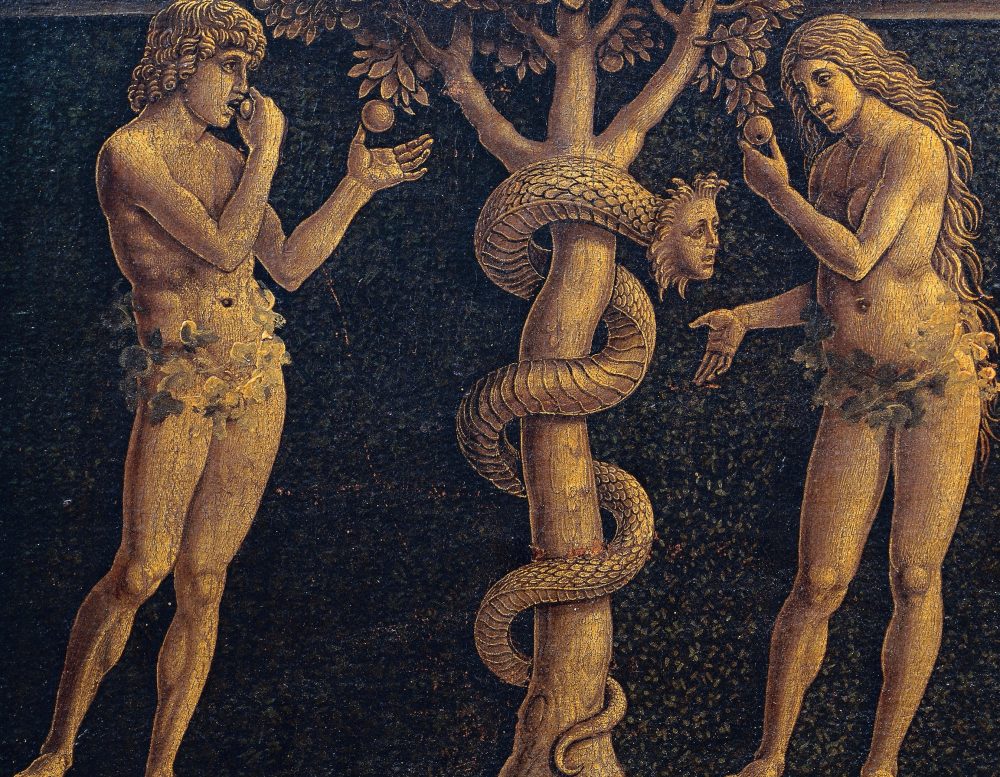
Christmas Eve is the traditional commemoration of Adam and Eve, our first parents – I don’t think there’s any etymological connection between Eve and Eve, the first derived from ye Olde English ǣfnung, which means towards sunset, the end of the day. The name Eve is an English transliteration of her Hebrew name given by God, חווה, Hawwah, which means ‘living one’, or ‘source of life’, as she was the mother of all the living. Eve’s name is not far from the sacred name God says of Himself to Moses from the burning bush.
Adam, אָדָם Hebrew, has a more lowly derivation, related to the word for ‘earth’ or ‘dust’. For from out of the very stuff of the ground, he was made.
Together, they were the progenitors of all mankind. It may be a bit odd to think of them as saints, since they committed what we now know as the ‘original sin’, which infects all of us. We now come into this world without the grace of God, with darkened intellects, prone to ignorance, with weak wills and disordered passions disposing us to concupiscence and all manner of sin. Who will save me from this body of death! cried Saint Paul.
We should recall that we were not made this way. Adam and Eve were created in the state of grace and perfection, with all the praeternatural gifts – immortality, impassibility, agility, fullness of knowledge, original justice, in perfect harmony with God, with each other, with themselves and with all of creation. They were far more perfect than we are, spiritually and physically. If there’s evolution, there’s also devolution.
This harmony was smashed to smithereens by their rebellion against the Father-God Who had made them in His love. Like the Devil, who tempted them, our first parents wanted to be ‘like God’ – a good in itself, which God would have bestowed in due time – but ‘without God, before God, and not in accordance with God’ – a very bad thing in itself (cf, CCC, #398, and Saint Maximus the Confessor).
Yet, as we sing at the Exultet at Easter, we see this as a ‘happy fault’ – felix culpa – which gained for us so great a Redeemer.
Adam and Eve repented, and did suitable penance for their long lives to atone for what they had done. All the ‘sweat of the brow’ and ‘pains in childbirth’ and, of course, struggling with their faults and weaknesses. But it is for this very reason that God has mercy on us, forgives us our sins ‘seventy times seven times’, right up to we breathe our last.
And for this very reason also that He sent His Son into our world on a crisp winter eve, in the hidden village of Bethlehem, far away from the pomp and circumstance of this passing world. Only the hidden people – angels and shepherds – saw the greatest event in the history of the world, God-become-Man, the World-made-Flesh, the new divine Adam borne of the new sinless Eve, the very Incarnation of the Creator, the Alpha and the Omega of all time and history.
So Venite, adoremus, dear reader, and live as He would have us live, so we may gain eternal life with Him.
May it be a very merry Christmas, for one and for all.