
I appreciate Mrs. Julie Douglas’ reflection on what she experienced as beneficial in the (French) publicly funded Catholic school system, as well as her exhortation for good people to stay in the system to do what good they might therein. She also raises significant points about the diminution in parish life and its effectiveness, not least in catechetics.
So far, so good, but there are problems, most of which I discussed in a post back in January.
The takeaways, with a few added thoughts.
There are the many obvious flaws and deficiencies of the public system. Standards have dropped significantly, and grade inflation rampant. Students can barely do the basics anymore – reading, writing and (a)rithmetic, as any honest teacher will admit. No one is allowed to fail, or rarely, if ever, is failing grade even given.
Then there is the moral rot infecting the system, much of it in the sexual sphere: grave sins are at least implicitly tolerated, if not celebrated. Does the public system have a defined teaching on such things as masturbation, fornication, homosexuality and the stalking-horse of transgenderism, and consequent child mutilation? Is the much-maligned and neglected virtue of chastity taught and promoted? The pullulation of ‘pride flags’ is but one significant emblem of a deeply disordered mindset.
Is the French system free from all of this? Perhaps in the ‘old days’ – which were not all that long ago – things were better and more ‘Catholic’, as Mrs. Douglas alludes. Since the ‘three R’s’ were abrogated, however, in favour of an ‘education’ in secular ideology, the effect of full state control has been deleterious. Students come out malformed, and few keep what little faith they had.
Can la langue française save the day? That beautiful language became unhinged from Catholicism back in the ‘quiet revolution’, when the people of Quebec rejected the faith of their forefathers. The demise of French in la belle province has much to do with the downward spiral of demographics: Quebec has one of the lowest birth rates in the entire world, and there simply aren’t enough francophones. Should the state support a system that cannot support itself?
Which brings me to the final and central point: That he who pays the bills, calls the shots, which is the main problem with any socialist system, including a fully-publicly-funded Catholic system: The state can garnish as much money as it likes from the taxpayer – including beleaguered parents – and has the final say on any policy, any hiring or firing, any curriculum – and there is no recourse. Public education has become a bloated behemoth.
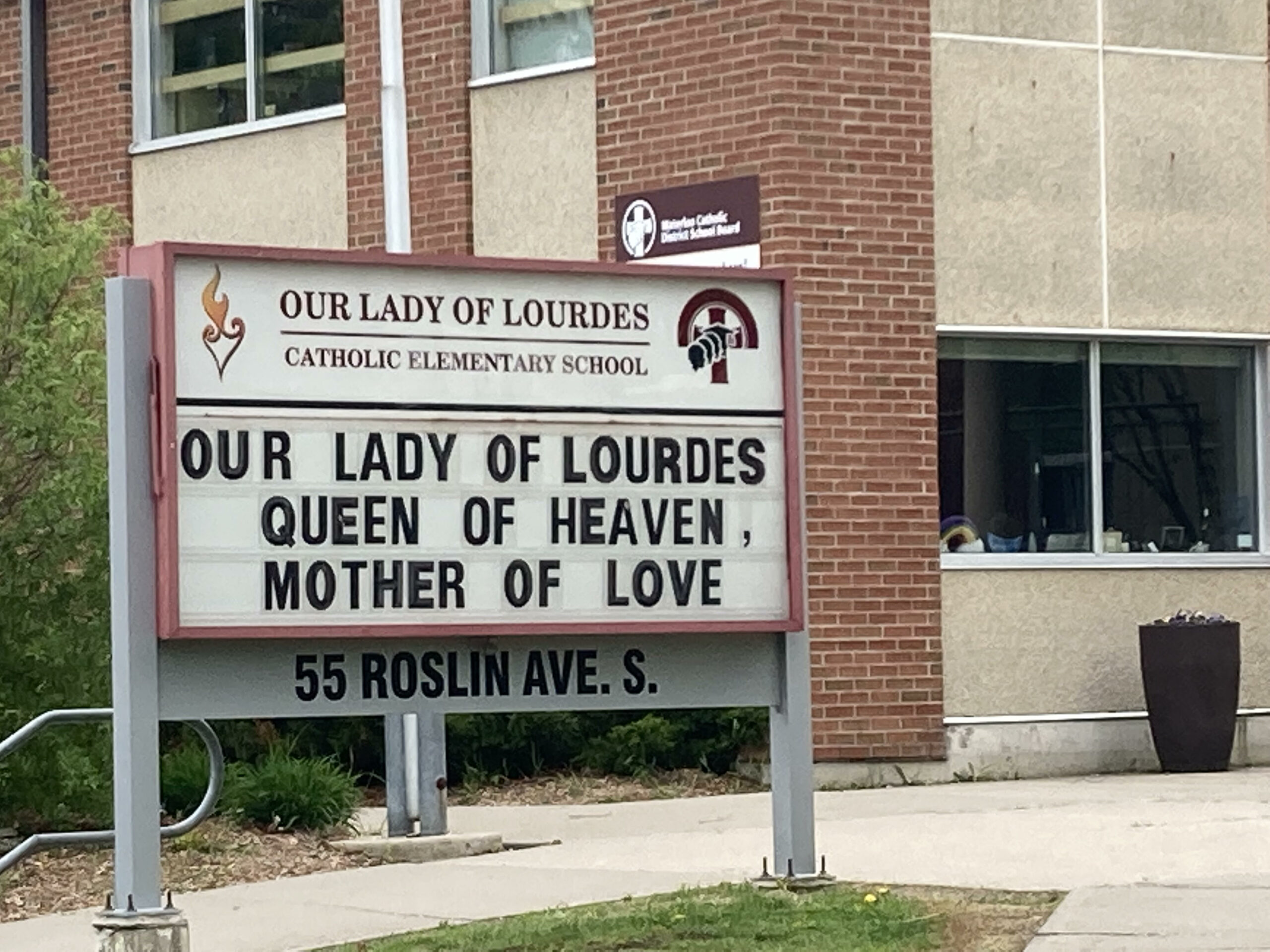
Hence, whatever good one may find therein – and there is still good, as the accompanying sign of the photo in front of a school dedicated to Our Lady of Lourdes signifies – a fully-funded system by its very nature violates the fundamental principle of subsidiarity, according to which a higher authority must not interfere in the affairs of a lower authority (barring extreme emergencies).
The Church in all of her educational documents – right up to Gravissimum Educationis of Vatican II and beyond – teaches that parents are the primary educators of their children, and have a right to choose what sort of education their children receive, a right that must be practically realizable.
There is nothing wrong, and much that is good, with some support from the state. But the Church warns against any monopoly in education, whether by the state or other entity, which obviates this right of parents. State control is particularly bad, for it has the full force of law on its side.
Sure, we could still use a few good teachers in the system, and I concur that we should all be willing to work within imperfect societies – which is to say every society that has ever existed his side of heaven – to do what good we might.
Yet there comes a point when a system degrades beyond the point of reform, and participation therein becomes counter-productive or ineffective, not least when one sends vulnerable and impressionable children into the fray. Besides the pedagogical deficiencies, how many countless young souls have been scandalized and corrupted, losing not only their faith, but also any incipient moral sense? The bitter fruit is evident.
A number of faithful educators I have known through these years – who have made a very beneficial impact on their students – have been beleaguered and bruised, often moved out of their positions of influence, when such becomes known, or some disgruntled student or parent lodges a complaint, often in response to an obvious moral truth. Others, I suppose, keep quiet with their heads down until retirement, praying, perhaps, that at least their own example will influence students.
I agree with Mrs. Douglas that we must do what good we can, and we still need good teachers in the system. May the grace of God be with them. But such is triage. The real key to reform, to my mind, however, is not in the public system. Rather, we must re-instantiate the principle of subsidiarity, build up families, parishes and local community life, which should be the ground for the many thriving private and homeschooling endeavours whose students are leagues ahead of those in the public system. The state, and most of all the hierarchical Church – bishops and priests – must throw its full support behind these efforts, offering parents and students the choice they need, and to which they have a right.
The fruit is there for all to see, and may much more good fruit be born.