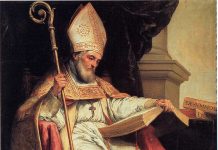

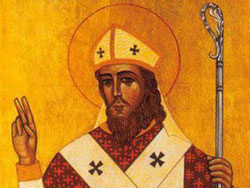
On this 13th day of January, in bleak midwinter, we celebrate two saints. The first, in the public calendar, is the great Saint Hilary (+367), Bishop of Poitiers, proclaimed a Doctor of the Church by Pope Pius IX in 1851 for his clear and incisive writings against the pernicious heresy of Arianism, which denied the divinity of Christ, a heresy which would in turn have dissolved the Church (and very nearly did so, as the near-contemporary Saint Jerome would soon lament). His zeal earned him the epithet ‘Malleus Arianorum‘, the ‘Hammer of Arians’. With his contemporary, Athanasius in the East, Hilary is considered one of the most pre-eminent theologians of the fourth century in the West, leaving behind a corpus of profound treatises, laying the foundation for the full doctrine of the Trinity and of Christ. Upon his work, Augustine, Athanasius, the Councils of Nicaea, Ephesus, Chalcedon would build, and on into the Middle Ages, the Scholastics, Thomas Aquinas, and the modern era, the whole ‘living Tradition’ of the Church. We stand on the shoulders of giants!
Hilary did much in his relatively brief life (going to his reward at the tender age of 52), raising a family, converting to the faith after reading the Bible, ordained to the priesthood and then episcopacy, standing firm in the truth, suffering four years of exile for his orthodox teachings by the Arian Emperor Constantius II (a much more serious punishment then than now). Returning to his diocese in triumph, Hilary was a living martyr for the faith, but, we may presume from his name, joyful all the while, a joy that the world could not give. We will leave you with his words on our Blessed Mother, devotion to whom goes back to the earliest days of the Church:
No matter how sinful one may have been, if he has devotion to Mary, it is impossible that he be lost.
Just so. Dust off that Rosary for this new year, if it’s just hanging from your windshield or tucked in a drawer. Our Lady shows the way to Christ, Who is the way, the truth and the life.
This is also the memorial of Saint Mungo (+614), whose birth and baptismal name was Kentigern, (Mungo was his common name, meaning in Celtic, ‘dear one’). He is close to my own heart, as the patron saint of the city where I happened to be born, Glasgow, evangelizing the area now known as Strathclyde, in the south of Scotland. His mother was Thenaw, daugther of a British prince; we know not who his father was (according to one legend, his mother was violated by King Uwen mab Urien, but she raised the child alone).
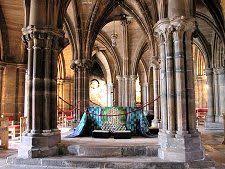
Mungo eventually settled in what came to be known as Clasgu, ‘dear family’ in Gaelic, now, of course, Glasgow, or, in the common dialect, Gles’gah. Exiled for a time to Wales as the pagans and Christians battled for control of Scotland, Mungo eventually returned to his native, and now Catholic, land, and became renowned for his goodness and holiness. He is buried in the crypt of the beautiful cathedral that bears his name – originally Catholic as well, but usurped in the 16th century ‘Reformation’ by the fiery, apostate priest John Knox. I visited his tomb on my pilgrimage through Scotland in 2018. His stone sarcophagus was surrounded by a ‘Lego display’. So I knelt and said a Rosary in that stolen cathedral, praying that Mungo intercede to make bonnie Scotland a Catholic nation once again. We must always hope.
Saints Hilary and Mungo, orate pro nobis!