
On this last day of the calendar year, we celebrate in muted tones the mysterious and shadowy Pope Saint Sylvester I, who reigned from 314, the year after Constantine made Christianity legal after his momentous victory at the Milvian Bridge, until his death on this day in 335. In the commemorative reading from today’s Office, we hear from his contemporary, Eusebius of Caesarea, and his history of the Church, of all the glorious celebrations which followed upon Constantine’s ‘Edict of Milan’:
For us above all, who had placed our hopes in Christ, there was inexpressible joy and a heavenly happiness shone on every face. Every place that a short time before had been laid waste by the tyrants’ wickedness we now saw restored to life, recovering, as it seemed, from a long and deadly disease. Churches were once again rising from the ground high into the air, far surpassing in splendour and magnificence the ones that had previously been stormed and destroyed.
The joy of the people, who had just lived through the most brutal and final persecution of Diocletian, was palpable:
Then came the spectacle that we had prayed and hoped for: dedication festivals throughout the cities, and the consecration of the newly erected houses of worship. For this there were convocations of bishops, gatherings of pilgrims from far distant lands, warm and loving contact between the different communities, as the members of Christ’s body united in complete harmony.
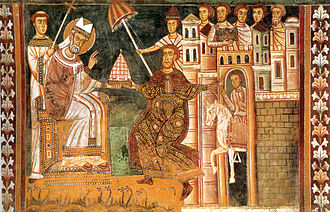
What role the new Pope played in all of this is not clear, but clearly was something. Sylvester must have been a vigorous man, for his reign was eventful: With her new-found legal status, the Church could build churches, and build she did, under the Pope’s direction: It is from this time that we have the magnificent Saint John Lateran, Santa Croce in Jerusalem, as well as the original ‘old’ Saint Peter’s Basilica – before the splendid renaissance structure we now know. There is also the ‘Donation of Constantine’, steeped in legend and controversy, with the emperor giving the Pope territory around Rome as a basis for the Church’s temporal apostolate and authority. Even if many historians now consider this an eighth century forgery, one never knows what historical roots it might have had. It is a truth that the Church needs some such temporal power to fulfill her spiritual mission, even if the overemphasis on this ‘temporal power’ would cause so much trouble in the Middle Ages, right up to the modern era (until the compromise reached with the Lateran Accord in 1929).
Sylvester also sent legates, Vitus and Vincentius, to the Council of Nicaea in 325, approving its decrees, including the condemnation of Arianism, defining for all time the divinity of Christ as homo-ousios, ‘consubstantial’, with the Father.
Stories told of Sylvester include that he cured the emperor of leprosy; that the emperor submitted to the Pope, walking on foot and leading him on horseback, a symbol that earthly power is subordinate to the spiritual that would culminate in Canossa, and is still a doctrine of our Faith.
Yet we should recall that the joy of those early Christians at the dawn of the fourth century would be short-lived, as Constantine’s sons adopted Arianism, and new heresies arose, along with the persecution of the faithful, right up to our own time, and to the end of time.
Providential that Pope Sylvester died on this last day of the year, and why we celebrate this saint of which we know so little. Also, as an aside, this is likely why Father Robert Hugh Benson named the last pope of all time in his apocalyptic novel, Lord of the World, Sylvester III (there was another Sylvester II, 999-1003, who lived through his own apocalyptic era, through the turn of the first millennium).
For as pilgrimage through time, and enter into this new year of 2025, we should remember each day that our end is heaven, not this earth, the form of which is passing away.
Saint Sylvester and all holy saints and angels of the Lord, praise the Lord, and pray for us.