
During Advent, on December 12, we celebrate the Feast of Our Lady of Guadalupe. It is an image traditionally held not to have been made by human hands, a miraculous sign that continues to inspire faith and devotion. This feast also invites reflection on another sacred image: the Icon of the Black Madonna, whose maker was undisputedly inspired by the Holy Spirit, for it too draws to itself countless faithful.
Poland cannot be fully understood without Mary. Without her, one cannot grasp what Poland truly is, nor discern its divine calling and ultimate mission. The Virgin Mary stands at the very heart of Poland’s history — a history in which, the destiny of a nation has become intertwined with the mystery of faith.
More than a thousand years ago, in 966, at the Baptism of Poland, the nation quietly and willingly embraced Christianity, marking the beginning of its integration into Western civilisation. Many hold the conviction that Mary, in a mysterious way, brought Jesus to the lands of the Lechites — an event reminiscent of the Visitation (Luke 1:39–56), when Mary carried Christ to the house of St. Elizabeth.
For Western observers, one particularly striking Marian phenomenon is the vast number of pilgrimages to Jasna Góra throughout the twentieth and twenty-first centuries, from every corner of the country. This reflection, however, will focus above all on the story of the Miraculous Icon of the Black Madonna and on the “pilgrimages” of the Virgin Mary herself — when, through her holy image, she journeys to visit her people.
The Icon’s History and Legends
Venerated as both a miraculous image and a national relic, the Icon was entrusted to the care of the Pauline Fathers at Jasna Góra in Częstochowa by Duke Władysław of Opole on 31 August 1382. From that moment, the painting became not merely an object of devotion but a living mystery — the fulcrum and spiritual heartbeat of the Jasna Góra Shrine.
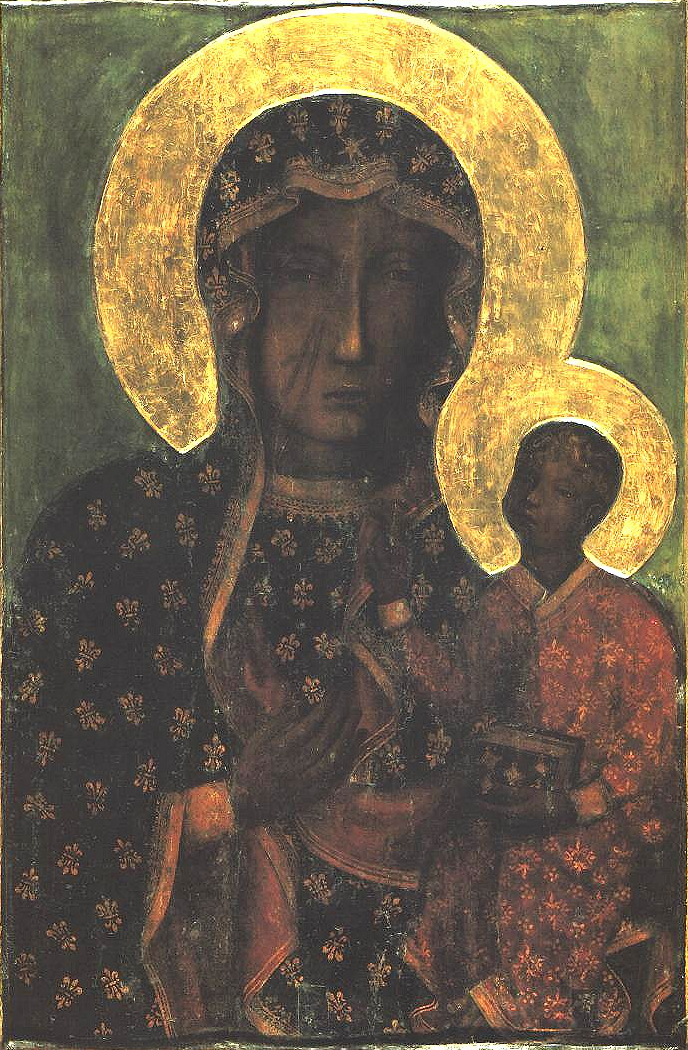
Commonly known as the “Black Madonna,” the Icon — revered as the Mother of God and Patroness of Poland — owes its title to the darkening hue of the figures of Mary and Jesus. The artist employed pigments mixed with molten wax which, over the slow passage of centuries, have naturally deepened in tone. This transformation was intensified by the constant burning of incense and candles before the painting, as well as by the fire of 1690, which the Icon miraculously survived. Thus, what time and flame sought to consume, devotion has transfigured — and the darkness of the Madonna has become the radiance of faith itself.
The most distinctive feature of the painting — the marks that set it apart from all other sacred images — are the scars upon the Virgin’s cheek. They date back to a violent assault on the monastery and the theft of the Icon in 1430.
The Częstochowa Icon belongs to the Hodigitria type — the “Guide of the Way.” In this sacred form, Our Lady leads the faithful to Christ, indicating the path to God, the Giver of Life. Her right hand, extended toward her Son, reveals Him as the Way, the Truth, and the Life, while her calm, steadfast gaze reflects the loving protection of the Mother who shelters Poland beneath her mantle.
According to tradition, St. Luke the Evangelist — who personally knew the Blessed Virgin and is said to have visited her in Ephesus after the Resurrection — painted her likeness on a cypress-wood tabletop once used in the home of the Holy Family. (In Christian legend, as many as four Marian icons are attributed to St. Luke.) Centuries later, Saint Helena is said to have discovered the image in A.D. 326 and presented it to her son, Emperor Constantine, who brought it to his new capital, Constantinople. There it was venerated for generations as a source of consolation and protection for the faithful in times of peril. In time, the Icon passed from the Byzantine emperor to a Ruthenian noble and finally to Duke Władysław.
The enduring mystery of the image may thus be seen as lending quiet credence to the legend itself — a gentle affirmation that faith and history often meet upon the same luminous threshold.
The Idea of the Pilgrimage
It all began three years after the death of the “red dictator,” Joseph Stalin, when a ray of hope broke through the clouds for the oppressed Catholics of Poland. In 1956, the Primate of Poland, Cardinal Stefan Wyszyński, was still imprisoned in Komańcza and therefore unable to take part in the Jasna Góra Vows of the Nation.
From his place of confinement, he instructed that the Miraculous Icon of Our Lady be brought out from the chapel to the ramparts surrounding the Pauline monastery. When they lifted the Holy Icon high above the vast square, where more than a million believers had gathered, the General of the Pauline Order, Father Alojzy Wrzalik, asked them to bless the people with the Image of Our Lady. The multitude, deeply moved, wept, and prayed aloud. Then, all at once, a spontaneous cry rose from the crowd: “Mother, come down to us!” — “Mother, stay with us!” — “Mother, we love you!”
This profoundly stirring moment occurred on 26 August, the Solemnity of Our Lady of Częstochowa. When the Primate of the Millennium was informed of what had taken place, he realised that the Polish people were yearning for a visible sign of the nearness of the Queen of Poland, venerated at Jasna Góra.
Although the original Icon had to be returned to its rightful place in the chapel, that spontaneous outpouring of faith inspired the creation of a pilgrim copy of the holy image — one that would journey from parish to parish across the nation. In time, that same image would travel far beyond Poland’s borders, visiting the worshippers around the world long after the fall of communism — a living testament to the enduring presence of Our Lady among her people.
At the request of the Polish Episcopal Conference, two exact replicas of the Icon of Our Lady of Częstochowa were commissioned. In May 1957, following his release from imprisonment, the Primate, Cardinal Stefan Wyszyński, together with Archbishop Antoni Baraniak and Bishop Michał Klepacz, travelled by train to Rome to receive his cardinal’s hat — passports having previously been denied by the communist authorities. The Primate carried with him two copies of the venerated Jasna Góra Icon: one was presented to Pope Pius XII as a gift, and the other was solemnly blessed by the Holy Father. This latter copy, however, departed from the Holy See almost immediately, as Cardinal Wyszyński perceived oppugnation among certain members of the clergy and laity.
Until almost the late 1980s, passports in Poland remained the property of the Ministry of the Interior. Any citizen wishing to travel abroad had to submit a formal application and hope, often in vain, for permission. Passports to destinations beyond the Iron Curtain were issued without delay or refusal only to those who cooperated with the security services. (Author’s note: My father applied seven times before finally being allowed to visit his sister living in Perth, Western Australia.)
The First National Pilgrimage (1957-1980)
Just three days after the solemn Holy Mass celebrated on 26 August 1957 at Jasna Góra, when the copy of the Icon was brought into intimate proximity with the original, in what might be called a holy kiss — the image set out on its pilgrimage throughout Poland, beginning in the Archdiocese of Warsaw.
Hardly had the Visitation begun when it started to bear abundant spiritual fruit. Everywhere the Icon was greeted by great throngs of the faithful. Long queues formed before the confessionals; Holy Communion was received in great numbers; many couples in irregular unions regularised their marriages within the Church; estranged families were reconciled; countless individuals pledged abstinence from alcohol, and some even laid down their Communist Party membership cards before the holy image — a visible sign of conversion and inner freedom.
Government Repressions
It is noteworthy that, despite their declared atheism, the Communist authorities considered the sacred image to be a potential threat. They sought in numerous ways to obstruct the continuation of the Marian pilgrimage — detaining and searching the vehicle transporting the Icon, setting up roadblocks, and diverting traffic along the planned route.
On 6 June 1966, the car was driven by the Pauline Father Lucjan W. Przekop and Bishop Jan Mazur of Lublin was seated beside him. After scarcely twenty kilometres they were stopped by police officers — among them a senior officer and a public prosecutor. The vehicle’s registration papers and Father Lucjan’s driving licence were confiscated. Refusing to hand over the keys or to continue driving, he watched as all the flowers were thrown out of the car and it was covered with a grimy tarpaulin. In the end, Bishop Mazur took the wheel, and escorted by the police, they were forced to continue to Jasna Góra.
On 2 September 1966, the Icon set out from Warsaw for Katowice. It was accompanied by Auxiliary Bishop Józef Kurpas of Katowice and a delegation of priests from the Katowice diocese. Between Częstochowa and Katowice, near Będzin, the police stopped the car, forced all passengers to step out onto the road, and insulted the bishop when he tried to defend the Image. The Icon was “arrested” by the state security services and taken to the Jasna Góra Monastery, where it remained under strict surveillance for the next six years.
To the regime’s dismay, Cardinal Stefan Wyszyński instructed that the pilgrimage should continue symbolically, with an empty frame carried in place of the holy image. Paradoxically, this act of repression proved counterproductive: it only drew greater public attention to the pilgrimage’s spiritual meaning and deepened the devotion of the believers.
Although the number of participants declined, the spiritual fruits of the pilgrimage remained undiminished. On 13 June 1972, with the discreet approval of the Cardinal, Father Józef Wójcik surreptitiously removed the Icon from Jasna Góra and returned it to the pilgrimage route.
Within the Diocese of Częstochowa alone, eleven cases of miraculous healing were recorded during the visitation. In the novitiate house of the Sisters Disciples of the Divine Master, one of the sisters reportedly experienced the miraculous restoration of her voice.
During Holy Mass at Jasna Góra on 4 June 1979, Pope John Paul II declared:
“If we want to know how this history is interpreted by the heart of the Poles, we must come here, we must listen to this shrine, we must hear the echo of the life of the whole nation in the heart of its Mother and Queen.”
The visitation of parishes continued without interruption for twenty-three years. During that time, the Icon visited more than eight thousand churches and chapels. In prayer before the Holy Image, many young people discerned their vocation to the priesthood or consecrated life. This experience brought with it a transformative liberation from fear, it became a surge of freedom, a strengthening of Christian faith, and a bulwark against secularisation. It concluded in the turbulent yet hope-filled year 1980, when the Solidarity movement was born.
The Second National Pilgrimage (1985–2025)
The Icon set out on its journey for the second time on 3 May 1985, beginning in the Diocese of Drohiczyn. Throughout this forty-year pilgrimage, Our Lady remained for twenty-four hours in each of approximately ten thousand parishes, excluding religious houses.
Everywhere the Image of the Visitation was received, people prepared for its arrival with great reverence. The routes it travelled were specially decorated; welcoming gates were built, and houses were adorned. The rich outward celebration was accompanied by deep inner reflection and prayer.
“Travelling from parish to parish, I witnessed miracles among both clergy and faithful, and I must admit that this is one of the most effective forms of evangelization,” remarked Cardinal Kazimierz Nycz.
As the late Primate Stefan Wyszyński had wished that the Icon should continue its unending journey throughout Poland, the tradition of its visitation has been faithfully upheld.
The Third Nationwide Pilgrimage (2025)
On 26 August 2025, the long-awaited third stage of the pilgrimage of the copy of the Jasna Góra Icon began. In the early hours of that day, bishops and pilgrims gathered at Jasna Góra to pray together for peace, God’s blessing, and a renewal of spiritual life.
The solemn inauguration took place during the indulgence Mass at Jasna Góra, presided over by the Primate of Poland, Archbishop Wojciech Polak.
This third visitation, was initiated in the Jubilee Year of Hope, signifies a time of preparation for the Church in Poland as it looks ahead to the Great Jubilee of Redemption in 2033.
Conclusion
Blessed Cardinal Wyszyński, in his parting words spoken a fortnight before his departure to the House of the Father (1981), once more directed those nearest to him towards the One to whom he had surrendered all, saying:
“New times shall come, demanding new lights and new strength. God will bestow them in His own appointed time. Let us remember that, as Cardinal Hlond before me, so too have I entrusted everything to the Most Blessed Mother. And I know that she will not show less power in Poland, even though people themselves may change.”
Yet even as dark clouds gather over Poland — as Prof. Mieczysław Ryba said, “when Mr Tusk’s government’s crackdown on the opposition increasingly recalls the methods of the Lukashenko regime” — one must not lose faith in Divine Providence.
The Black Madonna continues to intercede mightily for Poland and for the world, as has been manifest throughout history, against all the errors of this age. Pray, therefore; hope, and fear not — the enemy may strike once or twice, but in the end, the victory shall be the Virgin Mary’s.